


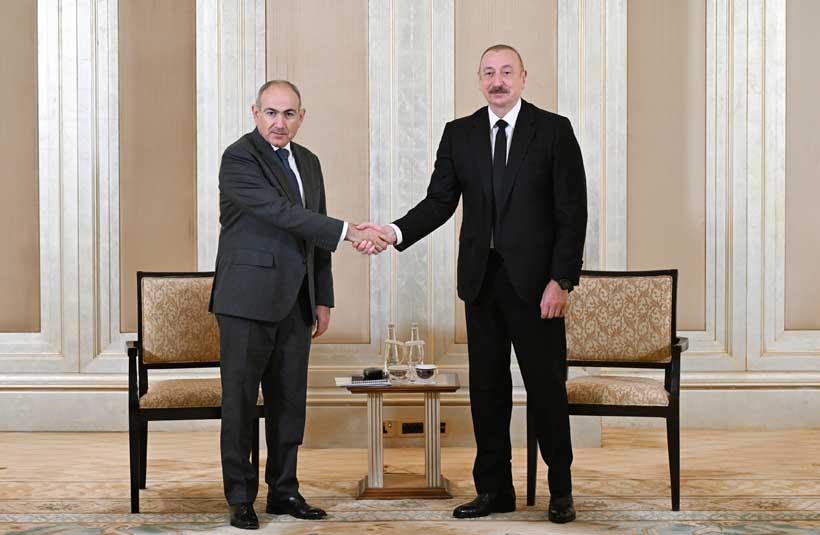
As the summer lull gives way to renewed diplomatic activity between Armenia and Azerbaijan, the prospect of normalization between the two nations will once again draw international attention. This follows three decades of conflict, culminating in the 2020 war and the mass displacement of Armenians from Nagorno-Karabakh in 2023.
Yet for all the ceremonial handshakes and carefully worded communiqués—both recent and anticipated—one fundamental question remains: Will the peace agreement being pursued deliver a sustainable peace, or merely impose calm over a crisis that remains deeply unresolved?
The details of the prospective deal remain opaque, but reports suggest it involves two highly contentious elements: a transit corridor through Armenia’s southern Syunik province linking Azerbaijan to its exclave of Nakhichevan and the exclusion of any right of return for the displaced population of Nagorno-Karabakh. The fate of these two issues will determine whether a real and lasting peace is possible.
The so-called “Zangezur Corridor,” while presented as a route for trade and regional integration, remains legally undefined. Its ambiguous status has triggered alarm in Armenia, where many fear it could erode national sovereignty and sever the country’s only direct land link to Iran. Tehran, in turn, has issued warnings that any such disruption would cross a red line—adding another layer of volatility to an already fragile region.
Stay ahead of the geopolitical week.
MD Briefing delivers expert analysis across five global fronts — the Indo-Pacific, energy, geoeconomics, European security, and the Middle East — every Monday morning. Free.
What makes the corridor especially dangerous is not just its legal ambiguity but its evolution—from a theoretical passage mentioned in the 2020 ceasefire to a maximalist Azerbaijani demand, amplified by geopolitical narratives. The original rationale—that it would mirror the Lachin Corridor from Armenia to Nagorno-Karabakh—collapsed once Lachin was dismantled and Nagorno-Karabakh’s Armenian population was forcibly expelled. Yet the demand endures, largely due to the Armenian government’s failure to categorically reject it. Rather than anchoring regional connectivity in mutual sovereignty and reciprocity, Armenia’s leadership allowed the corridor narrative to take root—legitimizing it through mixed messaging, damaging concessions, and an alarming readiness to echo Baku’s narrative.
Far from being a neutral infrastructure initiative, the corridor represents a unilateral attempt to establish extraterritorial control over Armenian land. Azerbaijan seeks not just transit access but a corridor stripped of Armenian customs, legal authority, or security presence—a demand no sovereign state should accept.
The second unresolved issue is the fate of the over 120,000 ethnic Armenians displaced in 2023 from a region their ancestors had inhabited for centuries. Their self-governing institutions were dismantled, their leaders imprisoned, and no credible path to return has since emerged. While Azerbaijan claims to welcome back those who wish to return, it has offered few details, and the international community has failed to demand enforceable guarantees for their safety and rights.
In November 2023, the International Court of Justice ordered Azerbaijan to allow the “safe, unhindered, and expeditious return” of displaced Armenians and to protect them from intimidation or harm. But ICJ rulings lack enforcement power. It falls to global actors to insist that peace includes justice, not just finality.
These issues are not purely bilateral. The South Caucasus has long been viewed as a strategic corridor by the West: a route for Caspian energy, a counterweight to Russian influence, and a buffer along Iran’s northern border. For the European Union, brokering a peace deal between Armenia and Azerbaijan aligns with its broader effort to reduce Russian presence in the region. For the United States, the motivation is more performative.
While these geopolitical motivations may be understandable from a realpolitik perspective, they pose real dangers for Armenia. The country must not be reduced to a prop in someone else’s strategic play—whether to outmaneuver Moscow or rack up symbolic diplomatic victories. For Armenia, the stakes are existential. Peace cannot be imposed from above or abroad; it must be grounded in guarantees of security, dignity, and self-determination.
From Baku’s perspective, the logic of normalization is straightforward: consolidate military gains, secure sovereign access to its exclave Nakhichevan, and close the chapter on conflict. But for Yerevan, the calculus is far more complex. Any agreement that undermines Armenia’s sovereignty and legitimizes past displacement or fails to provide credible safeguards for ethnic Armenians risks becoming a ticking time bomb—breeding resentment at home and abroad.
Many Armenians fear that the process is being rushed to meet external timelines. Real peace cannot be built on shortcuts. It requires acknowledgment of past wrongs, restoration of indigenous rights, and mutual respect for sovereignty. Diplomatic recognition and open borders would be welcome steps—but they are not enough. Without mechanisms for monitoring, enforcement, and reconciliation, today’s agreement could become tomorrow’s crisis.
