


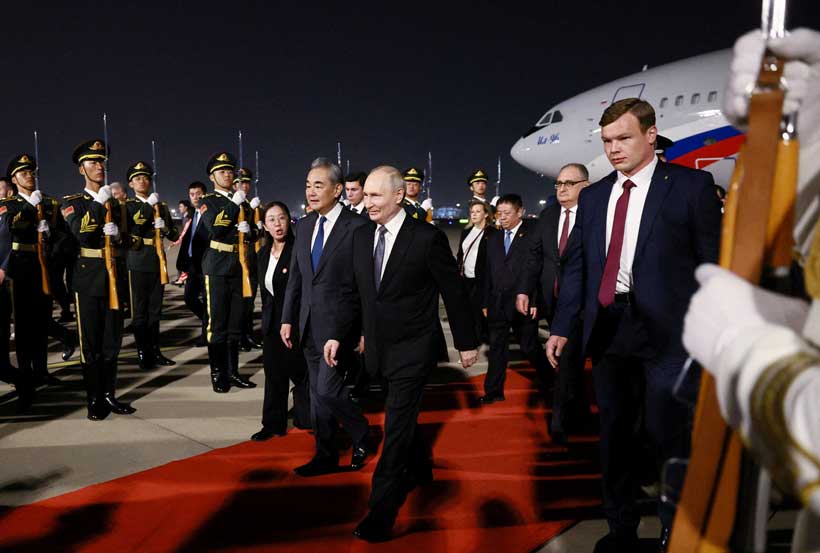
Russian President Vladimir Putin arrived in Beijing, the Chinese capital, for a two-day official visit on May 19 and 20, 2026, just 48 hours after US President Donald Trump concluded his historic visit to China. Putin’s visit coincided with (the 25th anniversary of the signing of the Treaty of Good Neighborliness, Friendship, and Cooperation between Russia and China in 2001). These successive visits reflect China’s efforts to solidify its role as a center of global diplomacy and a balancing force between the two superpowers. President Putin’s visit to Beijing constitutes a strategic demonstration of Russian-Chinese solidarity, as Moscow aims to assess the outcomes of the summit between Chinese President Xi Jinping and his American counterpart, Donald Trump, to ensure that the recent rapprochement does not threaten Russian strategic interests
A noteworthy observation in this context is the statement made by Russian President Vladimir Putin’s foreign policy advisor Yuri Ushakov, prior to Putin’s visit to China, that there was no connection between US President Donald Trump’s visit to China and Putin’s visit to Beijing. The Russian visit was thus primarily economic in nature, especially given President Putin’s insistence on including a high-level delegation comprising ministers, economic officials, and heads of major Russian energy companies. This underscores the importance Moscow attaches to its relations with Beijing in light of the Western sanctions imposed on it due to the war in Ukraine. Meanwhile, Beijing is leveraging the timing of the visit to project its diplomatic weight as a global stabilizing force capable of hosting the two major rivals within days. This was underscored by Chinese Foreign Ministry spokesperson Guo Jiakun, who stated that: Chinese President Xi Jinping and Russian President Vladimir Putin will exchange views on bilateral relations and cooperation between China and Russia in various fields to further elevate the development of China-Russia relations to a higher level, which will inject greater stability and positive energy into the world.
Russian President Vladimir Putin’s visit to China represents a strategic event with implications for the Middle East. It aims to strengthen an international axis opposed to Western and American influence, intensify joint coordination between China and Russia to ensure global energy security, and expand mediation efforts and diplomatic intervention to resolve regional crises, thereby safeguarding the economic and trade interests of both countries. The dimensions and objectives of Putin’s visit to Beijing encompass several points, particularly regarding its geopolitical context and timing. One key aspect is Russia’s attempt to explore the behind-the-scenes details of the (Trump-Xi summit). Putin seeks to ascertain the specifics and outcomes of the discussions between Chinese President Xi Jinping and his American counterpart Donald Trump, and to ensure that the recent rapprochement between China and the United States will not come at the expense of the strategic relationship between Moscow and Beijing. Another aspect is China’s attempt to demonstrate its diplomatic influence, highlighting Beijing’s capacity to host the leaders of the two largest and most competitive international powers within a single week, thus presenting itself as a global force for stability. Putin’s talks with Chinese leaders are of exceptional importance, as they come at a sensitive juncture marked by renewed international efforts to resolve the Russian-Ukrainian conflict and the emergence of signs of rapprochement between Russia and the United States on a number of issues. China is closely monitoring all recent communications and meetings between Moscow and the administration of US President Trump, assessing their potential impact on the future of Sino-Russian relations. This visit also comes amidst European discontent and Western concerns, including those of the United States, regarding the possibility of a military alliance between Moscow and Beijing. China denies providing Russia with advanced military technology, maintaining that cooperation is limited to joint exercises and training, developing programs for cooperation between armed forces, and conducting joint maritime patrols.
The importance of Putin’s visit to China for the Middle East is multifaceted, most notably in the management of energy markets. Russia and China are key pillars of the global oil market, and their partnership ensures the stability of energy supplies and prices for the Gulf and Middle Eastern states amidst global economic challenges and sanctions. The visit also reflects a convergence of views between Moscow and Beijing on pressing regional issues, such as developments in the Iranian nuclear program, the ongoing conflict with Iran, and the Syrian crisis, among others. This gives the Middle East greater diplomatic weight and increases the likelihood of joint Chinese-Russian intervention to de-escalate conflicts. Furthermore, Russia seeks, through this visit to Beijing, to circumvent the unilateral US sanctions policy and localize trade. Middle Eastern countries benefit from Beijing and Moscow’s promotion of financial and economic transactions independent of the US dollar system, granting them greater flexibility in diversifying their trade and military partnerships without succumbing to Western and American pressure.
Stay ahead of the geopolitical week.
MD Briefing delivers expert analysis across five global fronts — the Indo-Pacific, energy, geoeconomics, European security, and the Middle East — every Monday morning. Free.
As for the most prominent economic issues between Moscow and Beijing, they include reviewing their (energy security arrangements and the Power of Siberia 2 pipeline project). This latter issue tops the agenda, with Moscow hoping to finalize a serious and substantive agreement to increase gas and oil supplies to China, compensating for the loss of European markets due to sanctions. Discussions also cover maritime security, as the potential closure of the Strait of Hormuz and the escalating conflict in the Middle East, particularly the war with Iran, are a major concern for Beijing regarding Asian energy security, prompting it to secure reliable overland alternatives through Russia. Furthermore, China and Russia are keen to discuss trade in local currencies, aiming to promote the use of the yuan and the ruble in commercial transactions to reduce dependence on the Western and American financial systems. In addition to discussing a number of pressing political and security issues, such as (Taiwan and Ukraine), the two leaders will exchange support on key matters. Russia supports China’s position on Taiwan, while Moscow seeks continued Chinese economic and technological support to address the repercussions of the ongoing war in Ukraine. They will also coordinate their stance on the escalating US-Israeli military confrontation with Iran. Furthermore, President Putin’s visit to China will bolster Russia’s position on the ongoing efforts to resolve the Ukrainian conflict and highlight China’s balanced approach to finding political solutions.
As for (Russia’s strategic motives for this presidential visit to Beijing), Putin’s trip – his 25th to China – comes within the context of Moscow’s efforts to strengthen its strategic partnership with Beijing. The visit’s objectives include exploring the behind the scenes aspects of the (Trump-Xi summit), with the Russian delegation seeking to glean details of the discussions between the two sides, particularly regarding the conflict in Ukraine and Middle Eastern issues. This is aimed at ensuring that no US-China settlements come at the expense of Russian influence, while simultaneously attempting to secure Moscow’s economic and energy lifeline, especially in light of the harsh Western and US sanctions. The Chinese market represents the primary outlet for Russian oil and gas exports. Major projects, such as the (Power of Siberia 2 gas pipeline), are also being discussed to compensate for Moscow’s loss of the European energy market.
As for the objectives and implications of China’s moves toward Moscow, its successive hosting of the leaders of the two major rival powers reflects Beijing’s ability to manage the complexities of international balances. Beijing’s objectives include highlighting the centrality of Chinese diplomacy, as it seeks to portray itself on the international stage as an indispensable global superpower, capable of managing dialogue with both Washington and Moscow, and able to achieve strategic equilibrium. Here, China supports Russia and relies on it as a crucial energy source, while simultaneously striving to maintain stable relations with the United States to avoid economic isolation. At the same time, China seeks to prevent the expansion of the Russian-Ukrainian conflict, fearing that this could lead to an economic crisis in Europe, which would negatively impact Chinese exports to EU countries. This is all within the context of the alignment between the Chinese and Russian positions on the necessity of Ukraine’s neutrality and its refusal to allow the deployment of foreign bases or troops on its territory. While China is keen to discuss developments on the ground regarding the Russian war in Ukraine, Beijing continues to provide dual-use (civilian-military) goods to support the Russian economy and industry in the face of Western sanctions.
