


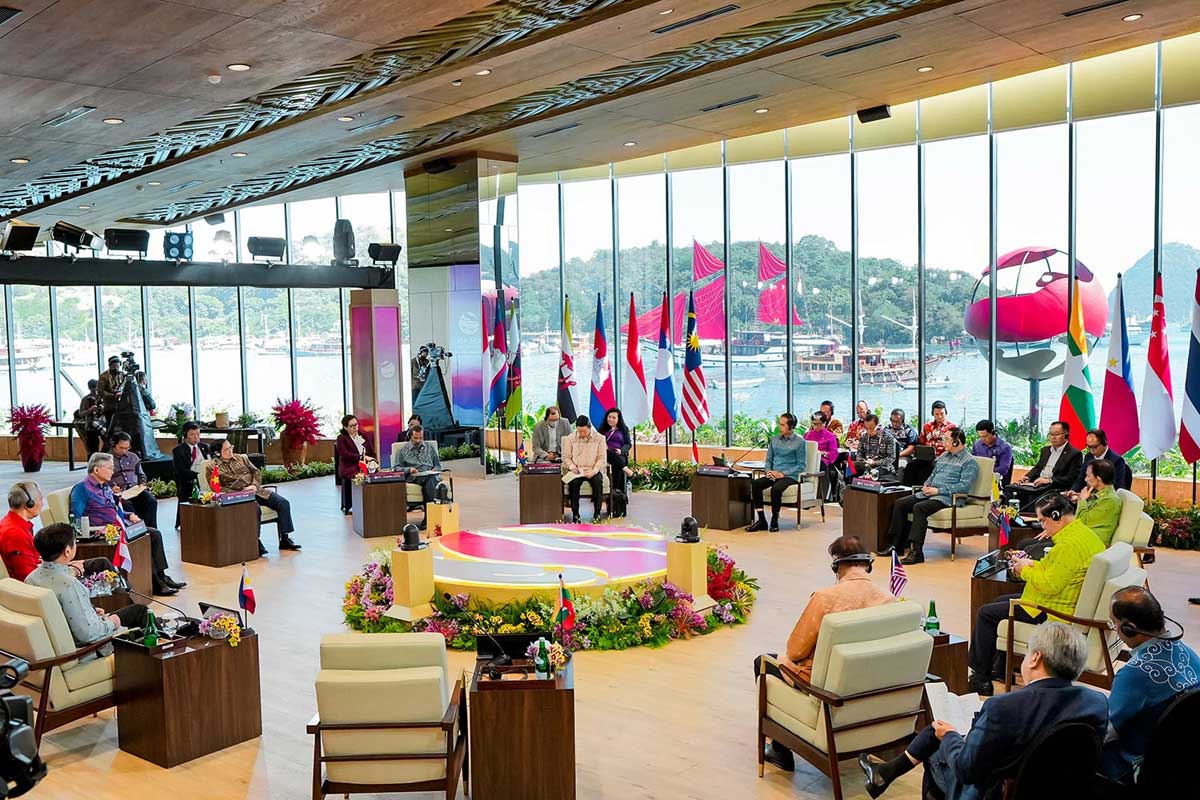
In an era defined by geopolitical fragmentation, economic nationalism, and existential climate threats, the Association of Southeast Asian Nations (ASEAN) has revealed an ambitious plan for its future. The Forum on ASEAN Community Building (FPCI)—a civil society initiative involving policymakers, academics, and regional experts—recently outlined 35 strategic recommendations to create a “resilient, inclusive, and sustainable ASEAN community” by 2045. Spanning political-security, economic, and socio-cultural domains, these proposals offer a timely roadmap for reinvigorating regional cooperation while addressing global challenges. At its core, ASEAN’s vision balances sovereignty with solidarity, economic growth with equity, and technological advancement with ethical guardrails. This analysis explores how ASEAN’s 2045 agenda could redefine modern diplomacy and position Southeast Asia as a laboratory for inclusive multilateralism in an increasingly polarized world.
The Indo-Pacific is now a key site of competition between the U.S. and China, with ASEAN often playing a supporting role. However, the Forum’s recommendations reject this narrative, asserting ASEAN’s role as the “premier platform” for regional dialogue. Central to this ambition is the ASEAN Outlook on the Indo-Pacific (AOIP), which prioritizes inclusivity, maritime cooperation, and adherence to international law. ASEAN aims to institutionalize its neutrality and elevate the Treaty of Amity and Cooperation (TAC) as the behavioral code of the Indo-Pacific by formalizing dialogues with organizations like the Indian Ocean Rim Association (IORA) and the Pacific Islands Forum (PIF). Crucially, the forum calls on ASEAN to resolve internal disputes, notably the Myanmar crisis, to bolster its credibility.
The Myanmar conflict shows ASEAN’s challenge merging non-interference with proactive conflict resolution. The Five-Point Consensus, adopted in 2021 to address the coup, has yielded little progress, prompting criticism of ASEAN’s inaction. Recommendation 2 of the Forum urges ASEAN to “extend appropriate support” to member states in crisis. This recommendation suggests mechanisms such as Track 1.5 dialogues, which involve civil society and neutral third parties. Indonesia and Malaysia could help mediate between Myanmar’s junta and the National Unity Government. ASEAN membership for Myanmar should be linked to verifiable steps toward democracy. Failure to address the situation in Myanmar could erode ASEAN’s legitimacy, as evidenced by Myanmar’s exclusion from the 2023 ASEAN Summit. Conversely, resolving the conflict could establish ASEAN as a model for conflict mediation in regions such as Africa and the Middle East.
Maritime security is also a key part of ASEAN’s vision. China and ASEAN members like Vietnam and the Philippines are at odds over territorial claims in the South China Sea. Recommendations 9–11 of the Forum propose an ASEAN-led framework for joint patrols, coast guard cooperation, and a regional space agency. These measures aim to reduce reliance on external powers. Examples of these powers include U.S. Freedom of Navigation Operations. The measures also aim to foster intra-ASEAN trust. Indonesia’s “Global Maritime Fulcrum” strategy, which emphasizes infrastructure and fisheries management, offers a template for this approach. ASEAN could enhance domain awareness and deter illegal fishing, which costs the region $6 billion annually, by collaborating with Vietnam and the Philippines on satellite-based maritime surveillance. However, reconciling competing claims, such as Indonesia’s Natuna Islands and China’s Nine-Dash Line, requires delicate diplomacy. Revitalizing the 2002 Declaration on the Conduct of Parties in the South China Sea (DOC) with binding codes would test ASEAN’s resolve to transition from a diplomatic forum to a security actor.
Stay ahead of the geopolitical week.
MD Briefing delivers expert analysis across five global fronts — the Indo-Pacific, energy, geoeconomics, European security, and the Middle East — every Monday morning. Free.
ASEAN’s economic aspirations face a paradox: how to deepen regional integration amid global protectionism. The forum emphasizes open regionalism, urging ASEAN to “remain neutral between rival powers” while optimizing trade pacts, such as the Regional Comprehensive Economic Partnership (RCEP). The RCEP covers 30% of the global GDP and eliminates 90% of tariffs, but it lacks binding labor and environmental standards. Cambodia’s garment industry, for example, is dependent on cheap labor and faces minimal pressure to improve wages. The Forum proposes strengthening the RCEP by integrating SMEs and harmonizing digital systems. One way to do so is by allocating funds for technology transfer to SMEs, which account for 97% of ASEAN businesses but only 35% of exports. Similarly, adopting unified e-commerce regulations inspired by the EU’s Digital Single Market would streamline cross-border trade. The push for an ASEAN “central hub” in global supply chains aligns with the “China+1” diversification strategies of multinational firms. However, persistent development gaps threaten equitable growth. Singapore’s GDP per capita ($82,808) far exceeds Laos’ ($2,567), underscoring the need for “people-centered” policies, such as vocational education reforms and cross-border labor mobility. The Iskandar Malaysia-Singapore Corridor, a successful cross-border economic zone that has drawn $45 billion in investments since 2006, demonstrates the potential of such initiatives. Replicating this model in the Greater Mekong Subregion could uplift Cambodia and Laos by improving infrastructure.
The green transition is another focal point. ASEAN’s renewable energy capacity is projected to increase by 60% by 2045, a goal that would require an investment of $3 trillion. The Forum has advocated for the harmonization of carbon pricing and the issuance of regional green bonds. Nevertheless, challenges persist: Vietnam and Indonesia are reliant on coal for 50% and 60% of their energy, respectively, and coal-dependent communities such as East Kalimantan face the potential for economic and social marginalization. The Asian Development Bank’s Energy Transition Mechanism (ETM), which utilizes a blended finance model to retire coal plants, serves as a pertinent case study. However, ASEAN must maintain a delicate balance between external funding and concerns regarding sovereignty, as evidenced by Laos’ financial challenges stemming from BRI initiatives.
The ASEAN community’s sociocultural pillar has historically been its most vulnerable element, with a mere 24% of the population identifying as “ASEAN citizens.” The Forum has adopted a multifaceted approach to address this challenge, encompassing both symbolic gestures, such as rebranding the SEA Games as “ASEAN Games,” and substantive measures, including mutual recognition of skills and the implementation of regional MOOCs in AI literacy. Among the proposals under consideration, healthcare cooperation stands out as a particularly noteworthy initiative. The ongoing efforts to establish a unified health data system and to cultivate regional autonomy in the domains of vaccines and diagnostics are indicative of the EU’s aspirations for a health union. During the period of the pandemic, the procurement of vaccines exhibited significant disparities, with Singapore acquiring doses at a rate that was three times faster than Laos. The Forum’s advocacy for regional vaccine production, as articulated through the framework of the ASEAN Vaccine Security and Self-Reliance initiative, has the potential to mitigate future disparities. A similar focus on aging populations underscores the importance of proactive governance in a region where 10% of the population will be over 65 by 2045.
The digital divide is a significant concern. While the ASEAN digital economy is projected to reach $1 trillion by 2030, 40% of the rural population lacks internet access, and women are 20% less likely to own smartphones in Indonesia. The digital literacy programs of the Forum are required to address infrastructure gaps and misinformation. A potential solution to these challenges is to partner with Japan to deploy satellite internet in archipelagic states and replicate Malaysia’s SEBENARNYA. MY fact-checking platform regionally.
A recurring theme in the Forum’s recommendations is the role of non-state actors. In contrast to the top-down approach characteristic of EU policymaking, the ASEAN (Association of Southeast Asian Nations) utilizes Track 2 (civil society) and Track 1.5 (hybrid) dialogues to formulate regional agendas. The ASEAN Peoples’ Forum (APF), which advocates for human rights and environmental justice, and the ASEAN Youth Organization’s policy incubators exemplify this inclusive model. During the 2020 protests in Thailand, demands for democratic reforms led by the youth compelled the Association of Southeast Asian Nations (ASEAN) to address the crisis in Myanmar. Nevertheless, governments continue to exercise caution with regard to foreign-funded NGOs. Cambodia’s prohibition on grassroots organizations in 2015 and Thailand’s lèse-majesté laws have been identified as factors that impede the expression of divergent opinions. Achieving an equilibrium between openness and sovereignty necessitates the implementation of frameworks such as Indonesia’s NGO Cooperation Guidelines, which stipulate transparency without imposing restrictions on advocacy.
The ASEAN Community Vision 2045 is both aspirational and pragmatic. The document acknowledges the bloc’s limitations, including its fragmented governance, inequality, and external dependencies, while outlining a strategy to enhance resilience. The attainment of success is contingent upon institutional adaptability, equitable growth, and strategic autonomy. For the global community, the experiment conducted by the Association of Southeast Asian Nations (ASEAN) offers valuable lessons. The text’s emphasis on inclusivity, civil society engagement, and non-traditional security provides a countermodel to the West’s sanction-heavy diplomacy and China’s transactional regionalism. If realized, the Vision 2045 could position Southeast Asia not just as a geopolitical buffer, but as a beacon of cooperative multilateralism, thereby demonstrating that resilience in the 21st century requires not just power, but pluralism.
