


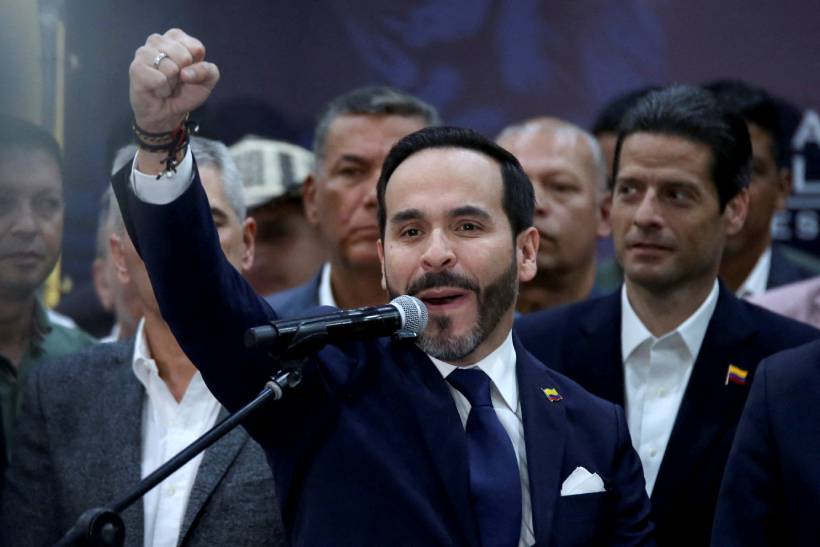
Colombia’s Congress has approved legislation that replaces former president Gustavo Petro’s “total peace” approach with stricter conditions for members of illegal armed groups seeking reduced prison sentences. The bill, introduced by right-wing President Abelardo De La Espriella, shifts the government’s strategy away from broad negotiations and towards disarmament, cooperation with authorities and stronger military enforcement.
The legislation marks one of De La Espriella’s first major legislative achievements and fulfils a central promise of his election campaign: ending peace negotiations with leftist guerrillas and criminal gangs while expanding military operations against them.
Under the new framework, armed group members who surrender can receive sentence reductions of up to 50%, provided they meet extensive requirements. However, they will be barred from holding public office or participating in peace negotiations, and the law will not suspend arrest warrants, extradition procedures or law enforcement operations.
Congress Approves Stricter Conditions for Surrender
The bill secured support in both chambers of Congress. The Senate approved it by 57 votes to 24, while the House of Representatives passed it by 95 votes to 10 in sessions that concluded late on Tuesday.
Stay ahead of the geopolitical week.
MD Briefing delivers expert analysis across five global fronts — the Indo-Pacific, energy, geoeconomics, European security, and the Middle East — every Monday morning. Free.
The legislation requires members of illegal armed groups to surrender their weapons, identify other members and provide information about political connections and corruption networks. They must also hand over recruited and kidnapped minors, contribute to efforts to locate missing people and surrender assets.
In exchange for fulfilling these conditions, participants can receive reduced sentences. The maximum reduction is 50% for ordinary members and 30% for commanders. Leaders cannot receive sentences of less than 10 years.
The bill now goes to De La Espriella for his signature before becoming law. Unlike the previous approach, it does not offer protection from arrest warrants or halt security operations while individuals pursue the surrender process.
A Clear Break With Petro’s ‘Total Peace’ Policy
The legislation represents a significant departure from the strategy pursued by Gustavo Petro, Colombia’s first leftist president. His “total peace” policy sought to reduce violence by negotiating with a range of armed organisations, including guerrilla movements and criminal groups.
Petro restarted negotiations with the National Liberation Army (ELN) towards the end of 2022 as part of an effort to end Colombia’s decades-long internal conflict, which has killed more than 450,000 people.
His government used measures including ceasefires and the suspension of arrest warrants to create conditions for negotiations. The approach was intended to address violence across multiple armed groups rather than focus exclusively on military confrontation.
However, the talks produced limited tangible results. Towards the end of his presidency, Petro acknowledged that the objective of achieving total peace had not been fully realised, while pointing to a reduction in homicides during his time in office.
Armed Groups Expanded During the Previous Administration
De La Espriella’s government has argued that the previous policy gave armed organisations opportunities to strengthen their positions. Officials contend that ceasefires and suspended arrest warrants allowed groups to expand their recruitment and consolidate control over areas important to drug trafficking and illegal mining.
Figures from Colombia’s Ministry of Defense indicate that the number of members of illegal armed groups increased from 15,120 at the end of 2022 to approximately 28,802 in July 2026.
The increase has become an important part of the new administration’s argument for changing course. However, the figures alone do not establish the extent to which the previous government’s negotiations contributed to the expansion, or how much of the increase reflects changes in monitoring and reporting.
The new legislation reflects the government’s position that surrender arrangements must require verifiable cooperation rather than provide armed organisations with opportunities to consolidate their influence.
Colombia’s Long Conflict Remains a Major Challenge
Colombia’s security crisis has deep historical roots. The country has experienced more than six decades of armed conflict involving guerrilla organisations, paramilitary groups, criminal networks and state forces.
Petro, himself a former member of the M-19 guerrilla movement, entered office promising to pursue a comprehensive settlement. His negotiations with the ELN and other armed organisations were intended to reduce violence and address the wider conditions sustaining the conflict.
The limited progress of those negotiations has now provided the political justification for a different strategy. De La Espriella is seeking to combine military pressure with conditional incentives for individuals willing to surrender and provide information.
Yet changing the legal framework does not automatically resolve the challenges facing Colombia’s security institutions. Armed groups remain involved in illicit economies, recruitment and territorial competition, while communities in affected areas continue to face the consequences of violence.
What Happens Next for Colombia’s Security Policy?
The immediate next step is presidential approval of the legislation. Once signed into law, its implementation will test whether stricter surrender conditions can produce meaningful disarmament, intelligence cooperation and the recovery of assets.
The government will also need to demonstrate that military operations can weaken armed organisations without increasing risks to civilians or creating further instability in contested areas.
For Colombia, the shift is more than a change in the terms offered to armed groups. It marks a broader transition from Petro’s negotiation-centred approach towards a security strategy built around conditional sentence reductions and continued enforcement.
Whether that approach can deliver more lasting reductions in violence remains uncertain. Its success will depend not only on the number of individuals who surrender, but also on whether the state can prevent armed groups from recruiting new members and re-establishing control over territories where illicit economies remain deeply entrenched.
With information from Reuters.
