


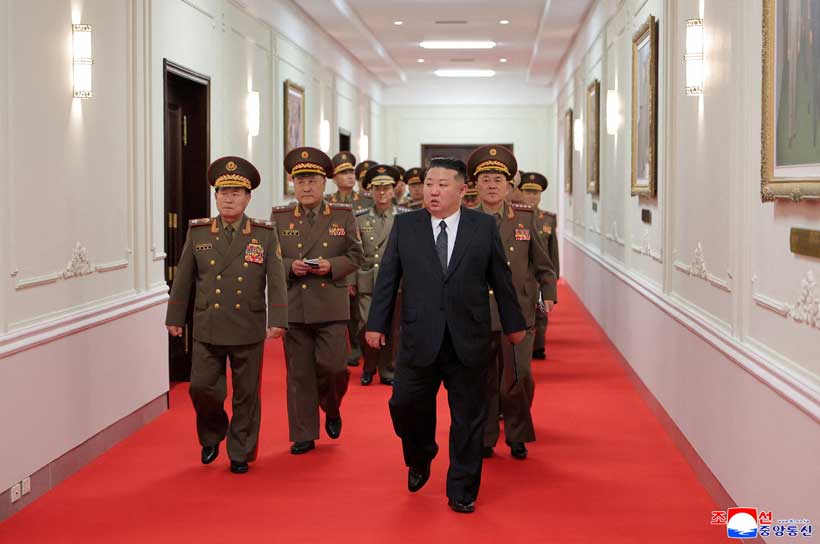
North Korean leader Kim Jong Un has called for absolute superiority in drone technology and faster integration of artificial intelligence into the country’s weapons systems, signalling a major push to modernise Pyongyang’s military amid rising tensions on the Korean Peninsula.
Kim made the remarks during an exhibition and demonstration of unmanned military technology, where North Korea displayed suicide attack drones, tactical cruise missiles, multipurpose unmanned aircraft and large multiple rocket launchers.
The exhibition offered a glimpse into Pyongyang’s evolving military priorities, particularly its interest in low-cost, remotely operated weapons and AI-enabled systems. It also comes as North Korea draws lessons from the wars in Ukraine and the Middle East, while relations with South Korea deteriorate.
The military display coincided with renewed exchanges between Seoul and Pyongyang over border security, missile activity and joint US-South Korean military exercises.
Stay ahead of the geopolitical week.
MD Briefing delivers expert analysis across five global fronts — the Indo-Pacific, energy, geoeconomics, European security, and the Middle East — every Monday morning. Free.
Kim Makes Drone Dominance a Military Priority
Kim described achieving superiority in drone technology as an indispensable requirement for modern warfare, according to North Korean state media. He also called for advanced artificial intelligence to become a priority in the development of unmanned weapons systems.
Images released from the exhibition showed drones carrying the North Korean Air Force emblem, alongside what appeared to be footage of an unmanned aircraft striking a military vehicle and exploding.
The display also included what analysts identified as a tailless, flying-wing stealth drone, publicly presented for the first time. Other images showed racks of small suicide drones and loitering munitions resembling the US-made Switchblade 600.
The emphasis on these systems suggests that Pyongyang is interested in expanding its ability to deploy relatively inexpensive weapons in large numbers. Such capabilities could allow North Korea to overwhelm air defences, target military infrastructure and complicate the response of technologically advanced opponents.
The exhibition also featured mock targets resembling South Korean K9 howitzers, M1 Abrams-type tanks and radar vehicles, indicating that the weapons are being developed with potential regional military contingencies in mind.
Ukraine War Provides a Testing Ground for Military Innovation
North Korea’s growing interest in drones and AI reflects the changing character of warfare demonstrated in Ukraine.
The Russia-Ukraine war has shown how relatively inexpensive unmanned aircraft can conduct surveillance, identify targets, disrupt logistics and strike military equipment. Both sides have increasingly relied on drones, electronic warfare and rapid technological adaptation.
Pyongyang has gained direct exposure to these developments through its military involvement in Russia’s war against Ukraine. South Korean intelligence estimates that North Korea has sent more than 16,000 personnel to support Moscow since October 2024, providing its forces with experience in battlefield operations, drones and combined-arms warfare.
That experience could help North Korea adapt its military doctrine to a battlefield increasingly shaped by unmanned systems and automated technologies.
Analysts also see the influence of conflicts in the Middle East, where drones and missile systems have demonstrated their ability to challenge conventional military advantages.
For Pyongyang, the attraction is strategic as well as technological. Expanding drone capabilities could offer a relatively affordable way to increase pressure on South Korea and US forces without relying exclusively on expensive conventional platforms.
AI Could Change North Korea’s Military Capabilities
Kim’s latest comments reinforce a pattern of growing attention to artificial intelligence in North Korea’s military modernisation programme.
State media reported that Kim ordered the mass production of suicide attack drones in November 2024. In March 2025, he oversaw tests involving AI-equipped drones, while later that year he described artificial intelligence as a major priority for weapons development.
The focus on AI suggests that North Korea wants to move beyond basic remote-controlled aircraft towards systems capable of processing information, identifying targets and supporting faster battlefield decisions.
However, the extent of Pyongyang’s actual technological capabilities remains uncertain. Official exhibitions and demonstrations do not necessarily establish how reliable, sophisticated or operationally effective the systems are.
Nevertheless, the direction of development is significant. Combining drones with AI, surveillance technology and missile capabilities could give North Korea additional options for challenging South Korea’s military superiority.
Border Disputes Deepen Tensions Between the Two Koreas
North Korea’s weapons exhibition comes against a backdrop of deteriorating relations with South Korea.
Seoul’s national security adviser, Wi Sung-lac, said on Friday that South Korea would respond firmly to protect the military border, despite Pyongyang’s claims that its activities were taking place within its own territory.
The dispute has intensified following a landmine explosion inside the Demilitarised Zone last month that seriously injured several South Korean soldiers. Seoul attributed the explosion to a North Korean mine, while Pyongyang denied responsibility.
North Korea has also criticised joint US-South Korean air defence exercises, describing them as provocative and warning that there was no limit to the measures it could take to maintain a strong deterrent.
Meanwhile, Kim’s sister, Kim Yo Jong, said earlier this month that North Korea would activate anti-South Korean propaganda loudspeakers along the entire border by the end of October.
The latest developments illustrate how military modernisation is unfolding alongside increasingly hostile political and military exchanges.
What Happens Next?
North Korea’s growing investment in drones and military AI could complicate the security calculations of South Korea and the United States.
Seoul already maintains advanced conventional military capabilities and benefits from its defence partnership with Washington. However, the wider availability of low-cost drones and autonomous systems could create new vulnerabilities, particularly around military bases, border installations and critical infrastructure.
The challenge will be to strengthen air defence, surveillance and counter-drone capabilities without allowing every weapons demonstration or border incident to trigger a broader escalation.
For Washington and Seoul, Pyongyang’s military cooperation with Moscow adds another concern. Battlefield experience gained in Ukraine could accelerate North Korea’s military learning and potentially strengthen its defence relationship with Russia.
Kim’s latest statements suggest that drones and AI are no longer secondary elements of North Korea’s military strategy. They are becoming central to its ambitions to reshape the balance of power on the Korean Peninsula.
With information from Reuters.
