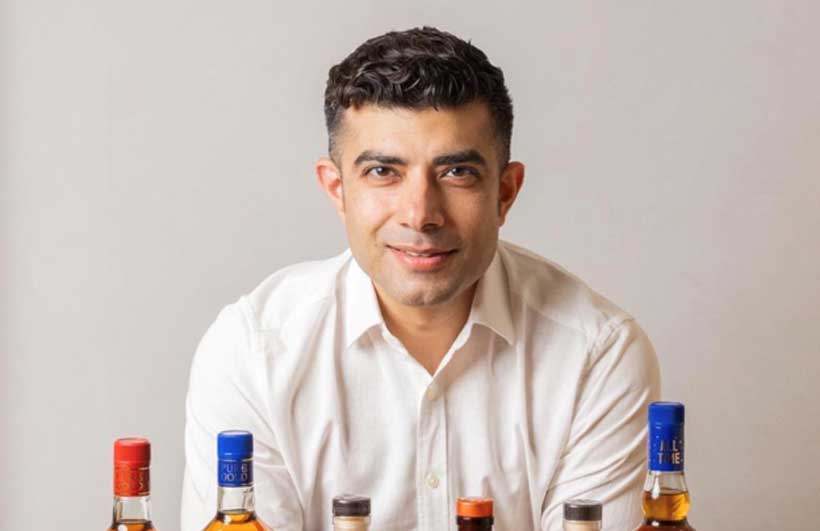
With his strategic mindset, extensive industry knowledge, and a diverse educational background, Pervez Bapuna, Chief Operations Officer at Bapuna Alcobrew, is driving innovation and transforming traditional business practices. Pervez holds a degree in Business Administration & Law, from Symbiosis Law School, Pune. Additionally, he has completed Business Management Studies, specialising in Business Administration, Management, and Operations of family owned enterprises, from the renowned SP Jain Institute of Management & Research. This unique blend of business and legal education equips Pervez with a comprehensive understanding of the intricacies of the AlcoBev industry.
As a third-generation distiller, blender and bottler, Pervez’s expertise is deeply rooted in his family’s rich legacy and experience in the industry. He brings a wealth of knowledge and a commitment to excellence to his role at Bapuna Alcobrew.
1. What inspired you to start Chambal Gin?
We’ve spent decades as distillers and bottlers for some of the biggest names in Indian alcohol, but always behind the scenes. Chambal was born from the desire to finally put our own name, our own region, and our own story on a bottle.
Stay ahead of the geopolitical week.
MD Briefing delivers expert analysis across five global fronts — the Indo-Pacific, energy, geoeconomics, European security, and the Middle East — every Monday morning. Free.
The inspiration came directly from Madhya Pradesh, the state we call home. Gwalior and the Chambal Valley have such a rich, layered history that’s rarely spoken of beyond folklore, and while most conversations around Indian gin gravitate towards the coast or Goa, we felt the heart of India, Madhya Pradesh itself, deserved a place on the map. That’s really where Chambal’s story begins.
2. Tell us more about the Banjara trail?
The Banjara Trail is our way of travelling across India, one region and one bottle at a time. It’s not a limited-edition series in the conventional sense; it’s an ongoing journey. Each Traveller’s Edition starts with a place that has a distinct botanical identity and a story worth telling, and we ask ourselves whether we can translate the essence of that region into a gin that still stays true to Chambal’s philosophy.
The Western Ghats edition, inspired by our proximity to Nagpur, was our second stop, built around orange, hibiscus and kokum. It explores a brighter, lighter and more floral side of the region while remaining rooted in the same approach to balance and craftsmanship. There’s no fixed endpoint to this trail. India has too many stories left to bottle.
3. What’s your educational background and how do you leverage that in producing new product lines?
My educational background is varied. I graduated with a degree in Law and Business. That education gave me a useful combination of commercial thinking, structure and an understanding of how businesses are built, but my strongest grounding has come from growing up inside the business.
Watching my father and uncles run the distillery taught me production, quality control and the discipline required to deliver consistency at scale. That hands-on exposure has shaped how I approach every new product line: creativity has to be paired with the rigour of execution. When we’re developing something like Chambal or a new Banjara expression, that manufacturing mindset allows us to dream big while making sure every bottle can deliver the same quality, batch after batch.
4. Tell us more about you being a third generation distiller?
Being third-generation means I’ve inherited not just technical knowledge, but a responsibility to honour what the generations before me built while finding ways to evolve it.
We’ve seen significant changes over the years, particularly in the last five, and every generation has brought new ideas and ways of working.
5. How can we put India on the map for global alcohol production?
By creating India-centric products that deliver genuinely world-class quality. Indian spirits have reached a point where we don’t need to borrow cues from elsewhere. Our landscapes, ingredients and distilling expertise give us everything we need to create expressions that are unmistakably Indian and can stand alongside the best in the world.
Chambal is one example of that approach. It is rooted in Madhya Pradesh, built around an Indian point of view and has already been recognised at several international spirits competitions. For us, global recognition starts with creating products that Indian consumers themselves are proud to choose.
6. With government restrictions on marketing alcohol, how do you ensure your product reaches your audience?
We lean heavily into storytelling and experience rather than conventional advertising. Regulation actually pushes us to be more thoughtful. The product and the narrative have to do the talking, so every touchpoint – from the label and the serve to the liquid itself – has to earn attention on its own merit.
7. What does your dream innovation in this industry look like?
For me, the most exciting innovation is where the product and the experience come together without the idea feeling manufactured. It could be a new spirit, an unexpected regional botanical or an entirely new way of experiencing a familiar category, but the narrative has to remain genuine and the liquid has to justify the idea.
The Banjara Trail is a good example of that: the innovation isn’t simply a new flavour. It’s a format that allows us to explore India through regions, botanicals and experience, while still making sure every edition works first and foremost as a really good gin. Innovation should give consumers something new to discover, not novelty for novelty’s sake.
8. If not a distiller, what would your alternate dream career look like?
Probably a lawyer or a travel photographer – two very different choices. Law appeals to the analytical side of me, while travel photography is about curiosity, observation and discovering places through a different lens. In some ways, that instinct to explore places and their stories has found its way into what we’re doing with Chambal and the Banjara Trail anyway.