


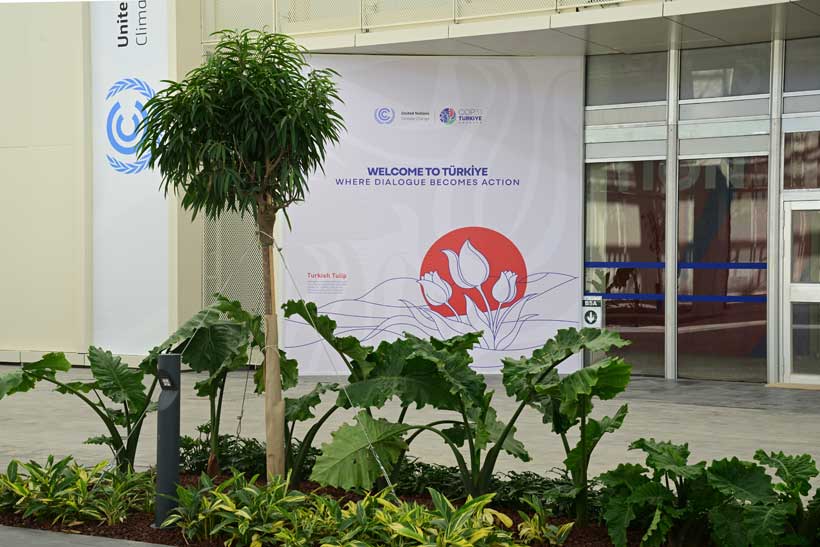
On 9 November, when delegations file into the converted Expo grounds in Antalya’s Aksu district, the United States will occupy a peculiar position. In strict legal terms, it will still be a party to the UN Framework Convention on Climate Change, the 1992 treaty on which every Conference of the Parties rests. Washington’s formal notice of withdrawal reached the UN depositary on 27 February 2026, and under Article 25 of the Convention the exit takes effect only on 27 February 2027. Antalya is therefore the last COP at which the United States holds a seat as a treaty party. It is also almost certain to leave that seat empty, as it did in Belém.
Most commentary treats this absence as a vacancy waiting to be filled, by China, by the European Union, or by some coalition of the willing. That framing misses what is actually happening. The more consequential story of COP31 is not who steps into Washington’s role, but how the climate regime is reorganising itself so that no one has to. The summit’s unusual governance, its carefully chosen flagship agenda, and the growth of parallel processes outside the UNFCCC all point in the same direction: towards a regime that keeps its consensus machinery running for minimum outcomes, while the substantive bargaining migrates elsewhere.
Legally present, politically gone
The American exit is unprecedented in kind, not just in degree. Leaving the Paris Agreement, which took effect for the second time on 27 January 2026, was a familiar manoeuvre. Leaving the parent Convention is not: the United States will be the first country ever to formally quit the treaty. The Treasury had already withdrawn from the Green Climate Fund and vacated its board seat in January, and Washington has typically supplied around 22 per cent of the UNFCCC secretariat’s core budget, a gap that lands on a body already struggling to fund its basic work.
Yet the practical consequence is subtler than the headline suggests. Washington stopped behaving like a party well before the legal clock began to run: it skipped recent summits and had already fallen behind on emissions reporting and secretariat funding. What formal withdrawal changes is predictability. Other delegations no longer need to price in the possibility of a late American intervention, the final-night call from a secretary of state or the joint statement with Beijing that resets the room. That form of great-power choreography, which delivered Paris in 2015, is now off the table by design. And because it remains unclear whether a president can lawfully withdraw from a Senate-ratified treaty without the Senate, a future return may prove harder than simply re-signing Paris. The rest of the membership is planning accordingly.
Stay ahead of the geopolitical week.
MD Briefing delivers expert analysis across five global fronts — the Indo-Pacific, energy, geoeconomics, European security, and the Middle East — every Monday morning. Free.
A presidency designed for a vacuum
COP31’s governance is the first visible adaptation. Under the compromise reached in Belém, Türkiye hosts the summit and holds the presidency while Australia leads the formal negotiations. Environment Minister Murat Kurum presides; Australia’s Chris Bowen, serving as vice-president, selects the co-facilitators and prepares the draft texts. Pacific states were given a formal stake through the pre-COP ministerial in Fiji and a leaders’ gathering in Tuvalu in early October.
The split model is often described as an awkward bargain. It is better understood as a hedge. With no hegemon available to underwrite an outcome, responsibility has been distributed across a middle power straddling Europe and the Middle East, an OECD economy with deep Pacific ties, and a bloc of small island states supplying moral weight. Diffused authority, however, also means diffused accountability, and the fault lines surfaced early. Ankara has asserted that it retains the final say even though Australia runs the talks. In June, EU member states and the Commission condemned Türkiye for inviting only 26 of the bloc’s 27 members and excluding Cyprus from preparatory consultations, a reminder that a host’s unresolved disputes travel with it into the negotiating room.
Neither presidency arrives with clean hands on the central question of the regime. Türkiye overtook Germany in 2024 as Europe’s largest producer of coal-fired electricity and is positioning itself as a regional oil and gas hub, while its NDC lacks an absolute emissions reduction target. Australia remains one of the world’s largest fossil fuel exporters and plans to expand coal and gas production. Against that backdrop, the choice of flagship agenda is revealing. The presidency’s headline goal is to raise electricity’s share of final energy demand to 35 per cent by 2035, from roughly 23 per cent today. Electrification is a sound decarbonisation lever. It is also a framing that lets both co-hosts discuss the energy transition without naming the fuels they produce and sell, and Türkiye’s own national energy plan projects its electrification share at just under 25 per cent in 2035. The agenda is less a statement of ambition than a map of where consensus is still possible.
The Pacific dimension deserves more scrutiny than it receives. Island states lent Canberra the legitimacy its candidacy needed, and the October programme in Fiji and Tuvalu was designed to put their exposure at the centre of the summit. But the relationship carries its own contradiction. Campaigners point out that Australia’s bid relied heavily on Pacific backing while Canberra resisted calls for a Pacific-wide fossil fuel phase-out. The most vulnerable states have been given a formal place in the process precisely when the process is least able to deliver what they have asked of it, which makes them, in effect, guarantors of a summit whose outcome they cannot shape.
Two regimes, one process
The deeper shift began in Belém. More than 80 countries backed a roadmap for transitioning away from fossil fuels, but in the final hours a coalition led by Saudi Arabia and Russia, joined by China, India and Nigeria, stripped even basic references to a fossil fuel transition from the Mutirão decision. Brazil responded by moving the roadmap into a voluntary presidency process outside the formal UN structure.
What followed was the first serious test of whether climate cooperation can function off the UNFCCC’s consensus rails. In April, Colombia and the Netherlands convened the first conference on transitioning away from fossil fuels in Santa Marta, attended by 57 countries representing about a third of the world economy. It did not seek a negotiated outcome. Instead it launched three workstreams, on transition roadmaps, macroeconomic dependencies and financial architecture, and producer-consumer alignment, alongside a science advisory panel, with a second conference to be co-hosted by Tuvalu and Ireland in 2027. Brazil’s informal roadmap is expected to be delivered at Antalya.
The episode exposed a structural feature of the regime that the American presence had long obscured. Consensus decision-making hands an effective veto to any sufficiently determined bloc. For most of the past decade, the weight of Washington, whether pushing for ambition or merely for a deal, gave negotiators a counterweight to the producer coalition in the final hours. With that weight removed, the balance of blocking power in the room tilted. Belém was not an aberration; it was the first COP to show what the consensus rule produces when no single delegation can absorb the cost of overriding a determined minority.
This is the emerging architecture: a universal track bound by consensus, which can protect existing commitments but struggles to extend them, and a plurilateral track of self-selected states prepared to move faster. Clubs have always operated at the margins of COPs. What is new is that, without a United States capable of dragging reluctant producers toward a deal, the plurilateral track is becoming the place where substantive transition policy is actually designed. Antalya’s real test is whether the two tracks connect, whether Santa Marta’s outputs and Brazil’s roadmap find any anchor in a formal decision, or whether they harden into parallel systems: one legitimate but thin, the other ambitious but partial. The coalition has its own fragilities. Within weeks of the Santa Marta report’s launch in June, observers noted that both co-sponsors already appeared to be realigning toward fossil fuels at home.
The leadership no one is claiming
The obvious candidates to fill the American role are behaving in instructive ways. China’s ecology minister, Huang Runqiu, argued in Brussels in June that international cooperation must not be weakened by the absence of individual leaders. The posture is that of a guardian of the process rather than a driver of new obligations. Beijing continues to press developed countries on finance and has long cast measures such as the EU’s carbon border adjustment mechanism, whose definitive phase began in January 2026, as protectionism. Defending the system and expanding it are different projects, and China has so far chosen the first.
Brussels, meanwhile, has drawn an uncomfortable lesson. According to an EU Council source, the bloc concluded after Belém that it had not sufficiently anticipated what the absence of its historic US partner would mean, and environment ministers meeting in Dublin in July discussed seeking partners within the Indian, Chinese and Saudi delegations, as well as among Arab and African states, particularly on climate finance. Set that beside the Belém record: three of the delegations Europe now hopes to court were among those that removed fossil fuel language from the final text. This is not hypocrisy. It is what coalition-building without a hegemon looks like. Europe can no longer assemble majorities from like-minded partners and rely on Washington to deliver the holdouts; it must bargain with the holdouts directly, and the price of any finance deal may well be continued silence on fuels.
What to watch in Antalya
The final decision, due on 20 November but more likely to arrive after it, will be read through the familiar lens of ambition and failure. A more useful measure is structural, and three questions matter more than the adjectives in the text.
The first is whether the formal process acknowledges the Belém roadmap and the Santa Marta outputs at all, even procedurally. A reference, however weak, would keep the plurilateral track tethered to the universal one. Silence would confirm the split. The second is whether Europe’s outreach to China, India and the Gulf yields anything concrete on finance, measured against the Baku to Belém Roadmap’s target of at least $1.3 trillion a year by 2035, and what it costs in transition language. The third is whether the split presidency holds together in the final nights, when a host’s instinct to claim success and a negotiator’s obligation to the text tend to diverge.
The American withdrawal from the Convention will take legal effect three months after Antalya closes. By then, the more important question will not be whether Washington eventually returns, but whether there is still a single climate regime for it to return to.
