


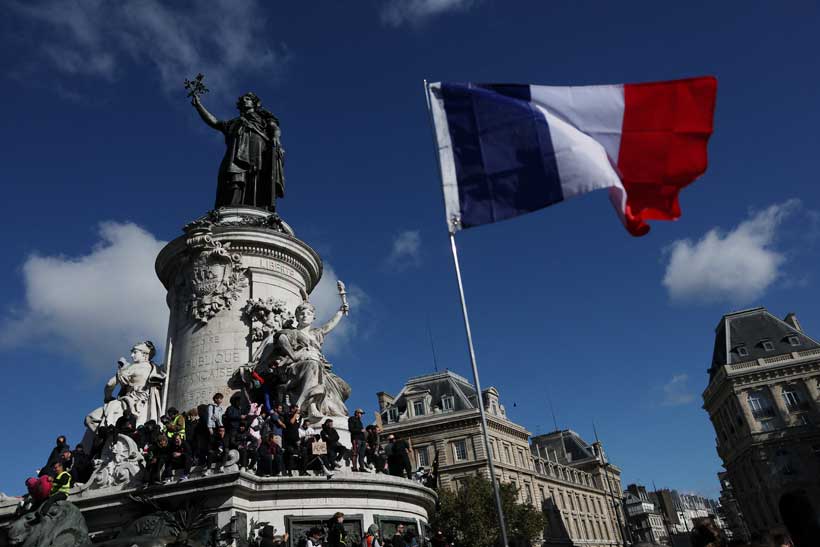
French President Emmanuel Macron is facing mounting pressure to restore public order after a weekend of violent riots exposed security shortcomings and intensified concerns about the country’s political and economic stability. Macron rejected Interior Minister Laurent Nunez’s offer to resign on Monday, instead demanding urgent action against looting and barricades and greater transparency over intelligence failures.
The unrest follows weeks of student demonstrations and comes six months before France’s next presidential election. With public frustration over living costs, deteriorating public services and a weak economy growing, the violence has created another challenge for an already fragile government.
The crisis is also unsettling financial markets as France prepares to pass a budget aimed at controlling its growing debt. Investors are increasingly concerned that political instability could complicate efforts to restore confidence in the country’s public finances.
Why Did France’s Protests Turn Violent?
Hundreds of thousands of people took to the streets over the weekend to protest what they described as declining and dysfunctional public services, alongside the growing cost of living.
Stay ahead of the geopolitical week.
MD Briefing delivers expert analysis across five global fronts — the Indo-Pacific, energy, geoeconomics, European security, and the Middle East — every Monday morning. Free.
Although many demonstrations began peacefully, violent groups disrupted protests in several cities, including Paris, Marseille and Lyon. Shops were looted, buildings were vandalised and a town hall was set on fire as clashes erupted between rioters and police.
Further confrontations took place in Paris and Marseille on Sunday, where riot police intervened to prevent businesses from being ransacked.
The unrest reflects broader frustrations that extend beyond public security. High living costs, economic uncertainty and dissatisfaction with public services have contributed to a climate of discontent in France and other European countries.
Demonstrations over similar economic pressures took place in Italy, Belgium and Albania during the weekend. High fuel prices, partly driven by the war with Iran, have added to the financial difficulties facing households.
For Macron, the challenge is to address the immediate security crisis without ignoring the economic grievances that have helped fuel public anger.
Why Is Macron Facing Questions Over Security Failures?
The scale of the violence has raised questions about whether French authorities adequately anticipated the unrest and deployed sufficient resources to contain it.
France mobilised 60,000 police officers and other security personnel on Saturday, according to Interior Minister Nunez. However, he acknowledged that the deployment had proved insufficient to control violent crowds in some cities.
Macron’s office confirmed that Nunez offered his resignation after the riots. The president rejected the offer but instructed the minister to develop new measures to end barricades and looting.
The Elysee also called for transparency regarding failures in intelligence and planning that contributed to the violence.
Justice Minister Gerald Darmanin reinforced the criticism, saying authorities had underestimated the threat posed by what he described as extreme-left rioters.
The government now faces pressure to explain why the security deployment failed to prevent serious disorder despite the mobilisation of tens of thousands of personnel.
The outcome of any review could influence public confidence in the police and government institutions, particularly if evidence emerges that warnings were overlooked or preparations were inadequate.
How Is the Unrest Affecting France’s Economy?
The riots are creating additional uncertainty for an economy already struggling with weak growth prospects, rising debt and pressure to restore fiscal stability.
France’s government needs to pass a budget designed to rein in public finances, but political tensions could make negotiations more difficult. Any delay or failure to secure sufficient support for fiscal measures could further undermine investor confidence.
Financial markets reacted negatively to the unrest on Monday.
France’s 10-year government bond yield rose by eight basis points to 4.86%, reflecting a decline in bond prices. Germany’s 10-year yield, a key benchmark for the eurozone, remained broadly unchanged at 3.41%.
French equities also underperformed other European markets. The CAC 40 fell 1.3% in early trading, while shares in BNP Paribas, Societe Generale and Credit Agricole each declined by around 2%.
These movements indicate growing investor sensitivity to France’s political and fiscal risks. Higher government borrowing costs could make debt management more expensive, adding to the pressure on policymakers to demonstrate that they can maintain stability.
Deutsche Bank analyst Jim Reid warned that the recent improvement in the gap between French and other eurozone borrowing costs could come under renewed pressure.
Could the Crisis Weaken Macron Ahead of the Presidential Election?
The timing of the unrest makes it particularly damaging for Macron’s government. With the next presidential election six months away, the administration has limited time to demonstrate that it can restore order and respond to voters’ economic concerns.
The immediate priority is to prevent further violence and reassure the public that security forces can protect businesses, public buildings and communities. At the same time, the government must avoid allowing the security response to deepen tensions with demonstrators who are protesting legitimate economic and public-service concerns.
The refusal to accept Nunez’s resignation suggests Macron wants continuity in the interior ministry while demanding improvements in the government’s response. However, retaining the minister also leaves the president politically exposed if further violence occurs or investigations reveal serious failures.
The crisis could also complicate the government’s efforts to secure budget measures. Political instability may make it harder to build support for spending restraint or other unpopular fiscal decisions, particularly when households are already struggling with higher costs.
What Happens Next?
France’s immediate challenge is to restore public order while establishing why security preparations failed to prevent widespread violence. Greater transparency over intelligence assessments, alongside a credible plan to protect public spaces and businesses, will be important in rebuilding confidence.
The government must also contend with the economic pressures driving public dissatisfaction. Security measures alone are unlikely to resolve concerns about living costs, public services and economic insecurity.
For investors, the central question is whether the unrest will remain a short-term disruption or develop into a wider political crisis that threatens fiscal reforms and increases borrowing costs.
For Macron, the stakes extend beyond the immediate riots. His administration must show that it can maintain public order, manage France’s debt and respond to growing social discontent before the presidential election.
Failure on any of these fronts could deepen doubts about the government’s ability to govern effectively at a moment when both political stability and economic credibility are under pressure.
With information from Reuters.
