


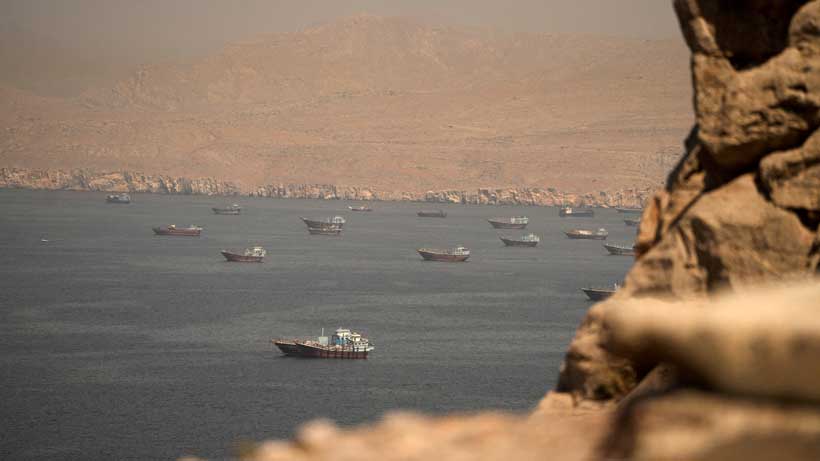
The Middle East’s oil market is entering a new phase of competition as Gulf producers race to recover customers lost during the Iran war, setting the region’s major exporters against one another just as crude flows through the Strait of Hormuz begin to recover.
For much of the past eight months, the conflict disrupted one of the world’s most important energy corridors. Iran’s blockade of the Strait of Hormuz sharply reduced the ability of Saudi Arabia, the United Arab Emirates, Kuwait and Iraq to reach international buyers through their traditional export routes.
That disruption is now easing. But the recovery is creating a new problem for the oil market: producers that were previously constrained by the conflict are once again competing for customers, potentially putting downward pressure on crude prices while exposing divisions within OPEC.
Oil exports through Hormuz averaged about 12 million barrels per day over the past two weeks, roughly 80% of pre-war levels, according to Kpler. When shipments through alternative routes are included, Middle Eastern crude exports exceeded their pre-war average of around 18 million barrels per day for much of the week ending October 3.
Stay ahead of the geopolitical week.
MD Briefing delivers expert analysis across five global fronts — the Indo-Pacific, energy, geoeconomics, European security, and the Middle East — every Monday morning. Free.
Energy Aspects estimates that the global crude supply deficit could narrow to about 250,000 barrels per day in October, compared with almost 4 million barrels per day in May.
The recovery, however, remains fragile. Iranian forces continue to target vessels using the waterway, keeping shipping and insurance costs elevated. Brent crude remains above $100 a barrel, around 40% higher than before the war.
That means the return of supply has not yet translated into significantly cheaper oil for consumers.
The Market-Share Battle Is Already Underway
Competition for market share is not new to the oil industry. OPEC has repeatedly faced periods when rising production outside the group threatened the dominance of its members.
During previous market-share battles, OPEC’s response often involved allowing its lowest-cost producers to increase output and put pressure on competing supplies. The shale revolution in the United States was one prominent example.
The current situation is different because the competition is increasingly taking place within the traditional producer bloc itself.
OPEC has already been weakened by internal disagreements. The United Arab Emirates withdrew from the organization in May as it pursued plans to substantially expand its production capacity, raising questions about the future cohesion of the Saudi-led group.
The Iran war has added another layer of uncertainty. Gulf producers responded to the disruption according to their own logistical capabilities and commercial interests, rather than through a clearly unified regional strategy.
As exports recover, those differences are becoming more visible.
UAE Moves First
The UAE has been among the best positioned to take advantage of the reopening of regional oil routes.
Abu Dhabi developed a system allowing crude to be transported around the Strait of Hormuz through alternative routes, reducing its dependence on the waterway.
According to Kpler, UAE crude exports have averaged around 3.3 million barrels per day since June, broadly matching pre-war levels. Its production has averaged about 4.2 million barrels per day during the same period, above its pre-war average of roughly 3.9 million barrels per day, according to Energy Aspects.
The UAE’s ability to maintain exports while expanding production gives it greater flexibility as competition for Asian buyers intensifies.
That matters because Asia remains the main destination for Gulf crude. Producers that can provide reliable shipments, competitive prices and flexible delivery routes have an opportunity to regain customers that turned elsewhere during the conflict.
Saudi Arabia Tries to Rebuild Its Position
Saudi Arabia’s recovery has followed a more complicated path.
Riyadh initially relied heavily on its western coast and the Yanbu export terminal to bypass Hormuz. That strategy allowed Saudi exports to remain at around 60% of pre-war levels during much of the conflict.
But attacks on the East-West pipeline in September and a Houthi blockade affecting the Bab el-Mandeb route disrupted the kingdom’s alternative export strategy.
Saudi Arabia consequently shifted more shipments back through Hormuz.
The strategy has so far helped restore exports. Kpler data shows Saudi crude exports averaging about 7.3 million barrels per day over the past three weeks, close to pre-war levels.
Production has recovered more slowly. Saudi output is expected to average approximately 7.4 million barrels per day in October, around three-quarters of its pre-war level.
That gap reflects damage and disruption to domestic refining and processing capacity following strikes on Saudi energy infrastructure.
Saudi Aramco CEO Amin Nasser has nevertheless said the kingdom could increase production to 12 million barrels per day within days if required.
The statement is significant because Saudi Arabia retains substantial spare capacity that could quickly alter the balance of the global oil market if Riyadh decides to deploy it.
Asia Is Where the Competition Will Be Decided
The battle for market share is particularly important in Asia, where most Gulf crude is ultimately sold.
Saudi Arabia’s share of Asian crude imports fell dramatically during the war, from 24% in February to just 9% in September. It is expected to recover to roughly 14% in October.
The UAE has been more successful at maintaining its position. Its share of Asian crude imports slipped only slightly, from around 13% in February to 12% in October.
Iran has suffered the sharpest decline.
Following the US naval blockade and restrictions on Iranian exports, Tehran’s share of Asian crude imports fell from a one-year high of 6% in March to effectively zero in October.
This has created an opening for other Gulf producers.
Saudi Arabia, the UAE and Iraq now have an incentive not only to restore production but also to persuade refiners that their supplies are more reliable than they were during the crisis.
That competition could become increasingly aggressive.
Discounts Could Put Pressure on Oil Prices
Some Gulf producers are already using price to regain customers.
Saudi Arabia and Iraq have offered substantial discounts to buyers prepared to load cargoes from within the Gulf. Such discounts can help exporters rebuild relationships with refiners that were forced to find alternative sources during the conflict.
If more producers adopt the same strategy, the result could be greater competition for Asian buyers and downward pressure on crude prices.
But the effect may be limited as long as shipping through Hormuz remains dangerous.
The cost of transporting Gulf crude is significantly higher when vessels face the possibility of attack, delays and elevated insurance premiums. Those additional costs are reflected in the final price paid by buyers and can offset some of the benefits created by increased crude availability.
This explains why rising Middle Eastern exports do not necessarily mean an immediate decline in fuel prices for consumers.
What Happens to OPEC?
The deeper question is what the market-share battle means for OPEC’s ability to influence global prices.
The organization has historically depended on coordination among its members to manage supply. That coordination becomes more difficult when individual producers have strong incentives to increase production and defend their own customers.
The UAE’s departure from OPEC has already raised questions about the organization’s cohesion. The Iran war has demonstrated how differently Gulf producers can respond to the same disruption, depending on their infrastructure, export routes and commercial priorities.
If producers continue prioritizing individual market share over coordinated supply management, OPEC’s ability to act collectively could face additional pressure.
That does not necessarily mean the end of coordinated oil policy. Saudi Arabia remains a major producer with significant spare capacity, while OPEC and its wider producer alliances still possess substantial influence over global supply.
But the current competition shows that maintaining discipline becomes harder when producers are trying to recover from a major geopolitical shock at the same time.
The Recovery Could Remain Volatile
The Middle East’s return to higher export volumes is therefore not a simple story of supply returning to the market.
It is a contest over who controls the customers that were lost during the disruption.
Saudi Arabia wants to rebuild its position in Asia. The UAE is using its logistical advantages to maintain and expand its presence. Iraq is increasing exports, while Iran has seen its market access collapse.
At the same time, the Strait of Hormuz remains vulnerable, meaning that today’s recovery could be disrupted again by a single escalation.
For consumers, the most important variable is therefore not simply how much oil Gulf producers can produce. It is how safely and cheaply that oil can reach global markets.
The Gulf producers may be ready to fight for market share again, but as long as Hormuz remains a high-risk corridor, the normal rules of an oil-price battle do not fully apply.
The emerging competition could eventually push crude prices lower as supply recovers. For now, however, geopolitical risk, shipping costs and insurance premiums are keeping the oil market far more expensive than the improving supply picture alone would suggest.
With information from Reuters.
