


Israeli Prime Minister Benjamin Netanyahu delivered a combative defense of Israel’s actions in the region at the United Nations on Thursday, as dozens of delegates walked out of the chamber in protest, highlighting Israel’s growing diplomatic isolation ahead of its upcoming elections.
Netanyahu used the speech to defend Israel’s conduct in the Gaza war, attack critics including New York Mayor Zohran Mamdani, and accuse Turkey and Qatar of spreading what he described as false claims about Israel.
As Netanyahu began speaking, dozens of delegates left the UN hall. He dismissed them as “moral cowards,” while supporters in the gallery responded with chants of “The people of Israel live.”
“You tried to stop me from coming here. You tried to silence me. Well, you can’t silence me,” Netanyahu said, directly addressing his critics.
Stay ahead of the geopolitical week.
MD Briefing delivers expert analysis across five global fronts — the Indo-Pacific, energy, geoeconomics, European security, and the Middle East — every Monday morning. Free.
Mamdani has previously said he would seek Netanyahu’s arrest over alleged war crimes if the Israeli leader visited New York, although he later acknowledged that he did not have the legal authority to do so. This week, Mamdani described Netanyahu as the “architect” of what he called a genocide against Palestinians.
Netanyahu rejected the accusation.
“Israel didn’t commit genocide. Israel prevented genocide,” he said, while also accusing Mamdani of supporting Hamas, an allegation Mamdani has denied.
Mamdani later accused Netanyahu of repeating what he called “baseless lies” to defend Israel’s actions in Gaza. He also pointed to the International Criminal Court arrest warrant against Netanyahu, which alleges war crimes and crimes against humanity.
Qatar and Turkey separately rejected Netanyahu’s accusations. Qatar’s foreign ministry said his repeated attacks on Doha were aimed at diverting attention from responsibility for policies on the ground. Turkish officials likewise dismissed his accusations against President Tayyip Erdogan and said they could not obscure the humanitarian crisis in Gaza or international legal proceedings.
Netanyahu’s political future on the line
Netanyahu’s UN appearance also came as Israel approaches a general election on October 27, putting his political future at the center of the speech.
With polls showing his bloc trailing its rivals, Netanyahu used the roughly 40-minute address to highlight what he described as Israel’s fight on seven fronts, including its conflict with Iran following US-Israeli strikes in late February.
The speech was broadcast live during evening prime time on Israel’s main television channels, giving Netanyahu a large domestic audience beyond the UN chamber.
His government also paid for hundreds of pro-Israel and anti-Iran billboards and dozens of trucks carrying messages supporting Israel across Manhattan, according to Netanyahu’s office.
As in previous UN appearances, Netanyahu used physical props to reinforce his arguments. He held up a pager associated with an attack targeting Iran-backed Hezbollah members in Lebanon and displayed a Starlink satellite internet receiver, saying he would leave it for Iran’s delegation.
Netanyahu also predicted that Iran’s government would eventually be challenged by its own population.
Protests outside UN headquarters
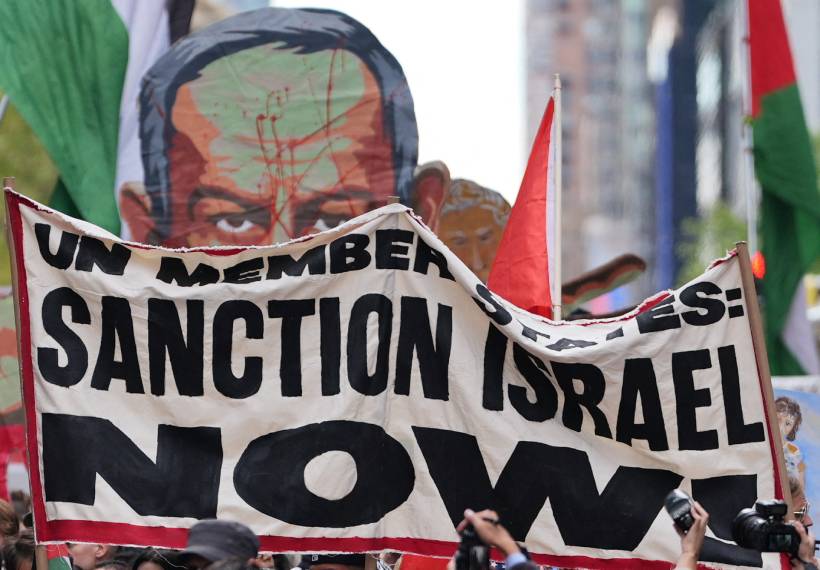
The confrontation inside the UN was accompanied by protests outside the building, where several hundred demonstrators gathered against Israel’s military campaign and US support for Israel.
Some protesters blocked traffic and chanted slogans including “Stop arming Israel, let Gaza live” and “Stop arming Israel, let Iran live.” Police detained several demonstrators.
Netanyahu made only a brief US visit for the UN address and did not have a scheduled meeting with President Donald Trump. He nevertheless praised Trump repeatedly, describing him as Israel’s strongest partner.
“We will continue to defend our state. We will continue to win because we have no other choice,” Netanyahu said.
Israel faces growing diplomatic pressure
The UN confrontation comes amid increasing international criticism of Israel over its conduct of the Gaza war, which began after the Hamas-led attacks on Israel nearly three years ago.
Netanyahu’s international movements have also been complicated by the International Criminal Court’s arrest warrant against him. The court issued warrants in 2024 against Netanyahu and his then-defense minister, as well as a senior Hamas commander.
Earlier this month, Britain, France and Canada announced sanctions targeting Israeli settlements in the occupied West Bank, a move that drew a limited response from Washington.
Netanyahu accused Western leaders of giving in to what he called “antisemitic mobs,” arguing that they had chosen weakness and appeasement.
He also sought to downplay violence by Israeli settlers in the West Bank, describing those involved as a relatively small group of young offenders.
“I can’t stand that. I won’t stand for vigilantism. We’re a country of law,” Netanyahu said.
The sharp exchanges at the UN reflected the increasingly polarized international debate surrounding Israel’s war in Gaza, while Netanyahu used the global stage to defend his government and reinforce his political message at home just weeks before Israel’s election.
With information from Reuters.
