


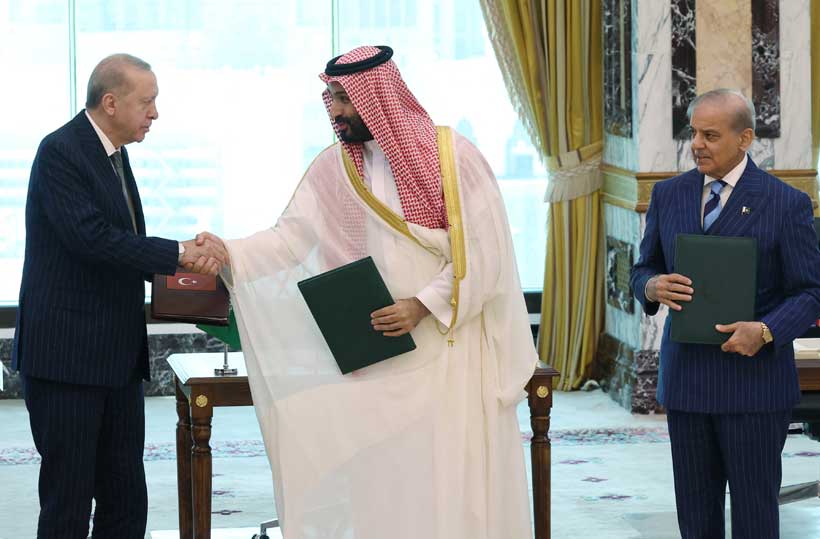
A defence agreement between Turkey, Saudi Arabia and Pakistan could evolve into a broader regional security arrangement involving other Muslim majority countries, including Iran, according to Turkey’s parliament speaker, raising questions over whether the emerging partnership could become a new framework for regional defence cooperation.
The three countries signed the Mecca Joint Defence Agreement in August, establishing a framework under which an attack against one member would be treated as an attack against all. The arrangement resembles NATO’s collective defence principle and was created as regional tensions continued to intensify.
The agreement has gained greater attention following attacks by Yemen’s Iran backed Houthis against Saudi Arabia and amid the wider conflict involving Iran.
Turkey’s parliament speaker Numan Kurtulmus said the agreement is currently undergoing preparatory discussions and is expected to be presented to parliament for ratification after lawmakers return from recess in October.
Stay ahead of the geopolitical week.
MD Briefing delivers expert analysis across five global fronts — the Indo-Pacific, energy, geoeconomics, European security, and the Middle East — every Monday morning. Free.
“For international agreements to come into effect, parliamentary approval is needed,” Kurtulmus told reporters in Ankara.
“The meetings held as part of the agreement at the moment are preparatory meetings.”
The timing of parliamentary consideration could determine how quickly the pact moves from a political commitment into a formal defence arrangement.
Could Iran become part of the pact?
One of the most significant questions surrounding the agreement is whether it could eventually include Iran.
Kurtulmus rejected the idea that the Mecca agreement was designed as an alliance against Tehran, saying Turkey viewed it instead as a framework intended to strengthen regional security.
“We never see the Mecca Agreement as a pact against Iran,” he said.
He went further by suggesting that Iran could potentially join the arrangement, alongside other countries in the region.
“In fact, we hope the Mecca Agreement can turn into a broader agreement for the Muslim world,” Kurtulmus said. “Iran can join this agreement too.”
Such an expansion would significantly change the character of the pact. Rather than functioning primarily as a three country security arrangement, it could become a broader platform for cooperation among regional states facing overlapping security challenges.
Kurtulmus also linked the need for greater regional cooperation to continuing conflicts and what he described as Israel’s “hostile policies.”
The proposal, however, comes at a time when relations between Iran and Saudi Arabia remain shaped by competing regional interests and the wider conflict involving Tehran and its allies.
Turkey and Pakistan’s role
For Ankara, the agreement also provides an opportunity to deepen its security relationship with Riyadh.
Turkey has previously indicated that it could help meet Saudi Arabia’s military requirements, particularly in technical areas. Turkish officials have nevertheless said that any assistance at the current stage would largely remain bilateral and operate within the broader spirit of the alliance until the agreement receives parliamentary approval.
The next step is expected to involve the military chiefs of Saudi Arabia, Turkey and Pakistan, who are due to meet to discuss ways of supporting Riyadh.
The meeting comes as Saudi Arabia faces growing security concerns following attacks by the Houthis, who have targeted Saudi territory as part of the wider regional conflict.
Pakistan’s participation also gives the arrangement a broader strategic dimension, linking Gulf security with a major South Asian military power.
From three countries to a regional framework?
The immediate purpose of the agreement remains the security of its three signatories, but Ankara’s comments indicate that Turkey sees the possibility of something much larger.
A broader arrangement could provide Muslim majority states with a mechanism for coordinating defence and responding collectively to regional threats. At the same time, expanding the pact would raise difficult questions over its membership, command structure, military commitments and relations with countries that have competing interests.
Iran’s potential participation would be particularly significant. Tehran joining an agreement alongside Saudi Arabia, Pakistan and Turkey could transform the pact from a response to current regional tensions into a wider security framework designed to include states with different alliances and strategic priorities.
For now, however, the agreement remains at the preparatory stage in Turkey. Its parliamentary ratification and the military discussions between the three founding members will help determine whether the Mecca pact remains a limited defence arrangement or develops into the broader regional framework Ankara is proposing.
With information from Reuters.
