


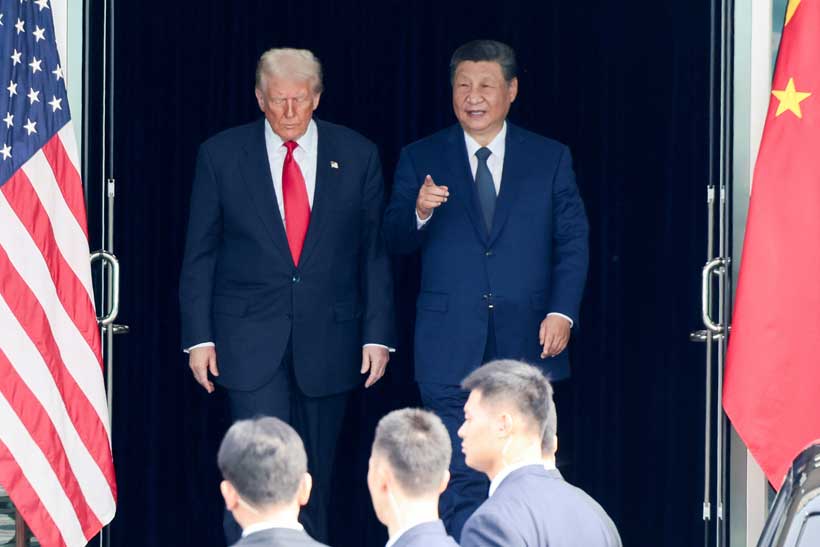
When Xi Jinping’s plane touches down at Joint Base Andrews on Wednesday, he arrives to a reception built for maximum contrast with his last encounter with Donald Trump. This is Xi’s first state visit to Washington in eleven years, and Trump, breaking with the ordinary protocol of who waits for whom, is reportedly meeting him on the tarmac, with a flyover from a stealth bomber and four fighter jets overhead. Nothing comparable happened when Trump visited Beijing in May. The Council on Foreign Relations reads the staging as a signal: Beijing believes it has tamed the Trump administration through rare earth export controls, and at times the administration seems to agree.
That imbalance sits beneath everything on Thursday’s declared agenda: trade, Taiwan, and artificial intelligence. Reciprocity is the Trump administration’s own watchword for the summit and for its wider China policy, but the gap in how the two leaders are being received undercuts that word before either man says it aloud. The same gap sits beneath the one live crisis that never made the official list.
How the two leaders got here
This is the third meeting between Trump and Xi in eleven months. The first, at Busan in October 2025 during the APEC summit, produced a narrow trade truce. China agreed to pause a new round of rare earth export controls for a year, and Washington eased tariffs and deferred a rule that would have blacklisted subsidiaries owned by Chinese companies. Trump then travelled to Beijing in May, where both leaders described the visit as having advanced the relationship even as Taiwan and Iran remained unresolved. Three meetings within eleven months signals urgency on both sides, whatever each government says in public about a settled relationship. Washington this week is the third stop in that cycle, and the first one on American soil, which is part of why the staging matters almost as much as the substance.
Three files, one clock
The White House has confirmed the agenda covers trade, Taiwan, and AI: what one Centre for European Policy Analysis fellow called “the summit of the three Ts: Taiwan, technology, and trade.” Only one of the three carries a fixed deadline. China’s suspension of the rare earth and critical mineral controls it announced in October 2025, a regime asserting extraterritorial licensing over any product manufactured outside China containing as little as 0.1 percent material of Chinese origin, expires on 10 November, three weeks after Thursday’s meeting. China currently controls around 91 percent of global rare earth processing and refining capacity, and as of this week, neither government has said publicly whether the suspension will be renewed. The truce has not been entirely quiet in the meantime. In June, Beijing added MP Materials and USA Rare Earth, the two firms the U.S. government is backing to build an alternative supply chain, to its own export control list. That single move is instructive: Beijing sees no contradiction between honoring the broad truce and squeezing specific targets inside it.
Stay ahead of the geopolitical week.
MD Briefing delivers expert analysis across five global fronts — the Indo-Pacific, energy, geoeconomics, European security, and the Middle East — every Monday morning. Free.
Taiwan carries the longest paper trail of deferral. Congress approved a $14 billion arms package months ago: Patriot interceptors, systems to counter drones, and air defense infrastructure. Trump has held onto it since, at one point describing it as “a very good negotiating chip” in his dealings with Xi. Xi warned in May that mishandling the file could seriously damage the wider relationship, and he is expected to press Trump again this week to defer it further. After the May meeting, Trump told reporters “I will make a determination” on the package, without committing to a timeline.
AI is the vaguest of the three. Bessent has confirmed it is on Thursday’s agenda, and the White House has invited a roster of American technology leadership, including Bezos, Pichai, Altman, Cook, Musk, and Huang, to the state dinner. What a bilateral AI dialogue would actually produce is unclear, given that the administration’s public posture resists new regulation on the premise that any American slowdown hands China the advantage.
The file that isn’t there
Nowhere in the public agenda setting does Iran appear by name. That absence is the more interesting fact, because Iran is where the summit’s underlying contradiction is sharpest.
In August, Treasury Secretary Scott Bessent unveiled what the administration calls Operation Economic Outcast: a campaign to sanction anyone who buys or transports Iranian oil, facilitates its financial transactions, or helps move its money, technology, or gold, with the declared aim of isolating Tehran from the global economy entirely. Asked directly whether Chinese banks would be targeted, Bessent declined to rule it out. “No one is above the reach of U.S. sanctions,” he said. He also declined to confirm it, later adding that he saw no reason to “blow up the global financial system.”
The hedge is the story. China buys somewhere between 80 and 90 percent of Iran’s oil exports, according to multiple industry estimates, making Beijing, in one Atlantic Council fellow’s assessment, the country for which “China, by far, is the most impactful one” if Washington genuinely wanted to choke off Tehran’s financing. Yet the August sanctions list, naming close to 60 entities across the Middle East, Hong Kong, Singapore, and Switzerland, left China’s banking system untouched. Fortune’s framing was blunt: the campaign’s “one major caveat” is China.
None of this proves an explicit bargain. Nothing in the public record shows Washington agreeing to spare Chinese banks in exchange for cooperation on rare earths or Taiwan, and asserting that link as established fact would overreach what is verifiable. What the record does show is a pattern. The administration’s most aggressively declared Iran policy runs headlong into its most economically consequential relationship, and so far, the policy has bent rather than the relationship. Whether Iran comes up at all on Thursday, and how, is worth watching for exactly this reason: its absence from the announced agenda means any mention would itself be a signal.
Leverage as something you hold, not spend
Across all three declared files, and the one undeclared one, the same pattern repeats. A lever each side insists is real is being kept in reserve rather than used. It is a logic that resembles nuclear deterrence more than ordinary diplomacy: the value of the weapon lies almost entirely in not firing it. Beijing has wielded its rare earth chokepoint selectively, against Japanese military end users earlier this year, but has not reimposed the suspended October 2025 controls even amid friction over Iran. Washington holds the Taiwan arms package and sweeping sanctions authority and has fully exercised neither. Trump’s own description of the arms package as a negotiating chip states the logic more plainly than officials usually do. A lever spent once cannot be spent again.
That logic explains the modest expectations attached to Thursday better than any theory about personal chemistry between the two leaders. The Council on Foreign Relations expects, at most, a temporary extension of the Busan truce, some Chinese purchases of American agricultural and energy goods, and an AI dialogue with no binding terms. Bloomberg’s assessment is similarly restrained: both leaders are likely to overrate their own position walking in, and the larger risk is that overconfidence compounds after the summit rather than causing a rupture during it.
Domestic timing sharpens that caution rather than easing it. Trump faces midterm elections in under six weeks, with polling favoring Democratic gains in Congress; Xi is a year out from a Party Congress at which he is expected to secure a further term. Both men are, in a sense, negotiating with an audience that is not in the room. Trump needs a summit that plays domestically as strength without a war record he cannot control in the Middle East. Xi needs a summit that plays domestically as respect without conceding anything on Taiwan before his own political calendar turns. Neither man has an obvious incentive to leave Thursday having visibly conceded something to the other. That is a different condition from having no incentive to cooperate quietly. Managed ambiguity, not resolution, is the more likely product, and it is likely to be sold to both publics as a win regardless.
What actually gets tested
The real test of this summit will not happen Thursday. It happens on 10 November, when the rare earth suspension either rolls over, gets renegotiated, or lapses, and separately, whenever the Taiwan package finally moves or is deferred once more. Both are decisions that can be made weeks after the cameras have left, once the pressure of a live, photographed encounter has passed. That gap between a summit’s visible choreography and its actual points of decision is worth remembering the next time a historic Trump and Xi meeting produces a joint readout heavy on constructive language and light on anything that resolves before the next deadline arrives.
The Iran contradiction may never resolve as cleanly, because acknowledging it publicly would require Washington to admit that its most aggressively marketed Iran policy is conditional on forbearance from the one country capable of undermining it. That is a concession that fits neither the economic onslaught rhetoric coming out of Treasury nor the reciprocity rhetoric coming out of the West Wing. The two leaders shaking hands on Thursday need each other’s restraint considerably more than they need each other’s agreement. Restraint, unlike agreement, is not something either side has to say out loud. That may be precisely why it is the one thing this summit is actually built to produce.
