


China and North Korea have opened a major new border bridge after more than a decade of delays, signalling closer economic ties between Beijing and Pyongyang as both countries seek to expand trade and improve cross-border connectivity.
Trucks carrying the national flags of both countries crossed the three-kilometre New Yalu River Bridge on Thursday, connecting the Chinese city of Dandong with North Korea. Although construction was completed in 2014, the bridge remained unused because North Korea had not finished the necessary approach roads and customs facilities.
Chinese Premier Li Qiang described the opening as the beginning of a new phase in bilateral relations, according to China’s official Xinhua news agency.
The bridge is expected to facilitate trade, improve customs procedures and strengthen economic cooperation in border areas. However, analysts caution that its opening does not necessarily signal an immediate return to the levels of trade that existed before international sanctions against North Korea were tightened.
Stay ahead of the geopolitical week.
MD Briefing delivers expert analysis across five global fronts — the Indo-Pacific, energy, geoeconomics, European security, and the Middle East — every Monday morning. Free.
China and North Korea Seek Closer Economic Ties
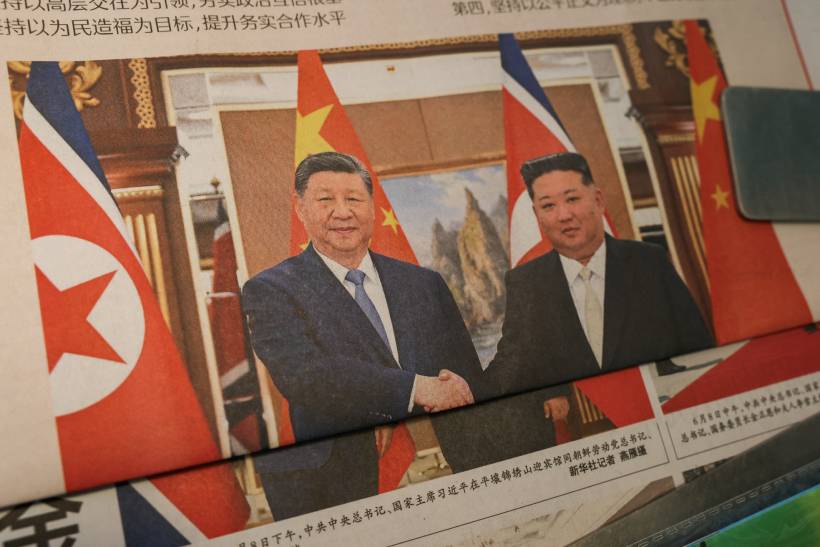
The opening represents the latest development in improving relations between Beijing and Pyongyang, following two summits between their leaders over the past year.
In his video address, Li said the bridge would strengthen economic and trade cooperation while encouraging greater exchanges between the two populations.
North Korean Premier Pak Thae Song also delivered a video address, although North Korean state media had not reported the event at the time of the announcement.
The new crossing could make it easier to transport heavy machinery, industrial raw materials and energy products into North Korea, supporting the country’s economic development plans.
China remains North Korea’s largest trading partner by a substantial margin, despite international sanctions imposed over Pyongyang’s nuclear weapons and ballistic missile programmes.
Chinese exports to North Korea reached $2.3 billion in 2025, a six-year high and a 25% increase from the previous year. However, trade remains below pre-2017 levels, when the United Nations strengthened sanctions against North Korea.
The bridge could help facilitate further growth, although the extent of its impact will depend on border procedures, trade restrictions and the willingness of both governments to expand commercial exchanges.
Why the Bridge Does Not Guarantee a Trade Boom
Despite the new infrastructure, a rapid return to unrestricted trade is unlikely.
United Nations sanctions have restricted a range of goods, economic activities and labour transfers involving North Korea in response to its weapons programmes. China and Russia, both permanent members of the UN Security Council, supported sanctions resolutions until 2017 but have since questioned the effectiveness and legitimacy of maintaining certain restrictions.
Analysts also suggest that Pyongyang remains cautious about becoming even more economically dependent on Beijing.
Lim Eul-chul of Kyungnam University’s Institute for Far Eastern Studies said the bridge was unlikely to produce an immediate return to pre-sanctions trade levels.
Nevertheless, improved transport infrastructure could increase the efficiency of permitted commerce and make it easier for North Korea to obtain equipment and materials needed for domestic development.
The opening therefore represents an expansion of economic connectivity rather than proof that longstanding political and regulatory barriers have been removed.
Dandong Hopes for an Economic Revival
The bridge’s opening also carries significant implications for Dandong, the Chinese border city that has historically served as the principal gateway for trade with North Korea.
The city’s economy benefited from cross-border commerce during the early 2000s, but delays in opening the new bridge limited its potential to expand trade and attract investment.
Until Thursday, most cross-border goods had travelled through an older bridge approximately 10 kilometres upstream. Built 83 years ago, the existing crossing combines a railway track with a single-lane road and remains the busiest of roughly 15 crossing points along the countries’ 1,350-kilometre border.
The new bridge offers additional capacity and the potential to improve the movement of goods between the two countries.
Residents in Dandong welcomed the opening, expressing hopes that the new crossing would bring greater commercial activity and attract more visitors to the area.
However, the extent of any economic revival will depend on whether increased infrastructure capacity translates into sustained trade volumes, investment and employment.
Regional Implications for East Asian Security
The opening also comes amid closer strategic cooperation between China and North Korea, a relationship that carries implications for the wider region.
South Korea is monitoring whether the bridge will be followed by additional measures to strengthen ties between Beijing and Pyongyang. A South Korean Unification Ministry official described the opening as the first visible implementation of agreements reached during a summit between the countries’ leaders in June.
Seoul is particularly attentive to the possibility that closer economic relations could accompany broader strategic coordination between the two neighbours.
Meanwhile, North Korea has strengthened its relationship with Russia amid the war in Ukraine. The United States and South Korea have accused Moscow of providing sensitive military assistance to Pyongyang in exchange for North Korean support for Russia’s war effort.
Against this backdrop, stronger China-North Korea economic links could further complicate regional security calculations, although the bridge itself is primarily intended to facilitate trade and transport.
What Comes Next for China-North Korea Relations?
The New Yalu River Bridge provides Beijing and Pyongyang with new infrastructure for expanding economic cooperation after years of delays and pandemic-related disruption.
Its significance will ultimately depend on how extensively the two governments use the crossing, whether trade continues to grow and whether additional agreements translate into practical cooperation.
For China, stronger cross-border commerce could support economic activity in Dandong while reinforcing its position as North Korea’s principal economic partner. For Pyongyang, the bridge offers improved access to essential goods, industrial equipment and energy supplies.
However, international sanctions, North Korea’s concerns about economic dependence and broader regional security tensions will continue to constrain the relationship.
The opening is an important step towards closer economic ties, but whether it leads to a sustained trade boom will depend on decisions extending well beyond the construction of the bridge itself.
With information from Reuters.
