


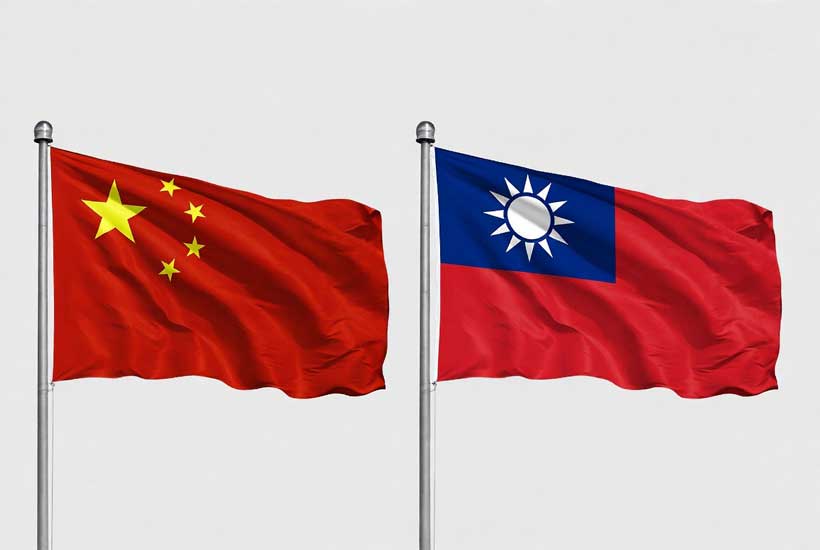
Taiwan remains one of the most sensitive issues in relations between China and the United States, combining questions of sovereignty, national identity, military security and the unresolved legacy of China’s civil war.
Beijing considers Taiwan part of China and describes the issue as a core national interest. Taiwan, meanwhile, rejects China’s sovereignty claims and maintains that it is already a self governing democracy formally known as the Republic of China. The United States does not take a position on Taiwan’s sovereignty but maintains extensive economic and security ties with Taipei.
The dispute has become increasingly important as military activity around Taiwan and US arms sales to the island have intensified.
Why does China claim Taiwan?
China says Taiwan has been part of Chinese territory since ancient times. The island became a province of the Qing dynasty in 1885 before being ceded to Japan in 1895 following the First Sino Japanese War.
Stay ahead of the geopolitical week.
MD Briefing delivers expert analysis across five global fronts — the Indo-Pacific, energy, geoeconomics, European security, and the Middle East — every Monday morning. Free.
At the end of the Second World War in 1945, Taiwan was transferred to the Republic of China government. Four years later, the Chinese civil war ended with Mao Zedong’s communist forces establishing the People’s Republic of China on the mainland. The defeated Republic of China government moved to Taiwan.
Beijing regards the division as an unresolved consequence of the civil war. It describes Taiwan as a Chinese province and rejects any claim that the island has the right to become a separate country.
China says it prefers peaceful reunification but has never renounced the use of force to achieve it. Chinese officials have repeatedly described Taiwan as part of China’s core interests and warned that moves toward formal Taiwanese independence would cross a red line.
Beijing also strongly objects to high level foreign engagement with Taiwan, particularly by the United States, viewing such contacts as interference in what it considers an internal Chinese matter.
How has China responded to US engagement with Taiwan?
China has repeatedly responded to major US and Taiwanese interactions with military exercises around the island.
In 2022, China conducted large scale military exercises around Taiwan after then US House Speaker Nancy Pelosi visited Taipei. Beijing has since carried out several other rounds of exercises following developments involving the United States and Taiwan.
The military pressure has coincided with growing US security support for Taiwan. In late 2025, the Trump administration approved an $11 billion arms sales package for Taiwan, described as the largest such package approved for the island.
China has repeatedly demanded that Washington stop selling weapons to Taiwan, arguing that such actions undermine China’s sovereignty and increase tensions across the Taiwan Strait.
What is Taiwan’s position?
Taiwan rejects Beijing’s sovereignty claims and operates as a democratic political system with its own government, military, elections and institutions.
Taipei argues that the People’s Republic of China has never governed Taiwan and therefore has no authority to claim sovereignty over the island or represent its people internationally.
Taiwan’s formal name remains the Republic of China, reflecting the historical government that relocated to the island in 1949. Taiwanese authorities maintain that the island already exercises independent self government and does not need to make a separate declaration of independence.
President Lai Ching te has repeatedly offered talks with Beijing, but China has rejected his overtures. Beijing does not recognise Lai as Taiwan’s president and instead describes him as a separatist.
Neither side officially recognises the other government’s authority over the other’s territory, leaving the political status of Taiwan unresolved.
What is the US position?
The United States ended its formal diplomatic relationship with Taipei in 1979 and established diplomatic relations with Beijing.
Washington’s policy toward Taiwan is based partly on the Taiwan Relations Act, which provides for the United States to make defensive arms available to Taiwan. At the same time, the US does not officially take a position on Taiwan’s ultimate sovereignty under its One China policy.
Washington has also maintained security assurances toward Taiwan. In 2022, the US State Department added references to the Six Assurances, security commitments made during the Reagan administration and formally declassified in 2020.
Among those assurances is that the United States has not agreed to establish a fixed date for ending arms sales to Taiwan or to consult Beijing before approving such sales.
China continues to demand that the United States end military support for Taiwan.
How does Washington engage with Taipei?
Although the United States and Taiwan do not maintain formal diplomatic relations, their relationship includes extensive economic and security cooperation.
Washington maintains the American Institute in Taiwan, which performs many functions normally associated with a diplomatic mission. Taiwan also maintains close contacts with US lawmakers and other officials.
Taiwanese presidents generally travel through the United States during unofficial transit stops while travelling to and from diplomatic partners in Latin America and the Caribbean. These visits can include meetings with US lawmakers despite the absence of formal diplomatic relations.
Direct communication between the US and Taiwanese presidents has remained unusual. Donald Trump said in May that he would speak with Lai, although that call had not taken place at the time of the source report.
Trump’s relationship with Taiwan has previously included an unusual moment of direct contact. In December 2016, shortly after his election, Trump held a roughly 10 minute telephone conversation with then Taiwanese President Tsai Ing wen.
China responded with a diplomatic complaint but initially described the episode as a “petty action” by Taiwan.
Why does the Taiwan issue remain so sensitive?
Taiwan sits at the intersection of China’s territorial claims, Taiwan’s democratic self government and the United States’ broader security relationship with East Asia.
For Beijing, the issue is closely tied to national sovereignty and the goal of reunification. For Taiwan, maintaining its existing political system and ability to govern itself is central to its position. For Washington, Taiwan is an important part of its wider security and economic relationship in the region while the United States continues to avoid formally recognising Taiwanese independence.
This combination makes Taiwan more than a bilateral dispute between Beijing and Taipei. US arms sales, political contacts and military activity around the island can all become points of tension between the world’s two largest powers.
The result is a delicate status quo in which China continues to reject Taiwanese independence, Taiwan maintains its self government, and the United States supports Taiwan’s ability to defend itself without formally recognising it as an independent state. How long that balance can be maintained remains one of the central strategic questions in the Indo Pacific.
With information from Reuters.
