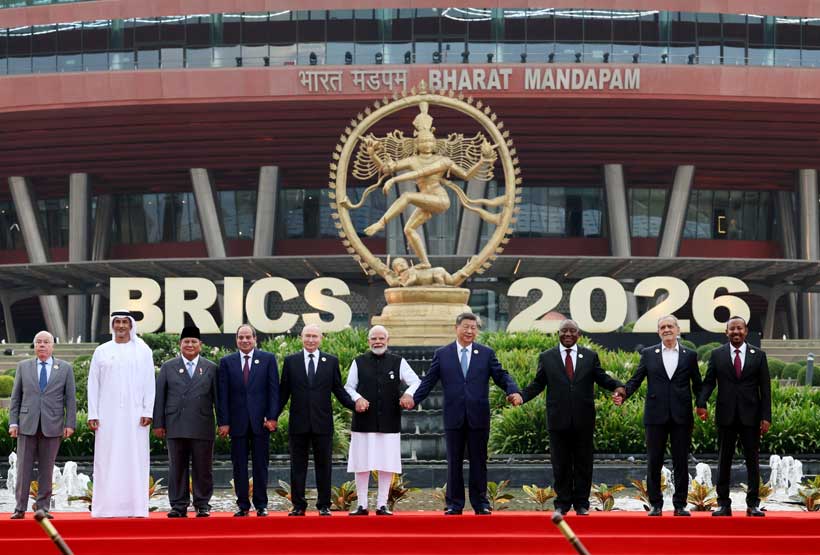
India hosted the 18th BRICS Summit, the fourth under its presidency since its inception, coincidentally on the UN Day for South-South Cooperation (September 12) in New Delhi. This comes against the backdrop of unilateral sanctions, coercive tariffs, and ongoing conflicts against or involving its member states and allegations of a perceived “anti-West” inclination of the intercontinental plurilateral grouping. However, host India categorically made it clear that the grouping is “not against anyone but instead seeks to take everyone along.” Together with the shelving of plans of a much-discussed common BRICS currency, a.k.a. “de-dollarization,” dispels misconceptions about its strategic orientation.
The original five-member grouping of emerging economies—Brazil, Russia, India, China, and South Africa—witnessed two rounds of expansion since 2010—one in 2024 when Iran, the UAE, Saudi Arabia, Egypt, and Ethiopia joined, and the next in 2025 when Indonesia joined, bringing the total membership to eleven. Collectively, these countries represent nearly half the world’s population, two-fifths of the world’s GDP, and over one-fourth of global trade. In spite of all its merits and strengths, the expansion of BRICS added another layer of heterogeneity to the Global South-led bloc, rendering a reconciliation of internal differences more elusive than ever.
Towards consensus
India steered over eight months of intense negotiations since assuming the BRICS presidency in January 2026, involving more than 350 meetings and 22 ministerial tracks covering political, economic, cultural, technological, and people-to-people ties, led by chief negotiators of respective countries called the Sherpas. However, when BRICS Foreign Ministers met in May 2026, the Iran-UAE acrimony over the conflict in West Asia prevented a joint statement, with the ministers expressing their “respective national positions” instead. From this point, the road to consensus as a unanimous joint declaration during the leaders’ summit seemed challenging.
Stay ahead of the geopolitical week.
MD Briefing delivers expert analysis across five global fronts — the Indo-Pacific, energy, geoeconomics, European security, and the Middle East — every Monday morning. Free.
But, four months later, the outcome was strikingly different as the Sherpas managed to agree upon a verbose 140-point joint statement—the New Delhi Declaration—although with a carefully generalized choice of words without directly putting the onus on any contentious individual leader or country. At the same time, it has clear positions on pressing humanitarian crises, coercive economic measures imposed upon its members, substantive global governance reforms, energy security, and counter-terrorism, among other issues, as in previous summits. But India’s approach to steer consensus, as stated by its Sherpa during a press interaction, was to identify positions that none of the members would reject before ascertaining “comfort areas” to work on towards a “common denominator.”
This ensured that the members remained free to retain their respective national positions with the acknowledgement that there is no “one-size-fits-all” approach, clarifying the strategic orientation of the grouping as non-confrontational and accommodative amid hot discussions in the media and strategic circles about the grouping’s fundamental nature and rationale of existence. India essentially reconciled differences that arose from within and resisted attempts to turn the grouping into a platform of internal geopolitical scuffles or anti-West rhetoric.
Moreover, India reaffirmed that discussions on local currency settlements were not intended to replace the existing global payment and settlement framework, which happens to be led by the West. In fact, bilateral mechanisms already exist among BRICS member states, such as the rupee-ruble, the yuan-ruble, the rupee-dirham, and the yuan-real settlement mechanisms. Furthermore, India’s presidency produced more than fifty practical outcomes across the thematic domains of resilience, innovation, cooperation, and sustainability, covering areas such as trade, finance, energy, digital public infrastructure, agriculture, health, and scientific research. It also called for a comprehensive reform of the United Nations and the Bretton Woods institutions—the IMF and World Bank—as in previous summits.
Differing strategic imperatives
It is interesting that the strategic imperatives and priorities of BRICS are perceived differently by different member states along different degrees of affinity to the West, something that was visible even from its very beginnings in the late 2000s, and it still holds true to a considerable extent.
The Russia-China combo prefers a confrontational approach, owing to their global geopolitical positioning vis-à-vis the West, while most of the other member states, except war-ravaged Iran, happen to be more accommodative. As Moscow seeks alternatives to bypass Western sanctions and the monopoly of the EU-based SWIFT banking network, Beijing’s push for BRICS expansion and new payment mechanisms should be read as its attempts to weaken or outcompete global U.S. hegemony on the economic and technological fronts, bringing more partners from the Global South into its orbit. China has already given shape to several multilateral initiatives to expand its influence worldwide, such as the Global Development Initiative, the Global Security Initiative, the Global Governance Initiative, and the World Artificial Intelligence Cooperation Organisation.
Notably, India happens to be the only Quad member in the BRICS and the only non-U.S. ally in the Quad. Its stature among countries of the Global South is that of a trusted development partner, as seen with the African Union’s inclusion into the G20 during India’s presidency in 2023 and its timely financial and humanitarian aid in times of crises. Despite BRICS membership, New Delhi’s ties with the West, including Washington, Brussels, Tokyo, and Canberra, are deepening and improving steadily with diversified areas of cooperation, from defense and technology to trade and investment. On the other hand, BRICS acts as a potent counterweight against the hegemonic tendencies of any single bloc, although India makes space for maneuverability with its long-held policy of strategic autonomy.
Russia and China, both permanent members of the UN Security Council, explicitly support a greater role for India and Brazil in the Council with permanent membership. However, they can’t afford to support revisionist ideas such as ‘de-dollarization,’ at least not in the foreseeable future, as it would be detrimental to their own economic ties with the West. Likewise, the UAE, Egypt, and Saudi Arabia share robust military ties with the U.S. and trade ties with Europe, which they would not wish to vitiate. In spite of the erratic behavior of the incumbent U.S. president, the idea of decoupling with the West appears far-fetched for most of the BRICS countries.
By crafting a consensus, what India essentially did was resist the pressure to be confrontational and reaffirm the broader reform agenda of the grouping without estrangement, which means greater representation and agency for countries of the Global South and protection against unilateral punitive economic measures, without abandoning access to the markets, capital, and technology in the West, while exploring all possible avenues of cooperation with tangible outcomes.
China’s upcoming BRICS presidency in 2027 could see Beijing pushing for its own revisionist agenda, which will be resisted again, and countries will continue to cling on to their freedom to engage independently with competing power centers, suiting their national interests. So, the exceptional length of the 2026 consensus statement is not only reflective of the widening ambit of cooperation among BRICS countries and partners but also its structural soft spots in short, effective and targeted agenda-setting. Yet, it wards off the looming prospect of stiffening itself into an outright confrontational coalition, at least for the time being.