


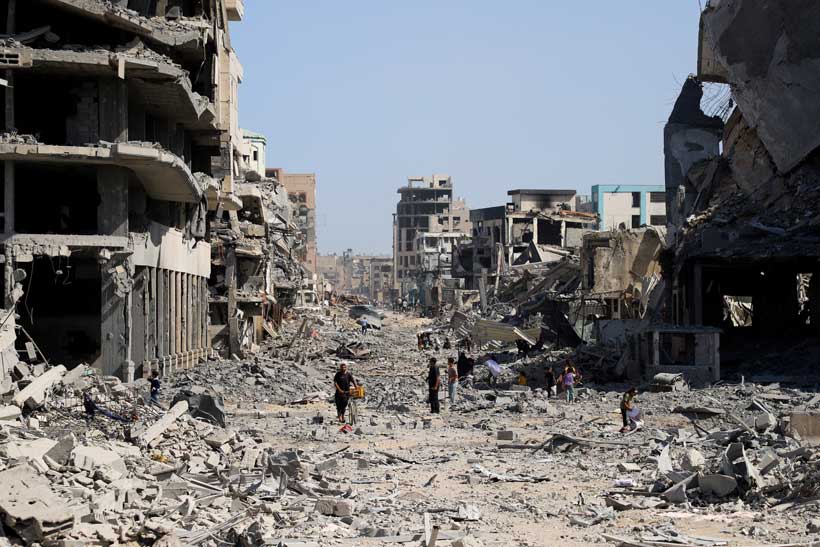
The recovery of hundreds of bodies from beneath buildings destroyed during Israel’s military campaign in Gaza has raised renewed concerns over possible war crimes, U.N. human rights chief Volker Turk said on Tuesday.
Turk said remains believed to belong to entire families were being discovered in the rubble, with many of the victims appearing to be women and children. He said the findings had revived concerns raised in a 2024 U.N. report over whether Israeli strikes on residential buildings and other civilian sites during the early stages of the war complied with international humanitarian law.
Israel has repeatedly rejected allegations that it deliberately targets civilians, saying its military operations comply with international law and are directed at Hamas militants. Israel also accuses Hamas of operating among civilians and using them as human shields, an allegation Hamas denies.
Hundreds of bodies recovered from rubble
The Palestinian Civil Defence says more than 630 bodies and human remains have been recovered from destroyed buildings across Gaza since November 2025.
Stay ahead of the geopolitical week.
MD Briefing delivers expert analysis across five global fronts — the Indo-Pacific, energy, geoeconomics, European security, and the Middle East — every Monday morning. Free.
Palestinian authorities estimate that more than 8,000 people could still be buried beneath the wreckage.
Turk warned that the remains recovered so far could represent only a small portion of those still buried. Large areas of Gaza have been heavily damaged by Israeli bombardment and subsequent demolition and clearance operations.
The scale of destruction has created an enormous humanitarian and forensic challenge. The United Nations estimates that Israel’s military campaign generated around 61 million tons of debris, which could take years to clear.
Why the remains matter legally
The discovery of human remains could have significance beyond identifying missing people. Investigators examining alleged violations of international humanitarian law may need to establish how individuals were killed, what type of weapons were used, whether civilians were present at targeted locations and whether attacks were proportionate to anticipated military objectives.
Turk called for international investigators to gain access to all parts of Gaza to preserve evidence and support ongoing legal proceedings concerning conduct during the war.
The U.N. rights chief also accused Israel of continuing to demolish structures in areas where its forces remain deployed, warning that such operations could further complicate efforts to locate and identify those buried beneath the rubble.
Israel has also restricted the entry of heavy machinery required to remove debris, according to Turk’s statement.
The challenge of identifying the dead
Recovering and identifying human remains has become increasingly difficult because of the scale of destruction and the length of time bodies have remained beneath collapsed structures.
U.N. expert Francesca Albanese has argued that evidence should be collected and human remains identified before large scale clearance operations begin.
The urgency was underscored this month when Palestinian Civil Defence officials said they recovered 96 bodies and human remains from a single site in Gaza City’s Zeitoun area. The remains reportedly included 58 children and 23 women.
A ceasefire has not ended the destruction
The discoveries come nearly three years after the war began following the Hamas led attack on Israel in October 2023. The attack killed around 1,200 people and resulted in 251 hostages being taken, according to Israeli figures.
Israel’s subsequent military campaign has killed more than 73,000 Palestinians, according to Gaza health authorities.
A U.S. brokered ceasefire ended full scale fighting in October 2025, but regular Israeli strikes have continued, with both sides accusing each other of violating the agreement.
The continued violence has complicated humanitarian recovery efforts and made the removal of bodies and debris more difficult.
Implications and analysis
The recovery of bodies from destroyed buildings could intensify international scrutiny of Israel’s conduct during the Gaza war. The central issue will not simply be the number of bodies recovered, but whether forensic and other evidence can establish the circumstances of their deaths and determine whether specific attacks violated international law.
Preserving evidence is therefore becoming increasingly important. Once rubble is cleared or structures are demolished further, investigators may lose information needed to reconstruct attacks, identify victims and determine whether military targets were present.
The issue also places pressure on the post war recovery process. Gaza cannot be fully cleared and rebuilt without removing enormous quantities of debris, but rapid clearance without adequate forensic documentation could make future investigations more difficult.
For international institutions, the challenge is to balance the urgent humanitarian need to recover the dead and clear dangerous rubble with the need to preserve evidence. If investigators gain meaningful access to Gaza, the newly recovered remains could become an important part of broader efforts to establish accountability for alleged violations committed during the war.
With information from Reuters.
