


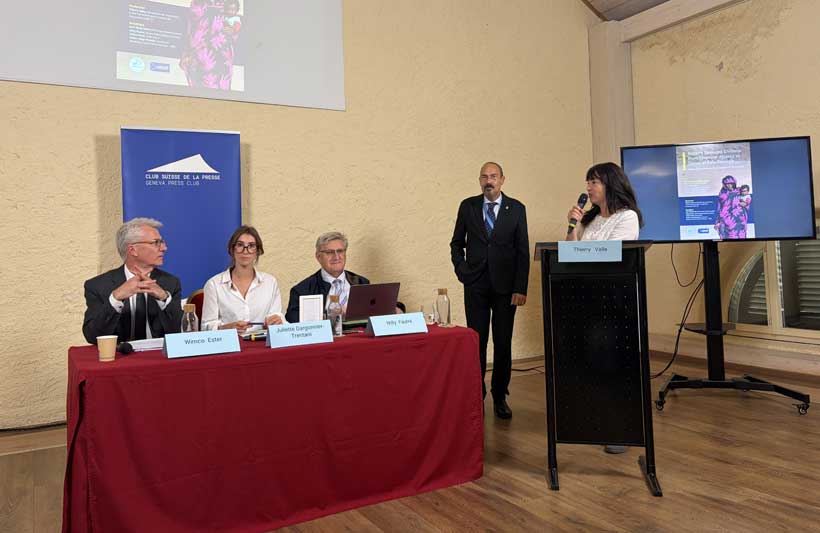
Human rights organizations used the opening week of the UN Human Rights Council’s 63rd session to press delegates on a conflict they say has been deliberately set aside, calling for an independent investigation into chemical weapons allegations in Sudan and urgent protection for civilians trapped in besieged cities.
The panel discussion, held at the Geneva Press Club on 8 September, was convened by CAP Freedom of Conscience and Human Rights Without Frontiers (HRWF). It brought together advocacy groups, a member of the European Parliament, and a speaker joining live from Port Sudan and closed with three recommendations aimed squarely at the Council meeting across the city.
Thierry Valle, president of CAP Freedom of Conscience, opened by challenging the level of international attention the war receives relative to its scale.
“The civilian suffering in Sudan is without parallel among today’s conflicts, and yet it is under-reported, under-funded, and pushed aside,” he said. “Let us be honest: there is no ceasefire, no credible political process, and no meaningful accountability. That is why we convened this panel during UNHRC 63, to put the spotlight on Sudan and to put concrete recommendations in front of the Human Rights Council.”
Stay ahead of the geopolitical week.
MD Briefing delivers expert analysis across five global fronts — the Indo-Pacific, energy, geoeconomics, European security, and the Middle East — every Monday morning. Free.
The claim is supported by the humanitarian figures. The UN estimates that around 33.7 million people in Sudan — roughly two-thirds of the population — will need assistance this year, with famine present or feared in 23 areas (UN News, Xinhua). It remains the world’s largest displacement crisis.
Willy Fautré, founder of HRWF, rejected the vocabulary that has attached itself to the conflict.
“Let us retire the phrase ‘forgotten war,'” he said. “No one living in Sudan has forgotten it—not the families in El Fasher, not the women in El Obeid who cannot reach a water point safely. This war is not forgotten; it is being ignored, and that is a political choice on our side, not theirs.”
His central complaint concerned the absence of any international inquiry into allegations of chemical weapons use, more than a year after the United States made a formal finding on the matter.
“Journalists have documented weaponized chlorine by the Sudanese Armed Forces, the United States has made a formal determination, and armed drones are now the leading cause of civilian death,” Fautré said. “There is still no independent investigation with the participation of the Organisation for the Prohibition of Chemical Weapons. That gap is the scandal.”
The State Department determined in April 2025, under the Chemical and Biological Weapons Control and Warfare Elimination Act, that the Government of Sudan used chemical weapons in 2024 (US Department of State). A second round of US sanctions took effect on 20 July, restricting financing, exports, and airspace access (RFI). Sudanese authorities deny the allegations (Arms Control Association).
Drone warfare has meanwhile become the dominant cause of civilian deaths, accounting for more than 80 percent of them in the first four months of this year, according to UN human rights monitoring (UN News).
Matej Tonin MEP, contributing by video, framed the response as a European obligation.
“As an MEP, I will continue to do my utmost, together with my colleagues, to make sure that every Sudanese receives the humanitarian assistance they need, regardless of their background, religion or beliefs, and that humanitarian access is restored and protected,” he said, “and, above all, that justice and accountability prevail, with full respect for international law and with no impunity for those responsible for atrocities against civilians.”
Wimco Ester, advocacy officer at Open Doors, turned to the position of religious minorities, warning against treating attacks on them as a by-product of the fighting.
“Bombed churches and Christians displaced and killed is not just collateral damage because of the war,” he said. “Do we want to see that often the attacks are systematic, that a further Islamization of society in different ranks will leave hardly any or even no room for other beliefs and convictions?”
The panel also heard from Fr. Dr. Jorge C. Naranjo Alcaide of the Comboni College of Science and Technology, speaking live from Port Sudan on daily conditions for civilians and his college’s work between Christian and Muslim communities.
HRWF closed with three requests to the Council: an independent international investigation into the chemical weapons allegations, with OPCW participation and a fixed reporting deadline; scrutiny in Council debates and resolutions of arms transfer disclosure and embargo compliance by all external actors sustaining the war, including Saudi Arabia, Egypt, and Turkey; and urgent guarantees of safe passage for populations besieged in El Obeid and El Fasher, alongside an immediate end to human shielding.
Those demands arrive at a moment of decision. Delegates held an interactive dialogue on 7 September with the Independent International Fact-Finding Mission for the Sudan (UN Geneva), whose report to this session examines the weapons, fighters and external support networks fuelling the conflict (OHCHR). Before the session ends in October, states must decide whether to renew that mandate (Human Rights Watch).
The full discussion is available on replay via the Geneva Press Club’s YouTube page.
