


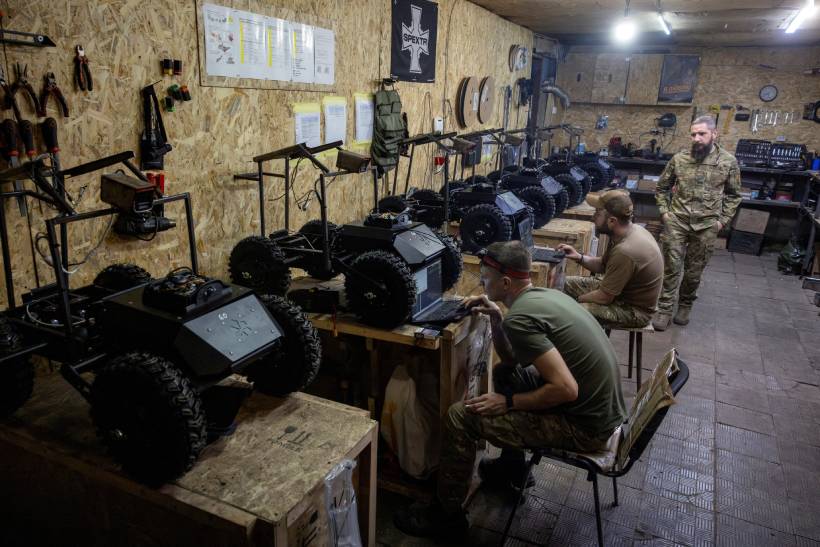
Ukraine is increasingly turning to unmanned ground vehicles to reduce the exposure of soldiers on one of the world’s most heavily monitored battlefields, potentially accelerating a transformation in how wars are fought on land.
Across the front line, Ukrainian military units are deploying four wheeled and tracked robots for missions ranging from transporting ammunition and evacuating wounded soldiers to attacking Russian positions.
The technology remains limited, but its growing use reflects a broader shift toward automated warfare in which machines increasingly perform tasks once carried out directly by soldiers.
For an army facing manpower constraints and persistent Russian infantry assaults, the objective is not simply to acquire more weapons. It is to reduce the number of soldiers exposed to increasingly lethal battlefields.
Stay ahead of the geopolitical week.
MD Briefing delivers expert analysis across five global fronts — the Indo-Pacific, energy, geoeconomics, European security, and the Middle East — every Monday morning. Free.
From Aerial Drones to Ground Robots
Drones have already transformed the war in Ukraine.
Constant aerial surveillance has made movement across exposed areas extremely dangerous, forcing both sides to adapt their tactics. Ukrainian military units are now attempting to extend the same technological transformation to ground operations.
Unmanned ground vehicles, or UGVs, are being deployed for logistics, evacuation, reconnaissance and combat missions.
Ukraine’s Defence Ministry said ground drones had conducted more than 50,000 logistics and evacuation missions during the year. On the battlefield, some vehicles have also been equipped with machine guns or explosives and used against Russian positions.
The technology allows Ukrainian forces to perform dangerous missions without immediately putting soldiers in harm’s way.
For units that have experienced the human cost of conventional ground combat, that advantage is particularly significant.
Replacing Soldiers With Machines
Ukraine’s Third Army Corps is among the formations pushing this approach most aggressively.
Brigadier General Andrii Biletskyi has described the growing use of UGVs as the next major revolution in warfare. His corps aims to replace roughly one third of its frontline troops with unmanned systems by the end of the year.
The ambition reflects a fundamental change in how military planners view manpower.
Infantry remains essential for tasks that machines cannot perform, particularly clearing buildings and trenches. But a growing number of supporting missions can potentially be delegated to machines.
A UGV does not require food, water or shelter. It can carry ammunition, transport supplies or approach an enemy position without exposing a soldier to the same immediate risk.
This could allow armies to preserve human manpower for tasks requiring judgement, adaptability and direct control of territory.
When Ground and Aerial Drones Work Together
The most important development may not be the replacement of infantry by robots, but the integration of different unmanned systems.
Ukrainian units are already combining ground and aerial drones during operations.
A ground vehicle can transport explosives or ammunition toward an objective while aerial drones provide surveillance and attack targets. Machine gun equipped UGVs can also support assaults while aerial drones strike opposing forces.
This creates a layered battlefield in which humans increasingly operate systems rather than directly exposing themselves to enemy fire.
The result could be a new form of combined arms warfare built around networks of relatively inexpensive unmanned platforms.
The Limits of Ground Drones
Ground robots are not yet capable of replacing infantry entirely.
Unlike aerial drones, UGVs must physically navigate the terrain. Trenches, rubble, buildings, vegetation and other obstacles can stop or slow them down.
They are also not yet available in sufficient numbers to create the kind of mass formations that have become possible with smaller aerial drones.
Most importantly, machines cannot independently perform every task required to capture and hold territory.
A robot may deliver ammunition to a position, evacuate a wounded soldier or attack an enemy trench. It cannot easily replace an infantry unit required to enter that trench, search it and maintain control of the area.
The technology therefore appears more likely to supplement infantry than eliminate it in the immediate future.
A Different Kind of Military Leadership
The spread of unmanned systems could also change how commanders make decisions.
When an operation does not necessarily require sending soldiers directly into the most dangerous environment, commanders may become more willing to conduct missions that would previously have carried unacceptable human costs.
This could make military planning more flexible, but it also creates new questions about the relationship between technology and risk.
If machines become increasingly expendable, commanders may be tempted to accept higher levels of operational risk because the immediate human cost is lower.
At the same time, soldiers who have experienced the realities of frontline combat see unmanned systems as a way to reduce unnecessary casualties.
For Ukraine, that calculation is particularly important after years of intense fighting and continuing pressure on its manpower.
What Comes Next?
Ukraine’s experience is likely to attract close attention from militaries around the world.
The country has effectively become a testing ground for technologies that combine artificial intelligence, aerial drones, ground robots, electronic warfare and battlefield communications.
The next stage could involve greater autonomy, allowing machines to navigate more independently, identify targets more efficiently and coordinate with other unmanned systems.
That would bring warfare closer to a battlefield in which humans increasingly make strategic decisions while machines conduct a growing share of tactical operations.
Implications and Analysis
The significance of Ukraine’s ground drones extends beyond the current war.
For decades, military technology has generally focused on making individual weapons more powerful and soldiers better protected. The expansion of unmanned ground systems points toward a different model: removing humans from as many dangerous tasks as possible.
That could fundamentally change the economics of warfare.
A relatively inexpensive machine can potentially replace a much more costly human deployment when the task involves transporting supplies, conducting reconnaissance or attacking a fixed position. At the same time, losing a machine does not create the political and social consequences associated with losing a soldier.
But automation will not make warfare less dangerous. It may instead make certain forms of military action easier to undertake.
The more armies rely on expendable machines, the greater the possibility that commanders will accept levels of battlefield risk that would previously have been considered too costly. Automation could therefore reduce casualties in some operations while potentially expanding the range of operations considered feasible.
Ukraine’s battlefield is also demonstrating that technological superiority does not necessarily come from the most sophisticated or expensive systems. Adaptable, relatively simple machines can have significant value when they are integrated effectively with existing drones, communications networks and human decision making.
The emerging lesson is not that robots are about to replace soldiers.
It is that the role of the soldier is changing.
Future armies may still require humans to hold territory, make decisions and exercise political judgement. But increasingly, the most dangerous work between those decisions may be carried out by machines.
Ukraine’s experiment with ground robots could therefore represent an early glimpse of a battlefield where human beings remain at the centre of warfare while becoming physically less present on its front lines.
With information from Reuters.
