


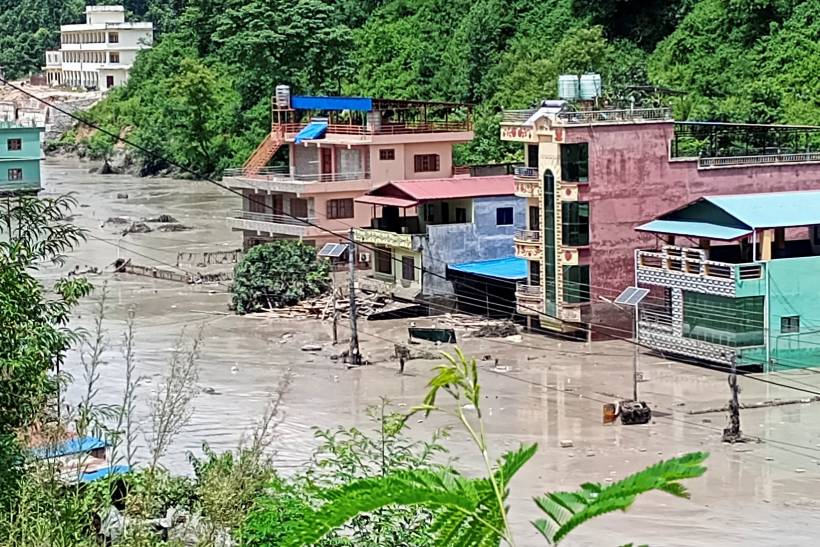
China’s aid model to Nepal, especially during crises and natural disasters, is a prime example of Global South solidarity, presented by Beijing as a development alternative to Western aid that is often contingent on political and structural reforms. This partnership primarily aims to serve the objectives of China’s Belt and Road Initiative by transforming Nepal from a landlocked country into a land-connected one through infrastructure networks traversing the Himalayas. In this respect, China’s aid model to Nepal exemplifies Beijing’s strategy of strengthening solidarity with countries of the Global South. These relations transcend traditional relief efforts, encompassing strategic and economic partnerships through which China seeks to offer a development alternative to conditional Western aid. For instance, China sent emergency humanitarian aid packages, cash assistance, and a team of experts to Nepal to assist those affected by the devastating mudslides and floods that struck the border region between the two countries in late August 2026. Chinese humanitarian aid to Nepal arrived in several phases. Successive shipments of supplies, including tents, blankets, sleeping bags, dry biscuits, and emergency necessities, were transported to Kathmandu via special Chinese transport aircraft. China also dispatched numerous specialized relief teams, tunnel rescue experts, and DNA experts to assist in search and identification operations. China provided extensive logistical and informational support to Nepal. It shared satellite data, aerial photographs, and hydrological data with Nepal and provided direct assistance to 1,720 Nepalese residents stranded in the Gyirong border district.
This Chinese model of solidarity with Nepal is part of Beijing’s efforts to strengthen its relations with developing countries and provide humanitarian relief and technological support in shared border regions. These Chinese relief, development, and humanitarian initiatives contribute to crisis response in developing countries like Nepal, mitigating the effects of natural disasters through the exchange of hydrological data and satellite imagery for monitoring floods and landslides and providing direct logistical and humanitarian support to populations trapped in rugged areas, such as the border region of Gyirong. This strengthens the strategic depth of Sino-Nepalese relations within the framework of China’s Belt and Road Initiative. This Chinese model of solidarity with developing countries can be analyzed through several geopolitical and economic dimensions, including China’s presentation of solidarity with the Global South and its development alternative. China’s aid to Nepal is based on the principles of South-South Cooperation, which differ from the Western model in characteristics such as non-interference in the internal affairs of states. This contrasts with Western aid and projects, such as the US Millennium Challenge Corporation (MCC) program.
The MCC program sparked political debate in Nepal. Furthermore, while China does not impose conditions related to governance or economic privatization, the West imposes political and economic conditions. Chinese aid is characterized by its flexibility in humanitarian crises. This Chinese solidarity was evident in its immediate response to natural disasters, such as the recent floods and mudslides in Nepal in August and September 2026. Beijing promptly sent emergency relief packages, provided cash assistance, deployed tunnel rescue experts, and shared satellite and hydrological data free of charge. This aligns with China’s Belt and Road Initiative, in which Nepal has been a strategic partner since the signing of a memorandum of understanding in 2017, culminating in the signing of a joint executive framework for cooperation. Furthermore, China is assisting Nepal in building the Nepal-Himalayan Connectivity Network, a multi-dimensional transportation and communications network encompassing roads and railways, such as the trans-Tibet-Kathmandu railway. Chinese aid and investment also extend to energy security, hydropower, and international airports, such as Pokhara International Airport, to facilitate trade and tourism.
This Chinese model of solidarity with Nepal and the Global South can be analyzed through several key axes that reflect the features of Chinese solidarity with the Global South, through (China’s focus on infrastructure and continental connectivity). Chinese investment aid in Nepal has been primarily concentrated on the infrastructure and transportation sector, the most prominent feature of China’s Belt and Road Initiative, which Nepal joined in 2017. The Chinese presence in Nepalese transportation projects also played a significant role in China’s rapid identification of all the gaps after the landslide crisis, especially with the participation of Chinese companies in the Trans-Himalayan Railway project linking Lhasa (Tibet) to the Nepalese capital, Kathmandu. In addition, China has financed international airport models for countries in the Global South, including Nepal. China has financed and built vital projects, such as Pokhara International Airport. China has also participated in building hydroelectric power plants to help Nepal achieve energy self-sufficiency and export surplus energy.
Stay ahead of the geopolitical week.
MD Briefing delivers expert analysis across five global fronts — the Indo-Pacific, energy, geoeconomics, European security, and the Middle East — every Monday morning. Free.
Thus, China’s model of solidarity, humanitarian aid, and crisis response in Nepal served as a clear example of unconditional Chinese solidarity with the Global South. China promotes its aid model as being based on respect for sovereignty and non-interference in internal affairs, a principle widely accepted in the Global South. This was not the first instance of Chinese aid to Nepal; it had previously provided emergency humanitarian assistance during the 2015 earthquake, delivering financial aid packages and deploying large rescue teams to help rebuild Nepal after the devastating quake. The same pattern repeated itself after the COVID-19 pandemic, with Beijing being among the first suppliers of vaccines and medical supplies to Nepal at a time when the Global South was grappling with vaccine nationalism in the West.
Thus, Chinese humanitarian aid in response to crises in the Global South aimed to (reduce economic dependence on the West and provide alternatives). Historically, Nepal, a landlocked country, relied almost entirely on India for trade and access to seaports. However, China signed transit agreements and protocols with Nepal, granting it access to Chinese sea and land ports. This broke the historical geographic monopoly and provided Nepal with strategic alternatives to enhance its national and economic security. Chinese solidarity with Nepal also included support for sustainable development projects and technical assistance. Chinese aid encompassed technology transfer and local capacity building in agriculture, education, and healthcare through scholarships for Nepalese students and training for technical personnel. Comparing the Chinese aid model with the Western model in the Global South, using Nepal as a case study, reveals the following:
| Points of Comparison | The Chinese Model (Applied in Nepal) | The Traditional Western Model |
| Preconditions and the Nature of Conditionality | Unconditional politically, focusing on mutual benefit, respect for sovereignty, and non-interference in internal affairs | Conditional on transparency, human rights, and structural reform, as well as conditions related to political reforms, human rights, and economic restructuring |
| Area of focus and sectoral focus | Hard infrastructure (roads, bridges, energy, airports, and emergency relief) | Governance, education, humanitarian relief, civil society, institution building, and health |
| Speed and execution | High speed in decision-making and project initiation | Bureaucratic procedures and lengthy evaluations before funding |
| Financing Mechanism | A mix of grants, concessional loans, and interest-free loans | Focuses on development grants or loans from international financing agencies |
By understanding the preceding table, we can grasp the comparisons between the Chinese model (as applied in Nepal and other countries of the Global South) and the traditional Western model. In terms of preconditions, the Chinese aid model is politically unconditional, focusing on mutual benefit. The Chinese model of solidarity with the Global South and Nepal is based on the principle of respecting sovereignty and non-interference in internal affairs. In contrast, the Western aid model is conditional on transparency, human rights, and structural reform, as well as conditions related to political reforms, human rights, and economic restructuring. Regarding the focus and sectors, Chinese humanitarian and development aid prioritizes hard infrastructure (roads, bridges, energy, airports, and humanitarian relief), while the traditional Western model focuses on governance, education, humanitarian relief, civil society, institution building, and health. Finally, concerning the speed and procedures in humanitarian and development aid and crisis response in the Global South, the Chinese side is characterized by rapid decision-making and project initiation, while the Western model is criticized for its slow pace. The West relies on bureaucratic procedures and lengthy evaluations before providing funding. In contrast, the Chinese model of solidarity financing is based on a mix of grants, concessional loans, and interest-free loans, while Western financing focuses primarily on development grants or loans from international financial institutions.
Finally,spite the pragmatism of the Chinese model of solidarity with developing countries, there are numerous practical challenges and complexities. Although this model is presented as a solidarity-based alternative, it is not without its challenges on the ground, particularly in Nepal, where the balance between loans and grants is a key issue. There has been ongoing political debate within Nepal urging Beijing to provide grants instead of concessional loans to avoid debt burdens and a recurrence of financial default scenarios. Furthermore, there is geopolitical caution, as Nepal finds itself navigating a delicate balancing act between the influence of its northern neighbor (China) and its deep historical and economic ties with India and the United States, creating numerous complications and challenges for the country.
