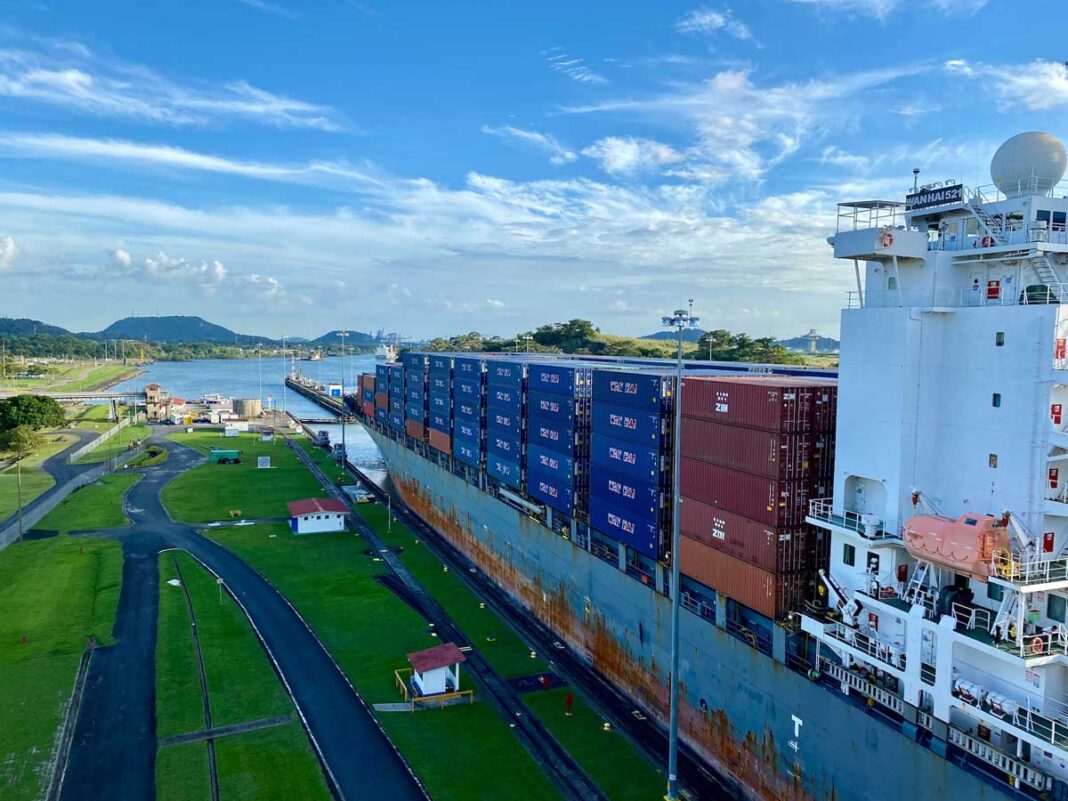
For centuries, the Atlantic and Pacific Oceans were separated not only by distance but also by geography. Before the construction of the Panama Canal, ships travelling between the two oceans had to make the long journey around Cape Horn, following the route associated with Ferdinand Magellan’s expedition and the southern tip of the Americas. Geography imposed the route; infrastructure later began to rewrite it.
The opening of the Panama Canal transformed this relationship. It did not merely shorten a maritime journey. It changed the geography of global trade by turning the narrowest practical connection between two enormous ocean systems into one of the world’s most consequential pieces of infrastructure. Panama demonstrated a principle that has become increasingly important in the twenty-first century: connectivity can change the strategic value of geography.
Panama and the Intermodal Panorama
Yet Panama also illustrates the limits of the chokepoint model. A canal creates efficiency precisely because it concentrates flows. The same concentration can create vulnerability. Congestion, accidents, geopolitical disruption, drought, and changing patterns of global trade can transform an advantage into systemic exposure. The question for the future is therefore not simply how to move more vessels through Panama, but how to build an Atlantic–Pacific system capable of remaining functional when one route is constrained.
Stay ahead of the geopolitical week.
MD Briefing delivers expert analysis across five global fronts — the Indo-Pacific, energy, geoeconomics, European security, and the Middle East — every Monday morning. Free.
Geopolitical uncertainty and the return of disruption are increasingly central to GAFG’s research and policy work.
This question has become more urgent because the global connectivity system is being tested simultaneously by environmental and geopolitical pressures. Climate change and water availability are long-term structural concerns for canal infrastructure, but they are not the only—or necessarily the most immediate—sources of disruption. The war in Eastern Europe has constrained important segments of the Eurasian land-transport architecture, while conflict and insecurity in the wider MENA region have disrupted normal shipping patterns through the Red Sea and Suez corridor. Together, these developments demonstrate how quickly geopolitical shocks can turn established trade routes into constrained or commercially uncertain pathways. The lesson for Panama and the wider Atlantic–Pacific connection is therefore not simply that more capacity is needed, but that alternative, interoperable routes are becoming a strategic necessity.
There is, however, another vulnerability beneath the physical and geopolitical ones: the uneven universality of the rules governing the maritime domain. The United Nations Convention on the Law of the Sea (UNCLOS) provides the principal legal framework for the oceans, but not all states are parties to the Convention. More importantly, the existence of international rules does not automatically guarantee their equal application. This raises an uncomfortable but increasingly important question for global connectivity: do international norms constrain power, or do they constrain primarily those states that are willing or able to comply with them? If rules are predictable for smaller and weaker actors but negotiable for the most powerful, the credibility of the entire connectivity system is weakened.
For the GMGF, this is not a peripheral legal question. Maritime trade depends on predictability: predictable passage, predictable jurisdiction, predictable liability, predictable insurance, and predictable dispute resolution. Where the application of international law becomes dependent on relative power, risk is transferred from the political sphere into shipping costs, insurance premiums, investment decisions, and ultimately supply chains. The challenge, therefore, is not only to build alternative routes but also to ensure that the rules connecting those routes are credible, interoperable, and applied consistently. Otherwise, the world may succeed in creating a network of corridors while failing to create a network of governance.
Intermodality, Supply Chains, and Food Security
This is where the idea of the multimodal bridge becomes important.
The nineteenth- and twentieth-century model largely sought to overcome geography by constructing a single decisive infrastructure link: a canal, a tunnel, a railway, or a major port. The emerging model is different. It combines maritime and land-based modes so that cargo can move through a network rather than depend entirely on one passage.
Central America is particularly suited to this way of thinking. Its geography offers several potential interfaces between the Atlantic and Pacific, including maritime routes, railways, highways, ports, and intermodal logistics platforms. The long-discussed idea of a Nicaraguan interoceanic canal is normally presented as a competitor or alternative to Panama. A more contemporary perspective would ask a different question: could Nicaragua become part of a broader interoceanic multimodal system rather than simply another canal project?
A Nicaraguan “speedway” of combined transport could, in principle, connect Atlantic and Pacific gateways through a coordinated system of rail, road, ports, and maritime services. Such a model would not necessarily attempt to reproduce Panama. Its purpose would be to diversify the ways in which cargo crosses the isthmus, allowing containers or other high-value freight to shift between maritime and land transport according to capacity, cost, time, security, and environmental conditions.
This is precisely the logic of the GAFG/GMGF Connectivity Doctrine: systems over projects, complementarity over competition, and interoperability over isolated infrastructure efficiency. The Atlantic–Pacific question should therefore not be framed as Panama versus Nicaragua, canal versus railway, or maritime versus land transport. The strategic objective is to create an interoperable network in which maritime, rail, road, and port infrastructure can reinforce one another. In this sense, resilience is not a property of a single corridor; it is an ecosystem property.
The importance of such an approach extends well beyond the movement of containers. Intermodality is becoming a strategic instrument for managing global supply chains. A resilient Atlantic–Pacific system would allow cargo to shift between ships, railways, roads, and ports according to changing circumstances. A vessel delayed on one side of the isthmus would not necessarily bring the entire supply chain to a halt: high-value or time-sensitive cargo could move by rail, bulk commodities could remain on maritime routes, while road and inland logistics networks could support regional distribution. The objective is not to make every mode equally important but to make them interoperable. Recent disruptions—from the pandemic and the war in Ukraine to instability around the Red Sea—have demonstrated how quickly a disruption at one chokepoint can propagate across continents. Redundancy is therefore no longer simply additional capacity; it is strategic optionality.
The same logic applies to food security. Grain, fertilizer, animal feed, vegetable oils, and other essential commodities depend on predictable and affordable transport, and disruptions to maritime routes can rapidly translate into higher prices and shortages far from the original point of disruption. An Atlantic–Pacific intermodal network could provide additional options for connecting agricultural and commodity-producing regions with consumer markets in Europe, Asia, and the Americas. Central America’s geographical position makes this particularly significant: a diversified interoceanic system could strengthen the resilience of food and commodity supply chains by allowing cargo to move through different combinations of maritime, rail, and road infrastructure.
This reinforces the GAFG/GMGF proposition that infrastructure should be understood as an ecosystem rather than a collection of individual projects. Ports, canals, railways, roads, warehouses, customs authorities, insurers, financial institutions, and digital logistics platforms all form part of the same connectivity chain. A canal can move a ship, but only an integrated system can reliably move the supply chain. The strategic value of Panama—and potentially of Nicaragua and other intermodal alternatives—should therefore be measured not only by capacity but also by how effectively each adds redundancy, flexibility, and resilience to the global network.
From Ni-Ni to ‘In-In-Inclusive’
The distinction, therefore, is between corridor competition and network resilience—a principle repeatedly advanced in GAFG’s connectivity work.
Panama will remain a uniquely important maritime gateway; the question is how its role can be complemented rather than challenged by other modes and routes. The route around Magellan remains a geographical reminder of the enormous distances that infrastructure seeks to overcome. Nicaragua represents a different possibility: not necessarily replacing the canal model, but demonstrating how multimodal connectivity could create redundancy around a highly concentrated maritime system.
Climate change makes this discussion even more urgent, but it should not be understood as the only source of vulnerability. Panama has demonstrated that water availability can become a strategic variable in maritime connectivity. A canal depends not only on engineering capacity but also on the ecological system that supplies its operating water. Future interoceanic connectivity therefore has to incorporate climate resilience into infrastructure planning from the beginning.
The lesson from Magellan, Panama, and the potential Nicaraguan connection is therefore not that one route replaces another. It is that the history of global connectivity is a story of progressively reducing dependence on geography without ever eliminating geography itself:
Magellan revealed the scale of the obstacle, hence the force of geography. Panama demonstrated the power of infrastructure to transform it. Nicaragua reminds us of the value of alternatives. The underutilized Arctic inter-oceanic connection reminds us that neglect can itself become a form of strategic (down-)power—by leaving options unused. The disruptions of the present demonstrate the limits of concentrated connectivity. The next generation must therefore combine modes, routes, and governance into resilient networks, crossing the continental bridge. Exceptional times leave little room for holidays from history. They require broader perspectives—including those that do not come from the traditional centers of thought. Hesitation is a currency of loss.
The Atlantic and Pacific do not need one bridge. They need a network of bridges.
That is the deeper significance of the Central American isthmus for the future of global trade: not another race to construct the biggest corridor, but an opportunity to demonstrate how maritime routes, railways, ports, logistics systems and governance institutions can operate together as one resilient connectivity ecosystem.