


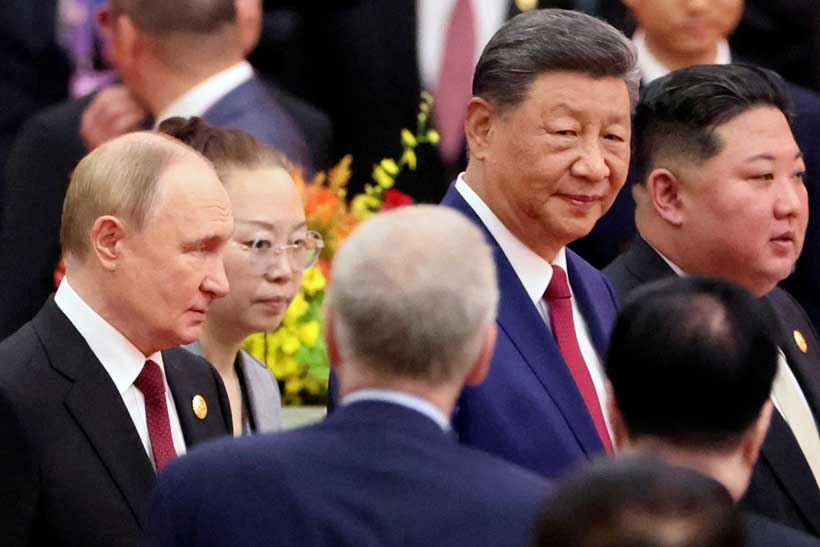
Understanding global geopolitics is complicated and challenging, especially today. Governments have complex relationships with each other at both the bilateral and multilateral levels. This situation certainly applies to the Russian Federation, the People’s Republic of China, and the Democratic People’s Republic of Korea (DPRK or North Korea). These countries have strong bilateral relations, but trilateral cooperation (or lack thereof) also needs to be considered. Given the war in Ukraine and tensions across the Asia-Pacific, defense relations between these three nations must be understood in this evolving landscape.
Defense cooperation
Military relations between governments tend to be murky and not very transparent, particularly among these three nations. However, open-source information allows us to understand the current situation. For example, as the war in Ukraine continues, and given the heavy losses the Russian military is suffering, Moscow is turning to non-Russian troops to replenish ranks. Moscow’s defense relationship with the DPRK is based on the mutual defense pact that the two governments signed in June 2024, which cemented the path for North Korean military assistance. According to Article 4, North Korea and Russia “shall immediately provide military and other assistance” to the other party if it “falls into a state of war due to armed invasion from an individual or multiple states.”
Since the pact was signed, the North Korean government has provided artillery shells, short-range ballistic systems, and other weapons to Moscow, in addition to reportedly deploying over ten thousand troops (some reports put the number at 14 thousand). The North Korean troops supported Russia to expel Ukrainian troops from Russia’s Kursk region, and there are contradictory reports on whether North Korean troops are fighting on Ukrainian soil now. Clifford May, founder and president of the Foundation for Defense of Democracies (FDD), recently noted that “Pyongyang is no longer merely supplying Moscow with missiles; it is now deploying missile personnel alongside them,” citing Ukrainian intelligence reports. Moreover, Ukrainian President Volodymyr Zelensky has warned that an additional 30 to 50 thousand troops will soon be on Russian territory, though South Korea has reported that this deployment is not imminent.
Stay ahead of the geopolitical week.
MD Briefing delivers expert analysis across five global fronts — the Indo-Pacific, energy, geoeconomics, European security, and the Middle East — every Monday morning. Free.
Military cooperation goes both ways, as Moscow is also providing military technology to North Korea, which Pyongyang can use “to improve its standing against the south,” Professor Virginie Grzelcyk argues. The Congressional Research Service, in a late 2025 report, added that “experts assess that Russia could transfer advanced military technology to North Korea if it has not done so already.”
FDD’s president May explains that the North Korean troops who do not die in the war will return home with very valuable combat experience, including regarding drone warfare. Similarly, “Moscow is passing Beijing the combat lessons the People’s Liberation Army needs before any move on Taiwan.”
Beijing is Pyongyang’s other primary ally, though the countries have a complicated history. Defense relations are ruled by a mutual defense treaty, originally signed in 1961 and renewed in 2021. This past June, Chinese leader Xi Jinping visited Pyongyang to meet with Kim Jong-un, the first time this has happened in seven years. The meeting and subsequent meetings by other senior officials have been labeled as a “reset” to strengthen relations. According to the Center for Strategic and International Studies (CSIS), “the most significant omission from all of these high-level exchanges was any mention of North Korea’s nuclear program from the Chinese side.”
Beijing has generally been cool or ambivalent regarding military cooperation towards North Korea. While the Chinese government appears to be changing its mind on this goal, no bilateral military exercises have been announced; “the closest the two militaries have come to this [goal] was indirect [cooperation] and with Russia,” CSIS has explained. The two leaders discussed increasing military cooperation during the recent meeting; however, they have not disclosed specific goals or topics.
CSIS analysts have mused about the possibility of trilateral exercises (with Russia) or Chinese support for North Korean defense projects in areas like modern air defenses, drones, and dual-use components such as microelectronics and machine tools to modernize North Korea’s defense industrial base. On the other hand, Pyongyang could also give Beijing access to the Tumen River, giving the Chinese military direct access to the Sea of Japan.
The bigger picture
International relations analysts love coming up with new acronyms and terms to describe new developments. For example, the current era of global geopolitics has been described as Cold War 2.0 or the era of Great Power Competition. Similarly, a new acronym appeared in recent years: CRINK—China, Russia, Iran, and North Korea. The term describes the loose alliance, or strong relations, between these countries as they face sanctions and tensions with Washington and many countries across Europe.
While Beijing, Moscow, and Pyongyang cooperate and communicate, we would be wrong to assume a formal alliance between the three governments exists. “Each of the three powers remains focused on its own geostrategic interests, which do not always align,” explains the Foundation pour la Recherche Stratégique. Rachel Minyoung Lee, a Senior Fellow for the Stimson Center’s Korea Program and 38 North, offers a similar analysis, explaining that “increasingly overlapping interests and positions do not necessarily translate into growing political intimacy.” There is competition at play as well, as Moscow-Pyongyang relations have significantly increased since the Russian invasion of Ukraine commenced, much to Beijing’s dismay, which has enjoyed its own special relationship with North Korea for decades.
Hence, predicting the future of defense relations at the bilateral and trilateral levels is complicated. First, it is safe to argue that while these three governments have some common objectives and adversaries, there is no NATO-style alliance among them. The mutual defense pacts are important, but it is debatable how far one country is willing to go to support its partner.
There are also unanswered questions, for example:
· For how long will the North Korean government be willing to send troops to Russia to fight in Ukraine? If casualties increase, will Pyongyang reconsider sending more troops?
· If a conflict, however brief, erupts between North Korea and South Korea, will the Russian government deploy troops to assist North Korea? Or will Moscow provide modern military technology like warplanes, tanks, or the S-400 missile system? This decision will largely depend on the role of the United States in supporting South Korea.
· As for China, will Beijing provide more military technology to North Korea to reduce the gap of (growing) strong defense relations between Moscow and Pyongyang?
· Similarly, how far is Beijing willing to go to support Pyongyang should a war break out between North Korea and South Korea (particularly if the United States is involved)?
Conclusions
In the realm of military cooperation and defense, since the war in Ukraine commenced, Moscow has sought to solidify alliances and partnerships with governments that can support the so-called special military operation. Belarus is a good example, but so is North Korea.
Case in point, in a message to President Putin, North Korean leader Kim Jong Un reiterated that the bond between the two countries would continue “in all the sectors.” (The two leaders exchanged messages to celebrate the 81st anniversary of Tokyo’s surrender in World War II and Pyongyang’s anniversary of independence from Japan’s colonial rule). Also in August, Russian Foreign Minister Sergei Lavrov reportedly sent a message to North Korean Foreign Minister Choe Son Hui, in which Lavrov said the two governments are working towards establishing a “new and righteous world order on the basis of genuine equality and national interests.”
Meanwhile, Beijing continues to maintain generally close relations with the North Korean government, following the June presidential summit. The Chinese government has continued to be silent regarding North Korea’s ongoing missile tests, as well. However, analysts who follow North Korea highlight the “warmth” of the Moscow-Pyongyang relationship, while Pyongyang is behaving in a more “subdued” manner “without commensurate warmth” towards Beijing.
How these bilateral relations translate into the defense realm is vastly different. North Korea is committed to continuing to support Russia in the war in Ukraine via weapons (particularly ammunition) and troops. The combat experience North Korean troops are gaining (at least those who survive) will be invaluable for any future conflict with North Korea. Meanwhile, while China does continue to support North Korea diplomatically, defense cooperation is more subdued, though this may change as Beijing wants to catch up to Moscow-Pyongyang relations. Finally, at the trilateral level, there is no formal defense alliance between the three countries, and even if trilateral military exercises were to commence, it would take years to achieve a level of trust and interoperability comparable to other defense partnerships around the globe.
China, North Korea, and Russia have a complex relationship with each other and towards the rest of the world. While defense cooperation is growing in some sectors, the three governments do not yet stand shoulder to shoulder.
