


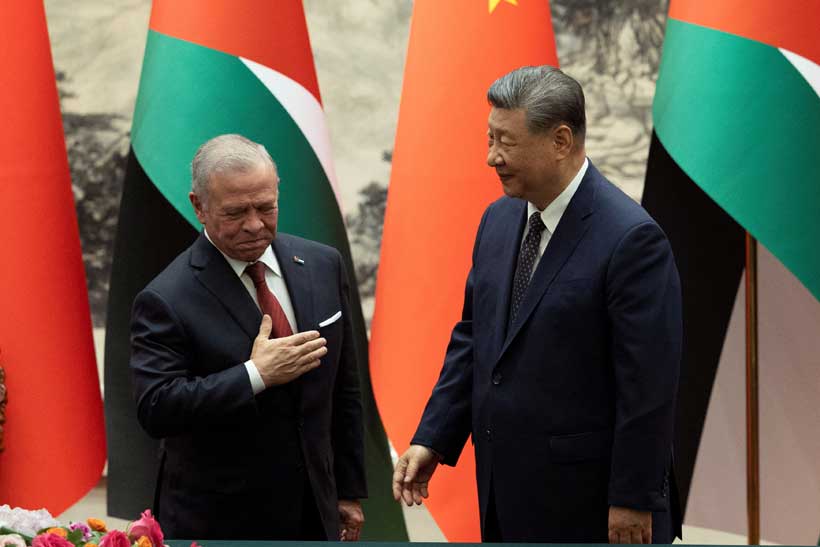
Chinese President Xi Jinping and Jordanian King Abdullah II held official talks in Beijing on Monday, August 24, 2026, focusing on de-escalation in the Middle East and the need for a just solution to the Palestinian issue. The Jordanian and Chinese positions align on the necessity of ending the Israeli occupation and establishing an independent Palestinian state within the 1967 borders, with East Jerusalem as its capital. The importance of the Chinese-Jordanian talks for achieving regional stability is underscored by the visit, which reflects a high level of political coordination aimed at reducing tensions and achieving stability. This is due to the centrality of the Palestinian issue for both China and Jordan, with both sides affirming that the Palestinian issue is at the heart of the Middle East conflict and adhering to the two-state solution. During King Abdullahs visit to Jordan, Beijing called for the establishment of an independent Palestinian state as soon as possible. King Abdullahs meeting with President Xi also addressed the tensions with Iran and the need to maintain de-escalation. Both sides called for preserving the ceasefire between the United States and Iran and ensuring the continued flow of maritime traffic. The joint statement issued by King Abdullah and President “Xi Jinping emphasized the need to resume normal navigation in the Strait of Hormuz. It also called for diplomatic dialogue, urging China to address the root causes of crises through negotiation, particularly regarding the Gaza situation and international efforts to achieve a ceasefire.
In this context, China is attempting to leverage Jordans membership in the UN-led Peace and Security Council and the UN-led Stabilization Force in Gaza to enhance its diplomatic presence in the Middle East and closely monitor US security arrangements. Jordans membership in these bodies carries significant political and strategic implications for Beijing, expanding its influence. China seeks to build close partnerships with moderate Arab states like Jordan to reduce US unilateralism in managing sensitive regional issues and to support Palestinian sovereignty over their territory. Therefore, Chinas political interests align with Jordans position that Palestinians must manage their own affairs and reject any imposition of absolute external dictates. Here, Beijing is closely monitoring the political decisions of the Peace Council, aiming to leverage the position of its Arab allies to steer the reconstruction process in a way that serves its future economic interests. This coincides with Chinas intensified intelligence monitoring and information gathering efforts. Chinese intelligence circles are utilizing diplomatic channels with Jordan to assess the behind-the-scenes details of the Councils security arrangements and to analyze American actions. Specifically, Chinese intelligence is observing the nature of American influence within the executive structures of the International Peace Council and the “International Stabilization Force (ISF) in Gaza, gauging Washingtons success in imposing its vision on the ground. Chinese intelligence, military, defense, security, strategic, and political circles are evaluating all the military and security dimensions of monitoring the international forces deployed in Gaza. The Chinese military is closely following the coordination surrounding the deployment of the ISF and the distribution of its tasks on the ground to draw strategic lessons. The Chinese military establishment is testing the effectiveness of these Western models in managing and resolving armed conflicts, transforming them into case studies for potential international conflicts, such as the Taiwan issue.
For this reason, Jordan and China benefit from a shared strategic relationship, with Jordan serving as a pivotal and stable gateway to the Middle East for Beijing. Furthermore, Jordans economic and logistical importance is crucial to Chinas Belt and Road Initiative. Jordan acts as a vital hub and meeting point for Chinese trade corridors distributing goods and services to Middle Eastern markets. The Port of Aqaba is also of paramount importance to China. Utilizing Jordans location and the Port of Aqaba allows Beijing to connect Asia, Africa, and Europe; develop a regional manufacturing and export center; and diversify Chinese investments and development partnerships. Consequently, China leverages Jordans industrial cities to increase bilateral trade, which has reached advanced levels, making China a major trading partner. The Chinese leadership also recognizes the significant political weight and role Jordan, under the leadership of King Abdullah II, plays in promoting regional stability and acting as a peacemaker and moderating force in the region, contributing to the wise resolution of regional issues. Therefore, China seeks further diplomatic coordination with Jordan to understand the various points of convergence of American and Israeli influence in the Middle East. The two countries share a common vision in supporting just causes and the two-state solution to the Palestinian issue, which strengthens the presence of Chinese political approaches in cooperation with moderate Arab capitals like Amman. Simultaneously, technological and developmental cooperation between Jordan and China is increasing, encompassing expanded partnerships in the digital economy, artificial intelligence, advanced manufacturing, and renewable energy. China is also investing its vast industrial capabilities in transferring Chinese expertise to Jordan and supporting the infrastructure, mining, and energy sectors in the Hashemite Kingdom of Jordan.
Furthermore, China and Jordan support efforts to halt military operations in the Gaza Strip while respecting the UN mandate. Beijing emphasizes the role of the international system and the United Nations in establishing a just peace. China also encourages Jordans role in fostering rapprochement with Palestinian factions to unify visions in support of the Palestinian cause, coordinating efforts with these factions to end the division, and continuing its pivotal role in providing humanitarian support, delivering aid to the people of Gaza, and calming the situation on the ground. The meeting between King Abdullah II of Jordan and Chinese President “Xi Jinping also affirmed the strengthening of the strategic partnership and discussed de-escalation in the Middle East. A key outcome of the meeting was the focus on the Palestinian issue, with President Xi Jinping emphasizing that the Palestinian question is at the heart of the Middle Easts crises and calling for the establishment of an independent Palestinian state. China reiterated its full support for the Hashemite custodianship of the Islamic and Christian holy sites in Jerusalem. This custodianship enjoys consistent Chinese political support in international forums. Both sides stressed the need for de-escalation in Gaza, the importance of consolidating the ceasefire, and the unrestricted delivery of humanitarian aid. The two leaders also witnessed the signing of several agreements and memoranda of understanding to enhance the economic partnership between the two countries, cooperation in the fields of technology, energy, and tourism, and the opening of direct flight routes.
Stay ahead of the geopolitical week.
MD Briefing delivers expert analysis across five global fronts — the Indo-Pacific, energy, geoeconomics, European security, and the Middle East — every Monday morning. Free.
Beijings vision aligns with Jordans position in rejecting absolute American unilateralism in managing Middle East conflicts and in consistently calling for diplomatic solutions and respect for the sovereignty of regional states, away from military interventions led by Washington and its allies. Jordan leverages its relationship with China (a permanent member of the Security Council) to gain additional diplomatic weight to counterbalance Western and American positions and push for just solutions to Middle East issues without aligning with any single power. King Abdullahs meeting with Chinese President Xi Jinping reflects the crucial importance of Chinas role in the Middle East in confronting American and Israeli actions and Chinas regional role in countering Israeli moves. Chinas support for the two-state solution and its rejection of the annexation of West Bank lands provide Arab diplomatic cover to counter unilateral Israeli policies, thus expanding political options. Especially given Jordans emphasis that its and other regional countries openness to Beijing does not signify the formation of a military alliance to replace Washington, but rather a tool for diversifying partnerships and creating a balance in dealings with major powers, thus granting China a (balanced presence). Therefore, the meeting between King Abdullah and President “Xi reinforces Chinas role as a reliable diplomatic and economic mediator advocating for political solutions through dialogue, in contrast to the unilateral American hegemony over regional issues.
Thus, political relations between Jordan and China are characterized as a “strategic partnership based on diplomatic balance and diversification of options. Amman leverages this partnership as political capital to support Arab causes, particularly the Palestinian cause, in international forums. China values Jordans pivotal humanitarian and political role in the Gaza Strip and considers it a key partner in any future arrangements that guarantee Palestinians self-governance. Chinas position on Jordans role is reflected in its praise for Jordanian humanitarian support and the significant humanitarian efforts undertaken by the Hashemite Kingdom of Jordan, with China emphasizing the paramount importance of the Jordanian land corridor in delivering urgent humanitarian aid to the Gaza Strip without restrictions. Furthermore, the Chinese vision aligns with the Jordanian position regarding the mechanisms and future plans for governance and administration in the Gaza Strip. Both emphasize that any future arrangements (administrative or otherwise) for the Gaza Strip must be led by a Palestinian leadership and authority to manage its affairs, while fully preserving the unity of the West Bank and the Gaza Strip as a prelude to the return of the Palestinian National Authority. With agreement on the framework for peace, the shared vision, as discussed in talks between King Abdullah II of Jordan and Chinese President “Xi Jinping in Beijing, is based on the necessity of establishing an immediate ceasefire and adhering to the two-state solution in accordance with UN and Security Council resolutions.
