


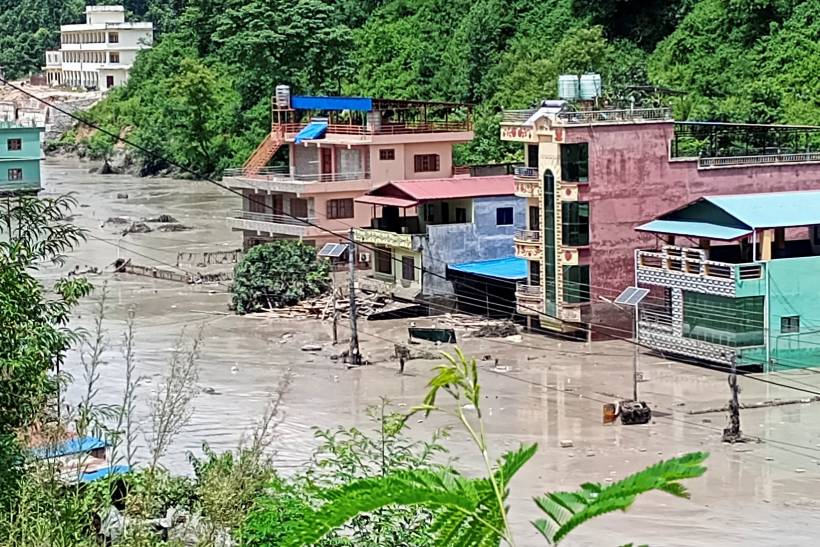
Nearly 1,500 people, including almost 800 foreign nationals, were missing across Nepal and China’s Tibet on Thursday after a massive collapse of mud and rock sent catastrophic floodwaters through Himalayan towns and valleys.
The disaster struck a rugged mountainous corridor connecting Lhasa in Tibet with Kathmandu, an area heavily visited by trekkers and pilgrims.
Nepali authorities said the death toll was expected to rise beyond 165 as rescue teams resumed searching for survivors and recovering bodies.
“This will go up, as we have resumed the search and more bodies are expected to be recovered,” police spokesperson Abi Narayan Kafle told Reuters.
Stay ahead of the geopolitical week.
MD Briefing delivers expert analysis across five global fronts — the Indo-Pacific, energy, geoeconomics, European security, and the Middle East — every Monday morning. Free.
Hundreds of Foreign Tourists Among the Missing
Nepali police and tourism officials said 826 people were missing in Nepal, including almost 500 foreigners from more than two dozen countries.
The missing included 177 Indians, 63 Americans, 34 Australians, 33 Britons and 25 Canadians.
In Tibet’s Gyirong county, 558 people were reported missing, including 260 foreign nationals, according to Chinese state broadcaster CCTV. China reported three deaths.
The high number of foreign nationals reflects the importance of the region as a tourism and pilgrimage route.
Survivors Describe the Force of the Flood
Verified videos showed enormous volumes of water, mud and debris sweeping through the Gyirong border area, destroying buildings and vehicles.
In Nepal, homes, roads and power projects were washed away as floodwaters moved downstream.
Keshav Prasad Baral, a 68 year old survivor being treated in a Nepali hospital, described how mud entered his home and swept away his wife as he tried to move her to safety.
A helicopter rescued Baral several hours later, but his wife remained missing.
Another survivor said he escaped by clinging to a mango tree while watching the building where he had been working disappear.
Emergency Rescue Operations Intensify
More than 5,000 Nepalese army and police personnel were involved in rescue operations, recovering 125 people on Thursday, including 20 foreigners, army spokesperson Raja Ram Basnet said.
Helicopters were deployed to search for survivors and deliver tents, food and other emergency supplies provided by neighbouring India.
Prime Minister Balendra Shah travelled by road to Bidur in Nuwakot district, one of the worst affected areas, to assess the situation.
The difficult mountainous terrain and extensive destruction have made rescue operations particularly challenging.
Glacier Collapse Believed to Have Triggered Disaster
Early reports suggested that an earthquake could have caused part of a glacier to collapse and trigger the floods.
The U.S. Geological Survey later said an earthquake initially reported at magnitude 4.4 was actually seismic energy generated by the collapse of glacial rock and ice, followed by a debris flow.
Satellite imagery from Planet Labs indicated that a landslide involving ice and rock unleashed floodwaters and debris into the Lhende River, about 20 km northeast of the Rasuwagadhi border crossing.
Chinese authorities have also warned of a still dammed lake upstream in Gyirong that could create additional risks and complicate rescue operations.
Pilgrims Among Those Caught in Disaster
Many people affected were travelling to Kailash Mansarovar, a high altitude pilgrimage destination in Tibet revered by Hindus and Buddhists.
Mount Kailash, believed by Hindus to be the abode of Lord Shiva, stands near Lake Mansarovar, which is considered sacred by several religions.
Sagar Pandey, chief executive of a Himalayan tourism company, said 15 Indian Australians travelling with the company were among those missing.
“There are no human-made things, no human settlement left. Everything is just flat,” he told Reuters after surveying the area by helicopter.
International Assistance Mobilised
The disaster has prompted international assistance as Nepal struggles with the scale of the emergency.
The United States said it would send a disaster response adviser and provide $500,000 in assistance.
Australia and Canada said they were monitoring the situation, while U.N. teams and partners were preparing supplies and personnel to support affected communities.
Australian Prime Minister Anthony Albanese said Nepal faced particular difficulties because of its limited resources and challenging terrain.
Videos Show Villages and Infrastructure Swept Away
Security footage from the Chinese side of the border showed people fleeing a torrent of rock, mud and water that destroyed buildings and vehicles.
In Nepal, families gathered outside an army training centre being used as a base for helicopter rescue operations, seeking information about relatives missing in Nuwakot and Dhading.
Several metres of mud covered homes, trees and vehicles, while television footage showed collapsed houses, floating cars and bridges being swept away.
“There is devastation everywhere we look,” said Tula Bahadur BK, a health worker in Rasuwa.
“The settlements next to the river have been completely swept away. Five of my own relatives are missing.”
Analysis
The scale of the disaster makes this more than a humanitarian emergency. It exposes the growing vulnerability of the Himalayan region to sudden glacier, landslide and flood disasters, particularly in areas where communities, tourism routes and critical infrastructure are concentrated along narrow river valleys.
The most important concern is the possible connection between glacial instability and extreme flooding. The apparent collapse of glacial rock and ice demonstrates how rapidly conditions in high altitude areas can translate into catastrophic downstream consequences. The presence of a potentially dangerous lake upstream in Tibet also means that rescue operations could face additional hazards.
The disaster has a major cross border dimension. The same river system connects Tibet and Nepal, while the affected corridor is an important route for tourism, pilgrimage and China Nepal trade. Damage to border crossings, roads and bridges could therefore disrupt both humanitarian access and regional connectivity.
The large number of foreign nationals missing also highlights the growing exposure created by Himalayan tourism. Pilgrimage and trekking have expanded access to extremely remote areas, but emergency response capacity remains limited compared with the scale and speed of disasters that can occur there.
For Nepal, the destruction of roads, bridges, settlements and power infrastructure could create significant economic consequences beyond the immediate loss of life. Rebuilding will require substantial resources at a time when the country has limited capacity for large scale disaster recovery.
The incident also reinforces the need for stronger China Nepal cooperation on early warning systems, glacier monitoring and disaster information sharing. Rivers and hazards do not respect political boundaries, making unilateral disaster management increasingly inadequate.
Ultimately, the tragedy illustrates a wider Himalayan security challenge: climate and geological risks are becoming directly connected to human security, energy infrastructure, tourism and regional connectivity. The immediate priority is rescuing those still missing, but preventing another catastrophe will require long term investment in glacier monitoring, early warning systems, resilient infrastructure and cross border emergency coordination.
With information from Reuters.
