


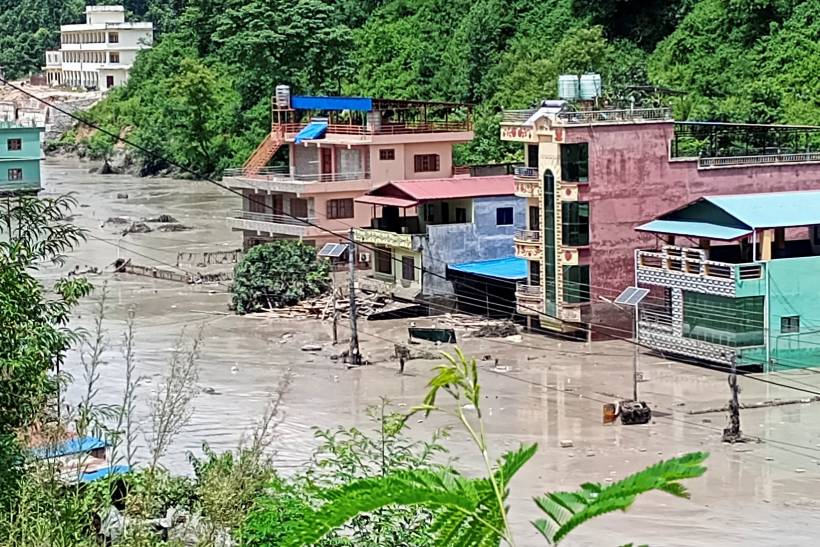
Flash Flood Sweeps Through Himalayan Villages
Nepal sent helicopters to the rescue on Wednesday after a massive flash flood swept through villages in the Himalayan nation, killing eight people and damaging roads, bridges and power projects near the border with Tibet, authorities said.
Across the border, Tibet reported “major casualties” with some people missing in Gyirong county after a mudslide struck a land crossing between China and Nepal, China’s official Xinhua news agency reported.
Floodwaters were too high for helicopters to land in Nepal’s affected areas of Syapru Besi and Timure in the mountainous Rasuwa district, home to about 50,000 people. Authorities warned that the full extent of casualties and damage remained unclear.
“There could be heavy casualties or loss of property,” district administrator Narendra Pariyar told Reuters. “But I cannot say for sure now.”
Stay ahead of the geopolitical week.
MD Briefing delivers expert analysis across five global fronts — the Indo-Pacific, energy, geoeconomics, European security, and the Middle East — every Monday morning. Free.
Residents Urged to Move to Higher Ground
Pariyar urged residents living along the Bhote Koshi river to move to higher ground, citing reports that villages and infrastructure project sites had been swept away.
“It all came suddenly,” the Onlinekhabar portal quoted a witness as saying. “We heard a loud sound, like a volcano erupting. People started to scream and ran away.”
Nepal’s rescue helicopters were unable to land in the affected areas until the waters recede, army spokesperson Raja Ram Basnet said.
The cause of the flooding was not immediately clear. However, a deadly flash flood on the same river last year was eventually linked to the draining of a glacier lake.
China Reports Major Impact in Tibet
The mudslide on the Nepali side also affected China’s Gyirong port, cutting roads, communications and power supplies in the Shigatse region near the Nepal border, Xinhua reported.
Chinese President Xi Jinping ordered “all-out” search efforts for missing people and called for stronger monitoring and early-warning systems to prevent secondary disasters.
The disruption highlights the wider regional consequences of disasters in the Himalayas, where communities, trade routes and infrastructure are closely connected across the Nepal-China border.
Hydropower Infrastructure Hit
Nepal’s energy ministry said 430 megawatts of electricity supplies were affected, mainly from hydroelectric projects. That represents more than 12% of Nepal’s total installed hydropower capacity of 3.2 gigawatts, according to a Reuters calculation.
Prime Minister Balendra Shah said police and military personnel were assisting rescue and relief teams.
“Instructions have been given … to move the people living in the lower areas to safer places,” he said, urging people living along the river to remain alert.
The damage to hydropower facilities adds an important economic dimension to the disaster, as Nepal relies heavily on hydropower for electricity generation and has increasingly invested in projects along its mountainous river systems.
Bhote Koshi River Connects Nepal, Tibet and India
The Bhote Koshi originates in Tibet before flowing into Nepal’s Trishuli river, which eventually enters India as the Gandak river.
The river system demonstrates how disasters in the Himalayan region can have consequences that extend beyond national borders. Flooding can simultaneously threaten settlements, energy projects, transport corridors and downstream communities.
Previous Flood Raises Fresh Concerns
Last year’s Bhote Koshi flood killed nine people and left 24 missing. It also washed away a bridge linking Nepal and China, disrupting trade and transport for months.
That flood was triggered by the draining of a supraglacial lake in Tibet, according to a regional climate monitor.
The recurrence of severe flooding in the same river system has raised concerns about whether existing disaster preparedness and early-warning mechanisms are sufficient for increasingly unpredictable mountain hazards.
Analysis: Growing Climate and Infrastructure Risks
The disaster highlights the growing vulnerability of Himalayan communities and critical infrastructure to extreme flooding and glacier-related hazards. The fact that the same river experienced a deadly flood last year underscores the difficulty of managing risks in a region where rapidly changing mountain and glacier conditions can produce sudden and destructive events.
The damage also has consequences beyond Nepal’s immediate humanitarian crisis. The loss of 430 MW of electricity capacity, including hydropower projects, is significant for a country that relies heavily on hydropower for its energy supply. Damage to roads and border infrastructure could also disrupt trade between Nepal and China.
Cross-Border Disaster Management Becomes Critical
The impact on China’s Gyirong port adds a cross-border dimension to the disaster. The Himalayas connect several countries through shared river systems and transport corridors, meaning that climate-related disasters increasingly require regional disaster monitoring, early-warning systems and cross-border coordination.
The episode also demonstrates the limits of responding to disasters only after they occur. Effective risk management in the Himalayas increasingly depends on cooperation between countries that share mountain ecosystems, rivers and infrastructure networks.
Climate Change and Future Infrastructure Planning
More broadly, the floods demonstrate how climate and geographic risks are becoming intertwined with infrastructure and energy security. As glacier lakes expand and extreme rainfall events become more disruptive, Nepal, Tibet and neighbouring countries may face increasingly difficult choices over where and how to build hydropower projects, roads and settlements.
Infrastructure designed without adequate consideration of glacier-related hazards could face growing risks of repeated damage, potentially increasing economic losses while threatening energy and transport security.
What Happens Next
The immediate priority remains rescue and relief, particularly as high waters continue to restrict access to affected communities. Authorities will also need to assess damage to hydropower facilities, roads, bridges and border infrastructure once conditions allow emergency teams to reach the worst-hit areas.
However, the repeated flooding of the Bhote Koshi suggests that long-term climate adaptation and early-warning infrastructure will be just as important as emergency response.
For Nepal, China and other Himalayan states, the disaster underlines the need for stronger monitoring of glacial lakes, improved flood forecasting, resilient infrastructure and greater cross-border coordination to reduce the human and economic costs of future disasters.
With information from Reuters.
