


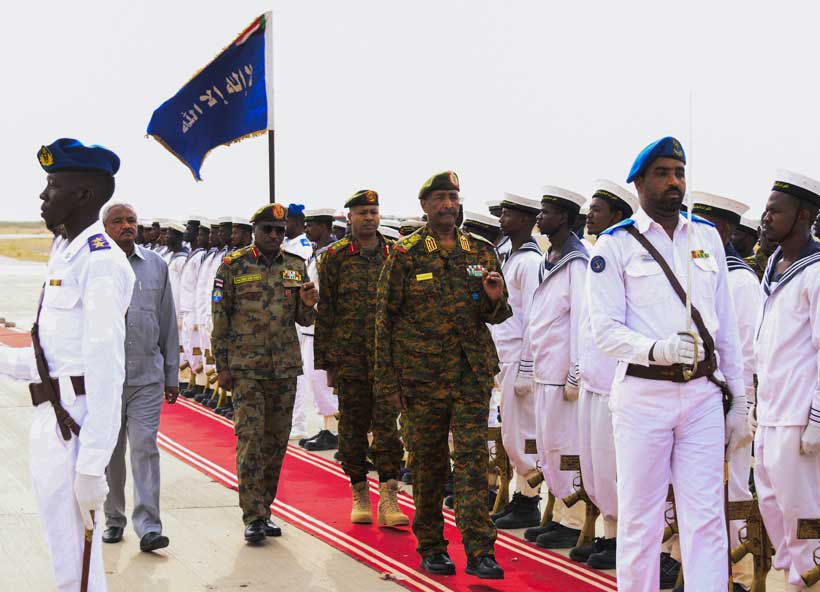
Saudi Arabia’s claim to oppose outside interference in Sudan is becoming increasingly difficult to sustain. Riyadh is no longer merely a venue for mediation or an advocate for a ceasefire: it is emerging as the principal regional underwriter of General Abdel Fattah al-Burhan’s effort to convert battlefield advantage into an enduring political settlement on his own terms.
The signs are accumulating. Burhan’s managed national dialogue, the African Union’s carefully timed mission to Khartoum, growing Saudi-Sudanese institutional ties, and a senior SAF delegation’s defense consultations in Ankara all point in the same direction: a regional diplomatic offensive intended to establish Burhan as Sudan’s indispensable political authority. Burhan’s proposed national dialogue is presented as a path back to civilian government. In practice, it looks more like an attempt to establish a civilian superstructure beneath continuing military control.
The process is reportedly being prepared by a committee led by lawyer Nabil Adib, with the stated purpose of producing a civilian government under the authority of the SAF commander. Yet it has neither a defined structure nor a settled agenda, and many of the civilian figures approached have refused to take part. Their objection is not procedural pedantry. It is political: they believe the outcome has been determined before the dialogue has even begun.
The Sudan People’s Liberation Movement–Revolutionary Democratic Current, led by Yasir Arman, has described the proposal as a unilateral initiative by one of the war’s belligerents. It argues that a dialogue convened without a ceasefire, meaningful humanitarian measures, or an agreed-upon preparatory mechanism will legitimize the conflict rather than end it. Its warning is apt. A process in which the military controls the invitation list, sets the terms, and retains authority over the proposed civilian administration cannot be described as a transition to civilian rule.
Stay ahead of the geopolitical week.
MD Briefing delivers expert analysis across five global fronts — the Indo-Pacific, energy, geoeconomics, European security, and the Middle East — every Monday morning. Free.
The objective is clear enough. Burhan does not need a genuinely inclusive settlement; he needs enough civilian participation to demonstrate political breadth, isolate those who refuse, and establish a government that external actors can recognize and engage. The language of dialogue thus becomes a route to consolidation. Saudi Arabia is central to this project.
Riyadh is emerging as the foremost member of a regional coalition—alongside Egypt, Iran, and Türkiye—backing a political arrangement that would keep Burhan as head of state while attaching a civilian cabinet and legislature below him and putting forward names for who should participate in the organizing committee. This is not neutral diplomacy. It is the shaping of a political outcome. Saudi officials have also held discreet meetings with Sumud figures, including Mariam al-Sadiq al-Mahdi, Abdelrahman al-Sadiq al-Mahdi, and Omar el-Degeir.
Civilian sources believe that figures with Saudi links have sought to bring members of Sumud and other civilian forces behind Burhan’s project. Meanwhile, Port Sudan has reportedly targeted internal divisions within the Sudanese Congress Party, the Democratic Unionist Party, and the National Umma Party, seeking to draw in individuals even where their organizations oppose participation. The mechanism is familiar: fracture the political opposition, offer access and assurances to selected individuals, and present their participation as proof of national consensus. The effect is not reconciliation but co-option.
This approach sits uneasily with the Quartet’s reported September 2025 position that neither the SAF commander nor Islamist forces should form part of a future transitional government. Yet Burhan’s emerging formula would do precisely that: preserve his position at the head of the state while making room for the Islamist networks that remain influential around the SAF and the remnants of the former National Congress Party.
A two-day field mission to Khartoum by an African Union Peace and Security Council delegation must be viewed against this background. Its stated objectives — advancing a ceasefire, improving humanitarian access and reviving an inclusive political process — are entirely legitimate. But timing is political. Burhan has every interest in receiving an AU delegation while presenting himself as the authority capable of delivering order, access, and a future political process. The visit offers Port Sudan an opportunity to recast military advances not as the consolidation of a wartime regime but as the necessary prelude to national recovery.
That risks creating an unintended diplomatic dividend. An African Union (AU) visit to SAF-held Khartoum can strengthen the perception that Burhan is becoming Sudan’s effective national interlocutor and effectively endorse Riyadh’s enabling role—this when the AU’s own stated objective is to ensure that Sudan’s future is not decided by its two-armed factions alone.
The AU is right to engage: while civilians remain exposed to conflict, displacement, and blocked aid, there is no ideal moment for this. But engagement should not shade into political validation. Its representatives should be unequivocal that dialogue cannot be controlled by one-armed party, that civilian participation cannot be manufactured through inducement or intimidation, and that a political process without a ceasefire is liable to become an exercise in legitimizing military power.
