


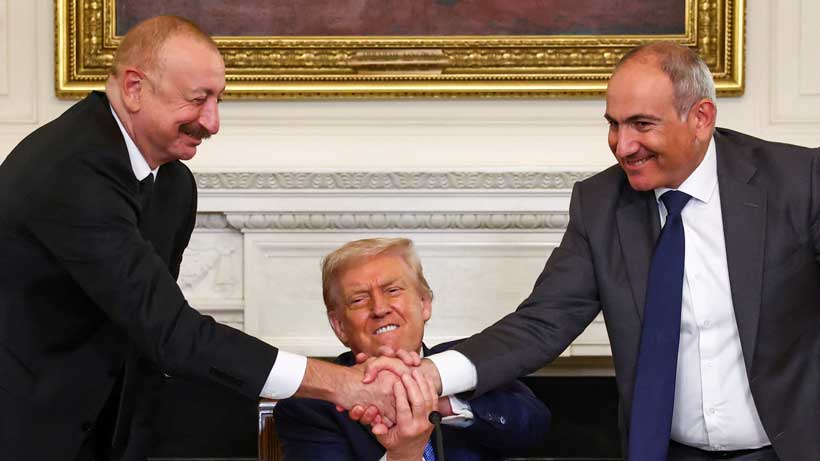
America’s foreign policy, is markedly robust in its deal-making energy. Since January of last year, the second Trump administration has charged forward to bring rivals to the diplomatic table, organize peace processes, and find resolutions to many of the world’s longest-running conflicts. The many deals are driven by special envoys and often incorporate promises of investment, but they also frequently lack forward-looking economic plans which so often lays the foundation that makes peace lasting, rather than merely a ceasefire.
Senior Advisor for Africa Massad Boulos has campaigned for peace in Nigeria, Sudan, and the Democratic Republic of the Congo, leading the US-brokered peace deal last June between the DRC and Rwanda. Now he is in Libya, working to resolve its 15-year civil war. Steve Witkoff, Special Envoy to the Middle East, has worked to mediate between Algeria and Morocco, Israel and Gaza, and now Israel, the US, and Iran. Ambassador Thomas Barrack has likewise been involved in peace facilitation efforts in the newly formed Syrian state. Even Vice President Vance has made peacemaking trips to Armenia, Azerbaijan, and Pakistan. In some instances, these peace deals are hastily made agreements that establish only a pause in hostilities; in others, they create reconciliation. By itself, a deal strikes a finite tone, but full relationships accomplish lasting reconstruction and prosperity.
Relationship building in the 2020 Washington Agreement organized peacebuilding between Kosovo and Serbia as an economic project. It opened borders and facilitated trade, integrating the two hostile neighbors into market structures that ultimately pacify tensions. The Washington Accords for the DRC and Rwanda attempted a similar method, aiming to bring US investment into the sub-Saharan region. In the alternative case of Armenia and Azerbaijan, however, borders remain closed, travel is extremely limited, and trade between the two is nonexistent. Cultural hostilities understandably remain high. Instead of a simple peace deal, the countries need an economic plan for integration, trade, and development financing—market mechanisms that bring people into contact with one another, create jobs, and foster mutual prosperity.
Throughout the history of peacemaking, only those deals that fostered economic relationships have truly guaranteed peace and restored healthy international relations. The resumption of the cotton trade reopened relations between Britain and America after the Revolution. Likewise, the Marshall Plan reconciled Germany with Europe and paved the way for the strength of the European Union today. At the beginning of the 20th century, John Maynard Keynes eloquently argued for the power of economic peacebuilding by urging “that the prosperity and happiness of one country promotes that of others, that the solidarity of man is not a fiction.”
Stay ahead of the geopolitical week.
MD Briefing delivers expert analysis across five global fronts — the Indo-Pacific, energy, geoeconomics, European security, and the Middle East — every Monday morning. Free.
Just as the Marshall Plan slowly reconciled Europe, commercial diplomacy played a major role in transforming the US-Vietnamese relationship after the wars of the 1960s and 1970s. The lifting of the embargo in 1994 opened the door to a trade agreement in 2001, leading Vietnam to become one of the US’s largest trading partners today. These plans were strategic, and they succeeded because of an economic doctrine that recognized the importance of relationship building for durable peace. Economic planning for peace means creating an environment in which businesses and local populations can work, invest, trade, and trust critical infrastructure. Economic planning should form part of American diplomacy from the outset, not be treated as an afterthought of reconstruction.
Calculating the economic benefits of peace deals can be complicated. Prosperity does not immediately follow a peace deal; financial reconstruction takes time and require security guarantees. In Venezuela, few companies want to enter the uncertain market. The same is true in Libya, despite Boulos’s commercial diplomacy between the rival factions. Estimating the benefits of relationship building following peace is fraught with uncertainty. Nonetheless, dedicated research has shown how shared prosperity can be achieved and become self-reinforcing over the long term, as supply chains function as peacekeeping mechanisms.
Robert Putnam’s acclaimed book Bowling Alone inspired Americans to view civil society organizations as a means of rebuilding resilient interconnected communities within a nation – a concept that can also be applied globally. Lord Jonathan Kestenbaum, a member of the House of Lords and former member of its Financial Services Regulation Committee, similarly applies Putnam-style cooperation to peacebuilding in Gaza and the West Bank. Lord Kestenbaum went on to become founding CEO of The Portland Trust which promotes economic development and cooperation between Israelis and Palestinians for long-term peacebuilding.
Under his leadership, the organization published, “Beyond Conflict: The Economic Impact of Peace on Palestinians and Israelis”. In it, Lord Kestenbaum argued that peace between the two parties would transform the opportunities for families on both sides of the divide, and that private investment would generate $8 billion in incremental GDP and create 160,000 direct jobs for Palestinians. Kestenbaum drew on Northern Ireland’s peace process and the critical role that economic development played there in conflict resolution. The Trump administration’s 20-Point Gaza Plan alongside the reconstruction aims of the Board of Peace similarly underscores the intersection between the brokering of peace deals and readily integrated economic plans.
Peace deals and economic development become critically interlinked. In fact, the RAND Corporation found that peace would create approximately $120billion in new economic growth for Israelis and $50 billion for Palestinians over the course of a decade. This does not account for the benefits of preventing further losses, which already amount to more than $400 billion. Practical analysis should accompany peace deals, quantifying growth plans and substantiating the need for economic development following a deal.
The Trump administration’s transactional and results-focused approach to conflict resolution has created many important diplomatic openings, particularly by using leverage, encouraging regional responsibility, and prioritizing practical agreements over prolonged bureaucratic processes. The next step is to strengthen this foreign-policy model of peace by ensuring that diplomatic breakthroughs generate lasting economic relationships. The Abraham Accords, attempted peace deals in Libya and Sudan, and, critically, the reconstruction plan in Gaza need clear economic planning to make the effort for peace meaningful. Private capital and regional investment will manage the hard work in the future if the administration lays the groundwork now. American diplomacy will be most effective when political deals become commercially and economically integrated, and they will remain resilient and irreversible as communities live alongside each other by finding shared human prosperity.
