


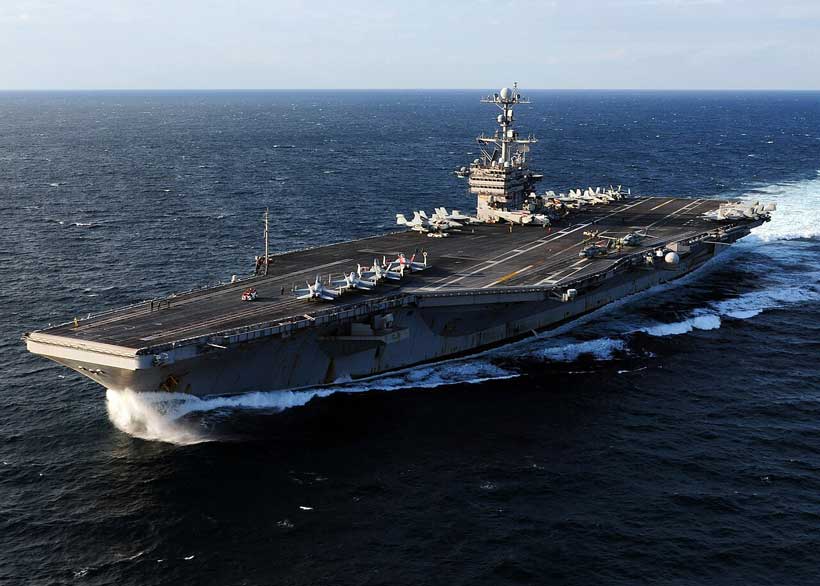
On July 30, 2026, international and domestic news sources simultaneously reported on the official visit of the aircraft carrier USS George Washington to Vietnam. The visit was seen as an affirmation of the US commitment to the Indo-Pacific region and a demonstration of its ability to continue leading the post-Cold War global order.
Unfavorable international context
Since becoming president for his second term, Donald Trump has pursued unilateral foreign policy strategies. This approach from the White House leader has caused concern among nations worldwide about a new form of American hegemony, using economics, trade, and tariffs as tools to deter power.
Donald Trump has implemented unprecedented escalation strategies. In South America, the Trump 2.0 administration has launched attacks on ships allegedly transporting drugs. Furthermore, the extradition of Venezuelan President Nicolas Maduro from Venezuela to the United States is a move that has caused concern among nations, particularly America’s partners and allies. This has severely diminished American influence.
In the Middle East, President Donald Trump’s administration unexpectedly escalated tensions by supporting Israel’s Operation Rising Lion in 2025. In 2026, President Trump decided to continue attacks on Iran to sever the China-Russia-Iran relationship, which White House policymakers viewed as a direct threat to U.S. national interests. The U.S. National Security Strategy (NSS2025) emphasized these three countries, with China holding a crucial position, potentially forcing the U.S. to adjust its approach. In reality, China provided the necessary support to prolong U.S. losses in the conflict with Iran. Furthermore, prolonging the conflict could bog the U.S. down in the Middle East, creating a power vacuum in other regions, particularly the Indo-Pacific, which President Trump had promoted in 2017.
Stay ahead of the geopolitical week.
MD Briefing delivers expert analysis across five global fronts — the Indo-Pacific, energy, geoeconomics, European security, and the Middle East — every Monday morning. Free.
Furthermore, the conflict in Europe, centered on Russia and Ukraine, shows no signs of ending. During his presidential campaign, Donald Trump repeatedly asserted that he would end the conflict after winning the election. However, the White House leader has yet to fulfill his promise to voters. This is due to support from countries outside the region, including China and Iran. The conflict has seen the involvement of China and Iran, with these two countries providing economic support, increasing trade cooperation, and supplying weapons on the ground to disrupt Washington’s strategic shift toward the Indo-Pacific region.
In the Indo-Pacific region, the rapidly escalating conflict between Thailand and Cambodia in the second and third quarters of 2025 reflected long-standing tensions between the two Southeast Asian nations. The Trump administration understood that a conflict in Southeast Asia, particularly between these two countries, would significantly strengthen China’s position and role. China had previously pursued various engagement strategies in Myanmar since the military junta took power. Furthermore, China had adopted a new approach of “administrative” and “localization” of the Taiwan Strait issue, turning it into an internal matter for Beijing with the goal of diminishing the motivation of the US and its allies to support Taiwan. This fueled speculation, with many senior US officials asserting the possibility of China annexing Taiwan by 2027. China also made moves that clashed with the Philippines at sea when the Marcos Jr. administration openly supported Taiwan, pledging support for Taipei as the island, along with Manila and Tokyo, successively carried out territorial demarcation at sea.
It is evident that under President Donald Trump’s administration, the United States has significantly weakened in terms of influence and leadership in the global order. Therefore, finding an alternative solution is extremely urgent for policymakers in Washington, D.C.
Vietnam – An ideal destination
Choosing Vietnam as the destination for the aircraft carrier USS George Washington highlights two important issues.
Firstly, Vietnam’s location is extremely advantageous from a geopolitical perspective. While Vietnam’s land area is only about 330,000 square kilometers, most of its provinces and cities border the South China Sea. This creates a huge advantage for Vietnam compared to other countries in the region. The United States recognized this from its invasion of Vietnam in the 20th century with the domino theory. Since the US pivot under President Barack Obama, Vietnam has become a crucial pillar of the US. Under Donald Trump, also in Da Nang, where the USS George Washington visited, the US announced its Indo-Pacific strategy in 2017 during the APEC 2017 conference. From a geopolitical perspective, mainland Southeast Asia and island Southeast Asia will form two arcs encircling the South China Sea. Accordingly, Vietnam will be the first country to encompass this sea region.
Secondly, Vietnam is considered a more balanced partner. Since implementing the Doi Moi policy in 1986, Vietnam’s consistent goal has been to cooperate and develop with countries around the world, guided by the principle of “being friends with all nations.” Vietnam also maintains the “four no’s” doctrine in its defense, creating a foundation of political trust for major powers, especially the US and China. While many countries experience conflicts and disputes, Vietnam has maintained its neutral position and role. Previously, Vietnam hosted the US-North Korea Summit during President Donald Trump’s first term. This reinforced Vietnam’s positive image with the US. Therefore, Vietnam will be a destination that White House policymakers will seek to strengthen the US’s role with partners and allies while ensuring that Vietnam will not be negatively affected by such visits.
The visit of the USS George Washington to Vietnam follows the visit of Acting Secretary of the Navy Hung Cao in June 2026. The USS George Washington is a Nimitz-class ship deployed at Yokosuka port, Japan. Commissioned in 1992, it serves as a symbol of America’s “peace built on strength.” This highlights Vietnam’s crucial role in the US’s security and foreign policy strategy over the next decade, potentially impacting US security and prosperity. Simultaneously, the USS George Washington’s visit reflects the implementation of US-approved documents and represents a strong commitment from the US to nations questioning the uncertainty of US foreign policy under President Donald Trump. By 2026, Vietnam will have hosted four aircraft carriers, including the USS Carl Vinson (2018), USS Theodore Roosevelt (2020), USS Ronald Reagan (2023), and USS George Washington (2026).
Conclusion
The visit of the USS George Washington to Vietnam on July 30, 2026, reflected the strong and consistent commitment of the United States under the Trump 2.0 administration to its partners and allies. Furthermore, the visit affirmed the development of Vietnam-US relations and reflected Vietnam’s increasingly important role in US security and foreign policy in the coming decade.
