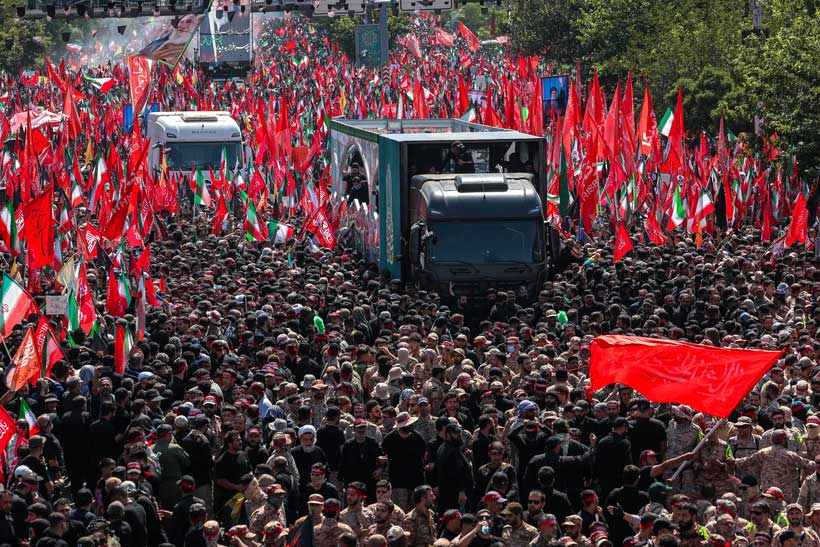
The march in Tehran on Monday, July 6, was, in size and scope, the high point of a ceremony that had begun several days earlier with tens of thousands gathering at Tehran’s Mosalla. Between the initial farewell ceremonies, the collective prayers, the presence of official delegations, and the main procession from Enghelab Avenue to Azadi Square, the crowd moved from a more limited ritual setting into a broader scene at the heart of the capital. Reuters could not independently verify the number of participants, but aerial images indicated the presence of hundreds of thousands on the day of the procession.
The significance of this pattern lies in the gradual expansion of public presence itself. Under ordinary circumstances, the death of a political leader can become a ceremony confined to the government’s loyal base. But when that death is the result of a direct attack by a foreign power, the funeral becomes a point of convergence for layers of society that, in daily life, are not necessarily aligned or moving in the same direction. In Tehran, those present were not in the streets for one single reason. Some came out of religious conviction; some to take part in a historic ritual; some to mourn; and some because they regarded the foreign attack as an assault on their country. It is precisely this diversity of motives that turns the ceremony from an official rite into a political sign.
This point matters for American policy. Iran has not been an easy adversary for Washington. There should be no naivety about the conduct of the Islamic Republic, its support for proxy forces, its pressure on domestic opponents, or its threats against America’s allies. But serious foreign policy begins with an accurate reading of reality, not with the assumption that eliminating a leader can pull a complex society onto Washington’s preferred path. The funeral in Tehran showed that, even in a society marked by deep internal divisions, a foreign attack can move the question from a dispute over government to the question of national ownership over the country’s destiny.
The central issue in Tehran’s streets was not merely the loss of a figure. The issue was who has the right to decide the fate of a country’s political leadership; who has the right to issue the sentence of removal; and what force can rewrite a nation’s political future through military attack. When the leader of a country is killed in a U.S.-Israeli strike, the message does not remain confined to Tehran. The message is that the political sovereignty of the targeted country does not enjoy absolute immunity before the will of a great power.
Stay ahead of the geopolitical week.
MD Briefing delivers expert analysis across five global fronts — the Indo-Pacific, energy, geoeconomics, European security, and the Middle East — every Monday morning. Free.
The Trump administration did not explain the operation against Iran merely in the limited language of defense. The White House spoke of destroying Iran’s missile, drone, naval, and industrial capabilities, and it presented the collapse of Iran’s command structure and leadership losses as part of the operation’s outcome. This language goes beyond deterrence. In such a framework, military power becomes a tool for determining the ceiling of a country’s defensive capacity, political capacity, and independent leadership.
For a conservative American outlook, this is where the danger lies. America is an unmatched power, but not every use of power increases security. The experience of Iraq and Afghanistan should have made one lesson clear: a military blow, even when it appears successful at first, cannot easily solve the problem of legitimacy, national identity, and the political future of another country. States do not collapse on a map. Societies respond to memory, pride, fear, and the feeling of humiliation. Sometimes the very attack meant to deepen internal fractures temporarily pushes those fractures under the shadow of an external threat.
That is the mistake made visible in Tehran. The rising scale of attendance at the ceremonies showed that an external assassination had activated something deeper than everyday political divisions: the right of the Iranian people to have the political fate of their country, whatever path they may choose in the future, decided in Tehran, not in Washington or Tel Aviv. This does not mean endorsing every policy of the Islamic Republic. It means that even critics of a government may, in the face of foreign attack, see the issue through the lens of national independence.
The consequences of this logic extend far beyond Iran. Small and medium-sized countries do not value the international order because they are attached to diplomatic communiqués; they value it as a shield against the deregulation of power. The principle of sovereign equality in the United Nations Charter was meant to prevent military strength from determining which country has a right to security and which country must simply endure the consequences of decisions made by others. When the assassination of political leaders becomes a tool of foreign policy, that principle is hollowed out from within.
In such a world, negotiation also loses its meaning. Why should a state trust security guarantees if it sees that the other side may target its political leadership even while talks are under way? Why should a country that feels its sovereignty is conditional on the satisfaction of great powers abandon its own efforts to strengthen deterrence? The result is not a calmer world. It is a more heavily armed, more distrustful, and more expensive world for America itself.
Trump did not understand this correctly. He assumed that a display of power could substitute for strategic calculation. But foreign policy is not a stage for the performance of personal pride. A decision that produces an image of resolve today may confront America tomorrow with harder enemies, more hesitant allies, and less credible negotiations. American power is effective when others understand that Washington distinguishes between deterrence and regime change, between defense and adventurism, and between pressure and the demolition of rules.
The funeral in Tehran did not determine Iran’s future. But it revealed a reality: the politics of assassination does not target only a political structure; it also stirs a nation’s sense of ownership over its country. When that feeling is awakened, the streets of a city can become a stage for the defense of a sovereignty that reaches beyond any individual, faction, or government.
A world in which great powers can shape the future of other countries by assassinating their leaders will not be safer or freer. Nor would such a world be a victory for America. It would be a world that values sovereignty according to each country’s military power; and for small and medium-sized states, such an order would mean nothing less than the real end of multilateralism.