


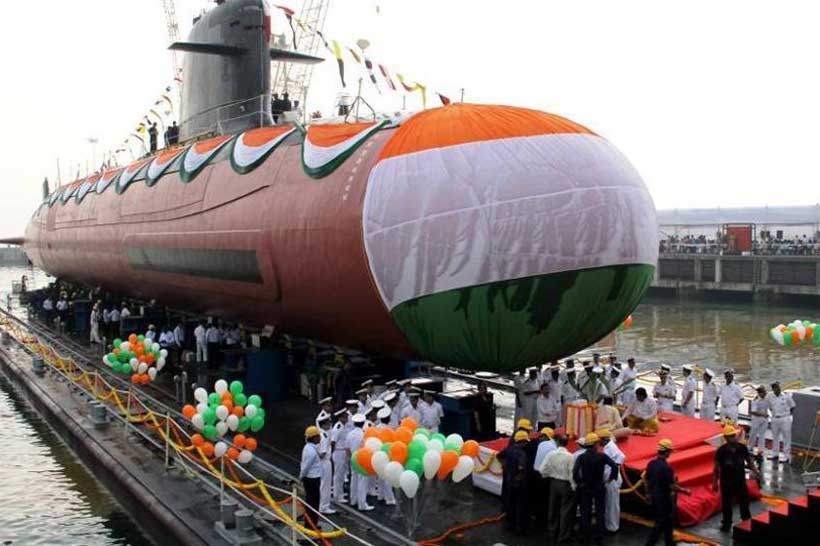
India has quietly crossed a threshold that Pakistan has no answer to —for the first time in the history of South Asian nuclear competition, one side may have nuclear warheads at sea, and the other has neither a submarine capable of carrying them nor a realistic timeline for acquiring one, and the gap is widening in a way that is restructuring the entire deterrence architecture of the subcontinent.
The 2026 SIPRI Yearbook buried the most significant development in South Asian nuclear history in a single hedged sentence. India, it said, may have started to deploy a small number of nuclear warheads on a single SSBN conducting occasional deterrence patrols. May. Small number. Single. Occasional. Every word doing careful work to qualify what the institute was not quite willing to state outright. Read past the hedging and what SIPRI is describing is the first time in the history of the India-Pakistan nuclear relationship that one side has probably put nuclear weapons to sea.
Pakistan has not, and maybe cannot. And the gap between those two sentences is the most important strategic development on the subcontinent since Islamabad tested its first bomb in 1998.
The opacity surrounding India’s submarine operations is deliberate. A submarine whose location, weapons load, and authorization status are unknown to the adversary is a submarine that cannot be targeted in a first strike. India has spent a decade building toward exactly that, while the rest of the world was watching something else.
Stay ahead of the geopolitical week.
MD Briefing delivers expert analysis across five global fronts — the Indo-Pacific, energy, geoeconomics, European security, and the Middle East — every Monday morning. Free.
From Proof of Concept to Operational Deterrent
The outside experts’ reaction to the commissioning of INS Arihant in 2016 was overwhelmingly that it was a technological feat and not a military. The submarine was armed with K-15 missiles having a range of 750 km, close enough to have to sail into open waters that could be tracked to hit anything of significance on the Chinese mainland. It is almost certain that its warheads were kept ashore in peacetime, as India has done for long, separating warheads from delivery systems. The dominant reading was that India has demonstrated its ability to construct a nuclear submarine, rather than its ability to construct a nuclear deterrent.
Ten years later, INS Arighat is equipped with the K-4 missile that has a range of 3,500 kilometres, well capable of hitting targets across a much larger radius and yet stay in the waters that the Navy may defend. INS Aridhaman came into the fleet in early 2026. INS Arisudan is anticipated to arrive in 2027. With four “on the water” SSBNs, there’s always one at sea, one in transit, one in maintenance and one in training, the minimum rotation needed to maintain a year-round patrolling submarine force. India has also hardened its preemptive attack submarine base on its eastern coast, excepted the name INS Varsha, and has an operational jetty in Agalega Island in the western Indian Ocean, where they can receive top-up without returning to the Indian coast, an area which is much larger.
What India did not announce was the doctrinal decision that SIPRI’s warhead assessment implies that India has shifted from storing nuclear warheads ashore to deploying them on submarines at sea. That decision, made somewhere between the commissioning of INS Arighat and the publication of the 2026 SIPRI Yearbook, is the one that changed everything.
Why Continuous Deterrence Changes the Entire Calculation
There is a version of India’s SSBN program that is strategically significant but manageable for Pakistan; the bastion model, where submarines operate in heavily defended home waters close to Indian shores, nuclear warheads stored separately, deterrence patrols infrequent. An adversary planning a disarming first strike against that kind of force has a targeting problem but not an impossible one. The submarines are probably in or near the Bay of Bengal. Their warheads are probably ashore. There is a window, however narrow, in which a sufficiently comprehensive strike might neutralize the sea-based leg of the triad before it can respond.
Continuous at-sea deterrence closes that window permanently. A submarine on continuous patrol, armed with nuclear-tipped missiles, somewhere in the Indian Ocean is not targetable by definition. Its location is unknown. Its warheads are already mated to its missiles. Its patrol area can extend from the Bay of Bengal to the waters near Agalega Island, covering millions of square kilometers. The geometry of a disarming first strike against such a force does not work regardless of how many missiles the adversary is willing to commit to the attempt.
Whether India is already operating continuous at-sea deterrence or is still in transition toward it is the genuine uncertainty in the current picture. The SIPRI assessment, the fleet size, the infrastructure at Varsha and Agalega, and signals from Indian strategic analysts all point toward CASD having already been operationalized or being very close to it. For Pakistan’s planners, the ambiguity itself is the operational reality they have to work with.
What Pakistan and India Have, and Why They Are Not Comparable
Pakistan’s sea-based nuclear capability is comprised of the Babur-3 cruise missile, which is believed to be potentially nuclear capable, to be deployed on conventional Agosta class submarines in 2027. The addition of a sea-based dimension to Pakistan’s deterrent is a first with the Babur-3. But a nuclear-tipped cruise missile on a diesel-electric subs is different in kind from a ballistic missile on a nuclear-powered SSBN, and to see a resemblance between the two on the basis of both being submarine-launched and using nuclear power is one of the more significant analytical mistakes in existing South Asian security reporting.
The conventional submarines have to surface or snorkel frequently to recharge their batteries, and are thus detectable. They last for weeks and not months. They have no ability to maintain continuous long range patrol with the necessary second strike survivability. An opponent patrolling an existing submarine has some tools at his disposal, such as surface ships, fixed underwater sensors, and patrol aircraft — but none is of much use against a submarine powered by a reactor that can stay submerged for months.
Leaked diplomatic cables reported in May 2026 described Pakistani requests to China for nuclear-powered submarines and SLBMs. If those reports are accurate, Islamabad understands precisely the gap being described here and is trying urgently to close it through China’s patronage. Whether Beijing will transfer nuclear propulsion technology to Pakistan, with all the proliferation complications that would create, the damage to China’s international relationships, and the countermeasures it would accelerate from India, is genuinely uncertain. China has strategic interests in Pakistani security but also strategic interests in not triggering a destabilization that harms its own regional position.
The Submarines Were Never Really About Pakistan
India’s SSBN program was designed around China, not Pakistan, and Pakistan pays the strategic cost of a capability built for a different adversary. An Indian SSBN carrying K-4 missiles has to navigate to the northernmost reaches of the Bay of Bengal to bring major Chinese political and economic centers within range. The geographic constraints are real: China’s landmass extends far inland, its political and industrial centers are deep in the country’s interior, and bringing them within a 3,500-kilometer radius from the Bay of Bengal requires sailing into waters that are increasingly contested as Chinese maritime power grows.
Chinese SSBNs face no equivalent constraint with respect to India. Armed with JL-3 missiles and operating from the South China Sea, they can hold any point on Indian territory at risk without entering the Indian Ocean at all. India’s SSBN program is a response to that asymmetry , an attempt to build a survivable second-strike capability against China that does not depend on land-based missiles alone. India’s next generation of submarines, the larger S5-class, will almost certainly carry longer-range missiles specifically to address this geographic problem.
The submarines India deploys to deter China look identical from outside to submarines deployed to deter Pakistan. The K-4 missile’s range covers Pakistani territory from the Bay of Bengal regardless of the intended target. The command and control architecture functions the same way in a crisis with China as in a crisis with Pakistan. India’s China-driven expansion generates strategic anxiety in Islamabad that New Delhi’s planners did not primarily design for and cannot easily address without undermining the opacity that makes the deterrent work.
The Control Architecture and What It Means for Crisis Stability
The Indian Navy commands the day-to-day running of the submarines, that is, the selection of crew, maintenance, navigation, and so on. During a deterrent patrol, the Strategic Forces Command holds all the keys to success in a crisis: custody of the nuclear warheads, mating of warheads with missiles, authorization to launch, and command of the submarine. The Prime Minister presides over the Nuclear Command Authority which is the highest body for authorization.
On land, this architecture works well because communication between political authorities and launch platforms is reliable and the authorization chain can be rehearsed. At sea, the same architecture creates tensions that have no clean solution. A submarine on continuous deterrent patrol in the middle of the Indian Ocean is far from the shore-based communication infrastructure that the authorization chain depends on. The communication links that carry launch authorization orders are themselves potential targets in a nuclear conflict, hardening them, building redundancy into them, and ensuring they function under degraded conditions is one of the hardest problems in nuclear command and control. India is now operating in the space where this has to be solved in practice rather than in theoretical planning documents.
The Scenarios
Base case (~55%): India completes the four-boat Arihant fleet by 2027 and establishes routine continuous at-sea deterrence. Pakistan fields the Babur-3 on conventional submarines, adding limited sea-based nuclear reach without closing the fundamental gap. The asymmetry grows but both sides manage it within the existing deterrence framework, and South Asian nuclear stability holds at a new and less comfortable equilibrium.
Downside case (~30%): A crisis — another cross-border military incident like 2019 or 2025 — occurs while India has an SSBN on continuous deterrent patrol. The opacity of submarine operations, compressed crisis timelines, and dual-key authorization pressures add a dimension of uncertainty to crisis management that land-based deterrence did not produce. Neither side has practiced managing this at sea, and the consequences of miscalculation in that environment are categorically different from those of miscalculation on land.
Upside case (~15%): India and Pakistan establish a bilateral communication mechanism addressing sea-based nuclear forces — hotlines, pre-notification protocols, or transparency measures reducing miscalculation risk. Given India’s deliberate opacity posture and Pakistan’s incentive to avoid legitimizing India’s sea-based advantage, this remains the least likely scenario. The 2007 Agreement on Reducing the Risk from Accidents Relating to Nuclear Weapons shows such measures are not impossible, but the political conditions that produced that agreement do not currently exist.
South Asia Has a New Nuclear Reality
For thirty years, South Asian nuclear deterrence operated on a logic both sides understood. Land-based missiles, aircraft, rough geographic knowledge of where the weapons were and what they could hit. The deterrence was mutual, visible, and built on shared assumptions about what each side’s arsenal looked like and how it would be used.
The sea dissolves those assumptions. A submarine on continuous deterrent patrol is invisible, always ready, and survivable against any first strike India’s adversaries could plausibly mount. It transforms India’s nuclear posture from one where the question in a crisis is whether India’s retaliatory capability would survive a preemptive attack into one where that question has already been answered. The SIPRI assessment that India may have already crossed this threshold is the most significant development in South Asian nuclear strategy since Pakistan tested its first bomb in 1998.
Pakistan’s response, the Babur-3 program, the Chinese submarine requests, the leaked diplomatic cables — reflects a government that understands the shift and is trying to respond with the resources available. Those resources are not equal to the challenge on any timeline that matters for the current strategic environment. Whether Pakistan finds in China’s patronage what its own industrial capacity cannot provide, and whether Beijing judges that transfer worth the cost, are the questions that will shape South Asian nuclear stability for the next generation.
