


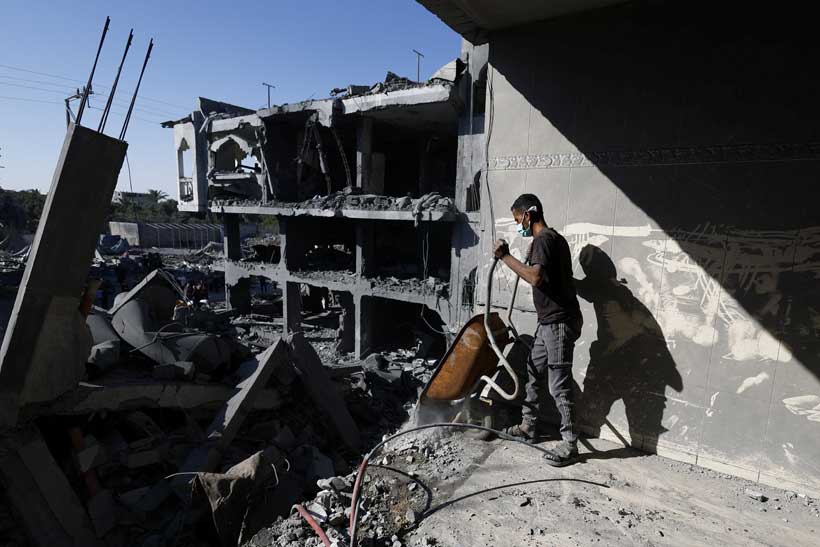
An Israeli airstrike killed three members of the same family, including a six year old girl, in central Gaza on Wednesday as efforts to advance the next phase of a United States brokered ceasefire agreement showed little progress. The latest violence underscores the fragile nature of the October truce, which has reduced large scale fighting but failed to end deadly exchanges between Israel and Hamas.
Family Killed in Central Gaza
Palestinian health officials said an Israeli airstrike hit an apartment building in Deir Al Balah, killing Omar Abu Qassem, his wife Asma, and their six year old daughter Habeeba.
Their son survived the attack but sustained injuries.
The Israeli military said the strike targeted a Hamas militant but did not immediately provide further details.
Stay ahead of the geopolitical week.
MD Briefing delivers expert analysis across five global fronts — the Indo-Pacific, energy, geoeconomics, European security, and the Middle East — every Monday morning. Free.
In a separate incident, an Israeli airstrike in Sheikh Radwan neighborhood in Gaza City killed another person, according to Palestinian medics. Israel did not immediately comment on that strike.
Violence Continues Despite Ceasefire
According to Gaza health officials, more than 1,100 Palestinians, most of them civilians, have been killed in Israeli attacks since the October ceasefire came into effect.
While the agreement largely halted full scale military operations, near daily Israeli strikes have continued across the enclave.
Israel says it continues targeting Hamas militants and military infrastructure, while Hamas has continued sporadic attacks that have killed four Israeli soldiers since the ceasefire began.
Peace Talks Make Little Progress
The latest violence coincided with another round of negotiations in Cairo aimed at implementing the second phase of the United States brokered peace initiative.
The talks, mediated by Egypt, Turkey, and Qatar, focused on several key issues, including:
- Hamas disarmament.
- Israeli military withdrawal from Gaza.
- The transfer of governance to a United States backed Palestinian technocratic administration.
- Deployment of an international stabilization force.
- Reconstruction of Gaza.
Officials involved in the negotiations said little progress had been achieved because of deep mistrust between the two sides.
International Force Yet to Deploy
Five countries including Indonesia, Morocco, Kazakhstan, Kosovo, and Albania have pledged troops for a proposed International Stabilization Force intended to help maintain security after any broader agreement.
However, no deployment has taken place as negotiations remain deadlocked.
Nickolay Mladenov, the Board of Peace envoy for Gaza, said this week that Morocco was expected to formalize its contribution to the mission, expressing hope that international forces could eventually begin operations.
Disagreements Over Ceasefire Terms
Hamas maintains that Israel has failed to fully implement the commitments contained in the first phase of the ceasefire agreement.
One of the principal disputes concerns Israeli troop withdrawals.
Under the agreement, Israeli forces were expected to reposition behind agreed security lines, but Hamas argues that Israeli troops have instead expanded their presence and now control more than 60 percent of Gaza.
Israel, meanwhile, insists that any further withdrawals depend on Hamas agreeing to disarm and relinquish control of the territory.
These unresolved issues continue to prevent negotiations from advancing to the next phase.
Humanitarian Situation Remains Severe
Nearly all of Gaza’s approximately 2 million residents remain displaced, with many living in temporary shelters, damaged buildings, or overcrowded camps.
The humanitarian crisis continues despite the reduction in major combat operations, with repeated airstrikes, damaged infrastructure, and shortages of essential services affecting daily life across the territory.
Why This Matters
The latest civilian casualties illustrate the limits of the current ceasefire, which has reduced but not eliminated violence. As negotiations remain stalled, both humanitarian conditions and regional stability remain vulnerable to renewed escalation. Without progress toward implementing the next phase of the agreement, the risk of a return to broader conflict continues to grow.
Analysis
The Gaza ceasefire has increasingly become a fragile pause rather than a durable peace agreement. While large scale fighting has subsided, continued Israeli airstrikes and unresolved political disputes demonstrate that the underlying issues driving the conflict remain largely unaddressed.
The negotiations face two fundamental obstacles. Israel views Hamas’s continued military capabilities as incompatible with long term security, while Hamas argues that Israel must first fulfill its existing obligations under the ceasefire before discussions can move forward. This sequencing dispute has effectively stalled diplomacy.
The proposed international stabilization force could eventually provide a mechanism for managing security during a political transition, but its deployment depends on agreements that remain distant. Until both sides bridge differences over disarmament, territorial control, and governance, sporadic violence is likely to continue despite the formal ceasefire, leaving civilians on both sides exposed to ongoing insecurity.
With information from Reuters.
