


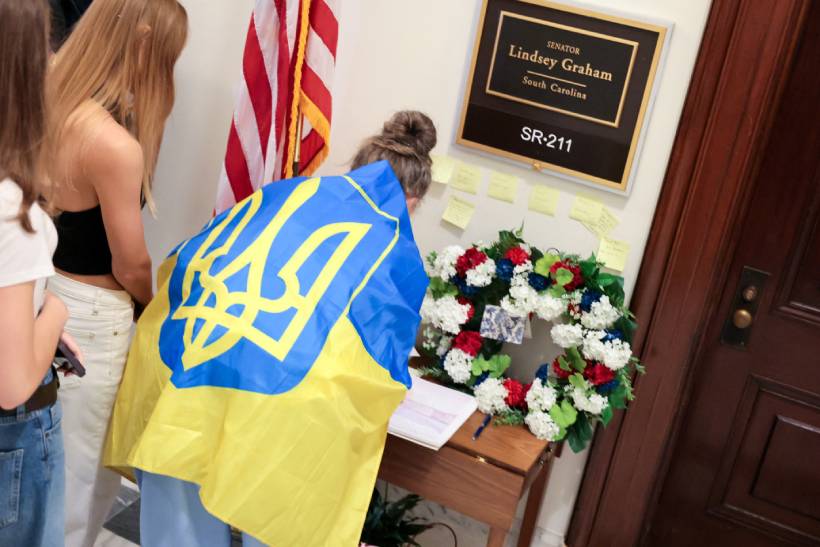
The death of United States Senator Lindsey Graham has created fresh uncertainty over the future of Washington’s support for Ukraine at a critical stage in the war with Russia. Graham was one of Kyiv’s strongest advocates in Congress and one of the few Republican lawmakers with direct access to President Donald Trump, allowing him to influence White House policy on sanctions, military aid, and strategic cooperation.
While many lawmakers have pledged to continue Graham’s initiatives, analysts say replacing his unique political influence will be difficult. His death comes as Ukraine faces intensified Russian attacks, renewed debates over military assistance, and uncertainty over whether Congress will approve tougher sanctions on Moscow.
Who Was Lindsey Graham for Ukraine?
For more than two decades, Lindsey Graham was one of the Republican Party’s leading foreign policy voices. Since Russia’s full scale invasion of Ukraine in February 2022, he emerged as one of Kyiv’s most consistent supporters in Washington.
Unlike many lawmakers, Graham maintained a close personal relationship with both President Donald Trump and Ukrainian President Volodymyr Zelenskiy.
Stay ahead of the geopolitical week.
MD Briefing delivers expert analysis across five global fronts — the Indo-Pacific, energy, geoeconomics, European security, and the Middle East — every Monday morning. Free.
He visited Ukraine 10 times during the war, regularly met Ukrainian officials, and publicly argued that continued United States support was essential for European security and for deterring authoritarian powers worldwide.
His greatest political advantage was his ability to communicate directly with Trump at times when many other Republican supporters of Ukraine struggled to influence the president.
The Russia Sanctions Bill
One of Graham’s most important priorities was the Sanctioning Russia Act, legislation designed to significantly increase economic pressure on Moscow.
The bill seeks to punish countries that continue purchasing Russian:
- Oil
- Natural gas
- Uranium
Its objective is to reduce Russia’s energy revenues, which remain a key source of funding for its military campaign.
Although the legislation gained 85 bipartisan co sponsors in the Senate, it remained stalled because of resistance from the White House.
Just one day before his death, Graham announced that he had finally secured an agreement with the Trump administration to move the legislation forward.
Many senators now hope Congress will pass the bill both as a strategic measure against Russia and as a tribute to Graham’s legacy.
Military Aid Could Face Greater Challenges
Beyond sanctions, Graham consistently advocated stronger military assistance for Ukraine.
He supported:
- Patriot air defense systems
- Missile production cooperation
- Expanded weapons transfers
- Long term security commitments
- Intelligence cooperation
His lobbying helped improve relations between Kyiv and Trump during periods of political tension.
Last year he also played a central role in negotiating a critical minerals agreement that gave the United States preferential access to future Ukrainian mineral projects in exchange for investment.
More recently, Trump announced that Ukraine would receive licenses to manufacture Patriot interceptor missiles domestically, an initiative Graham strongly supported.
However, Ukraine continues to emphasize that immediate deliveries of defensive weapons remain more urgent than future production capacity.
Why Graham Was Difficult to Replace
Analysts argue that Graham’s influence extended far beyond committee hearings or public speeches.
He served as an informal bridge between:
- Congress and the White House.
- Republicans and Democrats.
- Kyiv and the Trump administration.
Few Republican lawmakers enjoyed comparable access to Trump.
His ability to persuade the president privately often proved more valuable than public congressional debates.
This influence became especially important as many Republicans adopted a more cautious approach toward supporting Ukraine after Trump’s return to office in January 2025.
Several other senior Republican supporters of Ukraine, including former Senate leader Mitch McConnell, are also preparing to leave Congress, further reducing Kyiv’s network of experienced allies.
Will United States Policy Change?
Despite concerns, Graham’s death does not automatically mean a reversal of United States policy toward Ukraine.
Several factors suggest continued support:
Strong bipartisan backing
The Russia sanctions legislation already enjoys overwhelming bipartisan support in the Senate.
Institutional momentum
Military cooperation between Washington and Kyiv now involves long term industrial partnerships, intelligence sharing, and defense production agreements that extend beyond any single politician.
Trump’s recent policy shift
In recent weeks Trump has adopted a noticeably more supportive tone toward Ukraine.
He has endorsed licensed production of Patriot interceptors and appears increasingly willing to allow Congress to vote on tougher sanctions against Russia.
Nevertheless, uncertainty remains.
Without Graham acting as an intermediary, disagreements between Congress and the White House could become more difficult to resolve.
Political Reactions
President Volodymyr Zelenskiy described Graham’s death as a personal loss, noting they had remained in constant contact and met twice during the senator’s final visit to Ukraine.
Democratic Senator Jeanne Shaheen and several Republican lawmakers have proposed passing the Russia sanctions bill as Graham’s legacy, with some suggesting it should even bear his name.
Senate Majority Leader John Thune also called passage of the legislation an appropriate tribute to Graham’s decades of public service.
Why This Matters
Lindsey Graham represented something increasingly rare in Washington’s polarized political environment: a Republican with both strong pro Ukraine views and significant influence over President Trump.
His death removes one of Kyiv’s most effective advocates at a time when the war is entering another difficult phase. While institutional support for Ukraine remains substantial, personal relationships often play an outsized role in shaping United States foreign policy, particularly under the Trump administration.
Whether Congress can maintain bipartisan momentum without Graham may influence not only future sanctions but also military assistance and broader diplomatic engagement with Ukraine.
Analysis
Graham’s passing is unlikely to produce an immediate shift in United States policy, but it could gradually reshape the political dynamics surrounding Ukraine. His influence was rooted less in his legislative position than in his personal relationship with President Trump, allowing him to bridge the gap between a White House that has often been skeptical of deeper involvement in Ukraine and a bipartisan coalition in Congress seeking stronger action against Russia.
The sanctions bill may still pass because of its broad bipartisan support and the symbolic significance it has acquired following Graham’s death. However, future military assistance could face greater political hurdles. Weapons transfers and funding packages require sustained presidential backing, and without Graham serving as an intermediary, advocates for Ukraine may find it harder to persuade Trump during moments of disagreement.
At the same time, the institutional relationship between Washington and Kyiv is now far more developed than it was in the early years of the war. Joint defense production, intelligence cooperation, and long term industrial partnerships have created strategic ties that extend beyond the influence of any individual lawmaker. These structures provide a degree of continuity even as political leadership changes.
Looking ahead, the direction of United States policy will depend less on finding a direct replacement for Graham and more on whether other Republican leaders choose to embrace his internationalist approach or align more closely with voices advocating reduced American involvement overseas. The outcome will shape not only Ukraine’s military position but also the credibility of Western efforts to sustain long term pressure on Russia.
With information from Reuters.
