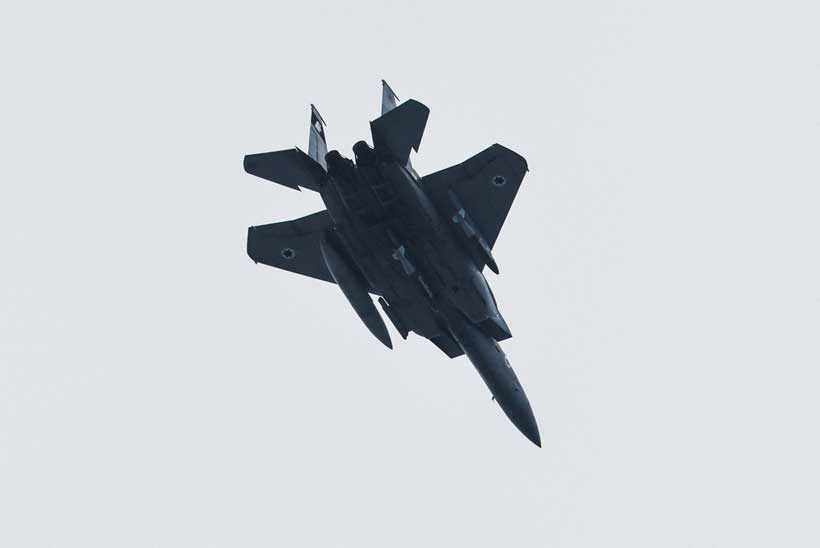
In March, Israeli F-35s struck three sites in central Syria that Turkish planners had quietly earmarked for a future airbase. No Turkish soldier had set foot there yet — Ankara had not finished the paperwork. But the message needed no translation: Israel would rather bomb a location pre-emptively than let Turkish forces operate from it. Ankara absorbed the hit and abandoned the deployment. It did not retaliate. That single, barely-reported decision — swallowing a strike on territory it did not yet occupy, from a state its own president now routinely accuses of genocide — reveals more about the odds of a Turkish-Israeli war than any speech Recep Tayyip Erdoğan or an Israeli minister has given this year. Two of the region’s most capable militaries are close enough to a shooting war that one is bombing the other’s future infrastructure in advance. Neither has pulled the trigger on anything more.
Background
Turkey and Israel were quiet security partners for decades, cooperating on intelligence and defence contracts even through periodic diplomatic spats. That relationship collapsed after October 2023, and Ankara suspended trade with Israel outright in May 2024, a rupture worth roughly $7 billion a year to both economies. The vacuum left by Bashar al-Assad’s fall in December 2024 reopened the fight properly: Turkey backs Damascus’s new government under Ahmed al-Sharaa and wants a strong, centralised Syrian state on its border, partly to finish off its own decades-long Kurdish insurgency. Israel wants the opposite — a fragmented, weakened Syria unable to host hostile forces — and has struck Syrian territory roughly three times more often since Assad fell than in the previous seven years combined. In December, Israel formalised a security pact with Greece and Cyprus, meeting in Jerusalem, that Turkish officials read as a deliberate encirclement strategy. The one thing holding the rivalry short of war is a technical deconfliction channel the two militaries built via Azerbaijani mediation in 2025 — which both governments insist, pointedly, is not a step toward normalisation.
Behind Rhetoric
Stay ahead of the geopolitical week.
MD Briefing delivers expert analysis across five global fronts — the Indo-Pacific, energy, geoeconomics, European security, and the Middle East — every Monday morning. Free.
Start with what the rhetoric obscures: Turkey cannot currently fight Israel and win, and its own general staff knows it. Erdoğan’s promised “Steel Dome” air-defence shield will not be operational before 2030. The Altay main battle tank, unveiled with fanfare as a symbol of Turkish military self-sufficiency, has three units in active service. Turkey’s F-16 fleet needs upgrades that require American sign-off, sign-off Washington has been slow to give precisely because of where the planes might end up being used. The Kaan fifth-generation fighter and the Kızılelma drone are real programmes, not vapourware, but they are years from meaningful numbers. A 30% increase in Turkey’s defence budget sounds significant until you set it against domestic inflation running close to the same rate. None of this is secret to Ankara. It is why Turkish officials describe the Azerbaijani-mediated deconfliction line as “strictly technical” rather than disowning it: they need it as much as Israel does.
This is where most coverage of the rivalry gets the mechanism wrong. The danger is not that Erdoğan decides one morning to order an attack — his government has been careful, for all its rhetoric, never to convert words into troop movements against Israeli forces. Ankara has identified its own red lines instead: large-scale Israeli occupation of southern Syria, a direct threat to al-Sharaa’s survival, or the collapse of talks to integrate the Kurdish-led Syrian Democratic Forces into Syria’s national army. Notice what all three have in common — none of them require Turkey to attack Israel directly. They describe conditions under which Turkey might feel compelled to move troops inside Syria, into space where Israeli aircraft already operate freely and where Israel has shown, in March, that it will strike first and explain later.
The strongest objection to calling this “unlikely” is a real one: two ideologically opposed regional powers, each building out serious defence industries, each convinced the other is expanding into its sphere of influence, is close to a textbook recipe for a war neither side intends. Rising, insecure powers colliding at their frontiers is not a new story, and it is not one confined to history books — the same dynamic has produced accidental wars between far better-matched militaries than these two. That objection deserves a direct answer rather than a shrug: what makes this case different is that both militaries are already operating inside a third country, under an active deconfliction mechanism, with a shared external patron in Washington that has strong reasons to prevent a NATO member and a key regional security partner from shooting at each other. That combination does not eliminate the risk of a clash — it relocates it, from a deliberate Turkish-Israeli war to an accidental one triggered by events inside Syria that neither Ankara nor Jerusalem is fully steering. The SDF integration deadline is the clearest example: if it collapses and Turkey moves forces toward territory held by the YPG — the Kurdish militia at the SDF’s core, and the group Ankara considers a Syrian offshoot of the PKK insurgency it has fought for decades — territory Israel has quietly been arming for years, the two militaries’ actual, physical presences converge in the same contested space for the first time. Everything since March has been a rehearsal for exactly that scenario — including the restraint each side has shown, which is the part of the story most coverage skips.
The Scenarios
Base case — roughly 65% likely: The shadow rivalry continues largely as it has for the past year. Rhetoric intensifies on both sides — Erdoğan needs the anti-Israel posture domestically, particularly as he manages Turkey’s economy and positions for the 2028 election, and Israeli officials have stopped pretending to be diplomatic about it. The deconfliction line holds because both militaries have more to lose from losing it than from using it. No direct clash occurs through 2027.
Downside case: SDF integration into Syria’s national army formally collapses, and Turkey moves special forces or proxy units toward Kurdish-held territory in Syria’s northeast that Israel has been quietly supplying. An Israeli strike intended to protect that supply relationship kills Turkish-linked personnel — not necessarily uniformed Turkish soldiers, but forces close enough to Ankara that the distinction stops mattering politically. Erdoğan faces domestic pressure to respond with more than words for the first time. The likely outcome is still not war — a symbolic, contained retaliation, probably against a Syrian target rather than Israeli territory — but it is the scenario that most readers are underpricing, because it does not require either government to want a war, only for the Syrian battlefield to force one government’s hand.
Upside case: A Gaza ceasefire that actually holds through 2026, combined with Washington leaning on both capitals, produces a formal upgrade of the deconfliction channel and a partial resumption of Turkish-Israeli trade — driven less by goodwill than by Turkey’s inflation problem and its need for the defence-industrial supply chains Israeli sanctions currently disrupt. Rhetoric would not disappear, but it would visibly decouple from policy.
What to watch
The question “how possible is a Turkey-Israel war” has an answer that will frustrate anyone looking for a clean yes or no: not very possible as a deliberate act by either government, and dangerously possible as an accident neither government chooses. The rhetoric is real, but it is not the mechanism — Ankara’s capability gap and its dependence on the deconfliction line with Israel are doing more to prevent war than any diplomatic effort is. What would actually change that picture is not another Erdoğan speech. It is what happens inside Syria, specifically around the SDF’s integration into al-Sharaa’s national army. Watch that process closely over the coming months: if it collapses and Turkish-aligned forces move into territory Israel has been arming, that is the moment the shadow rivalry stops being shadow. Everything else is noise.