


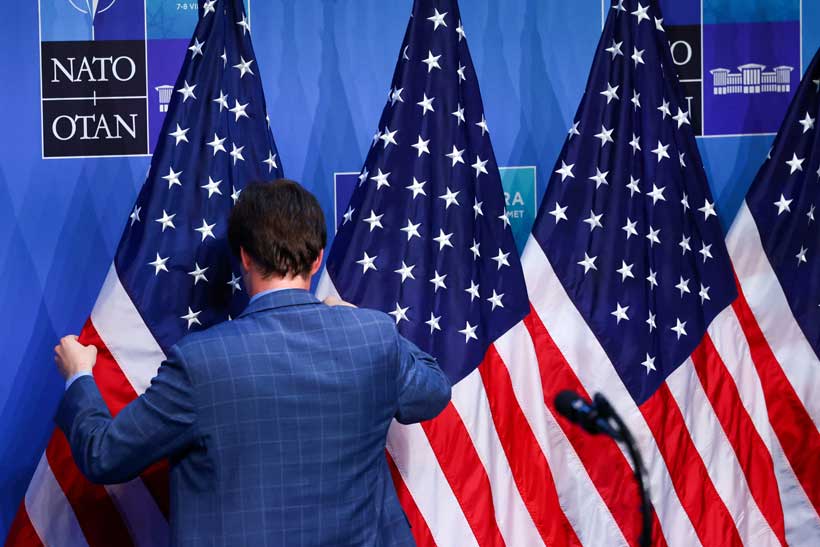
NATO leaders emerged from their summit in Ankara relieved that U.S. President Donald Trump reaffirmed Washington’s commitment to the alliance, but European officials acknowledge that relations with the United States remain fragile and expect further periods of uncertainty.
While the gathering ended on a positive note, diplomats say the alliance continues to face questions over Trump’s long-term approach to NATO, burden sharing and Europe’s security.
Summit ends on a more positive note
The two-day summit began amid fresh tensions after Trump criticized several allies, announced he wanted to cut off U.S. trade with Spain, and revived disputes over defense spending.
However, the atmosphere improved significantly by the end of the meeting.
Stay ahead of the geopolitical week.
MD Briefing delivers expert analysis across five global fronts — the Indo-Pacific, energy, geoeconomics, European security, and the Middle East — every Monday morning. Free.
Trump endorsed the summit declaration reaffirming NATO’s Article 5 mutual defense commitment, praised the unity among allies, and approved a license allowing Ukraine to manufacture Patriot missile interceptors.
European leaders viewed those moves as an important signal that Washington remains committed to the alliance despite months of increasingly strained relations.
Trump also described the summit as one filled with “love,” easing fears that the gathering could end in open confrontation.
European allies remain cautious
Despite the improved tone, European governments are preparing for continued volatility in transatlantic relations.
Officials note that Trump’s approach toward NATO has often shifted rapidly, creating uncertainty over U.S. security commitments.
Recent disputes have included Trump’s renewed interest in Greenland, criticism of allies during the Iran conflict, and repeated suggestions that European members should assume greater responsibility for their own defense.
Many European capitals believe maintaining strong ties with Washington remains essential despite these disagreements.
Without U.S. military capabilities, officials fear NATO’s ability to deter Russia would be significantly weakened.
Rutte emphasizes America’s central role
NATO Secretary General Mark Rutte stressed that the United States remains the alliance’s indispensable military power.
He noted that the U.S. economy accounts for roughly half of NATO’s combined economic strength and that American military capabilities remain unmatched within the alliance.
According to Rutte, NATO’s credibility and deterrence against Russia remain intact despite recent political tensions.
Not everyone shares that optimism.
Some former U.S. defense officials argue that repeated political disputes have already damaged perceptions of alliance unity and provided Moscow with opportunities to question NATO’s cohesion.
Several European diplomats privately acknowledged that while the summit avoided a major crisis, it did little to erase concerns created over recent months.
Defense spending helps ease tensions
One factor that helped calm relations was Europe’s significant increase in defense spending.
Trump has long argued that NATO members rely too heavily on the United States for their security.
Ahead of the summit, NATO officials highlighted large increases in military spending by European members and Canada, presenting the figures as evidence that Trump’s pressure has produced tangible results.
Alliance officials also emphasized billions of dollars in new defense procurement agreements announced during a defense industry forum held before the summit.
The deals covered surveillance aircraft, transport planes, drones and other military equipment worth more than $50 billion.
The announcements were intended to demonstrate that allies are translating higher defense budgets into concrete military capabilities.
NATO counters criticism over Iran conflict
Alliance officials also sought to push back against Trump’s criticism that NATO members failed to support the United States during the conflict with Iran.
Officials argued that, with the exception of Spain restricting U.S. access to military facilities, most allies honored existing agreements governing American military operations.
Those efforts were designed to reassure Washington that European allies remain reliable security partners even when political disagreements arise.
Pentagon review adds fresh uncertainty
Despite the summit’s relatively positive conclusion, uncertainty remains over America’s future military posture in Europe.
The Pentagon has already reduced some of the forces allocated to NATO defense plans and recently launched a review of approximately 80,000 U.S. troops stationed across Europe.
The review has fueled concerns that Washington could further reduce its military presence on the continent as European governments work to strengthen their own defense capabilities.
European leaders seek fewer flashpoints
Several officials suggested NATO may reduce the frequency of high-profile leaders’ summits to avoid repeated political confrontations.
Plans for a NATO leaders’ meeting in Albania next year have reportedly been put on hold as alliance members reassess the format of future gatherings.
Some diplomats believe limiting opportunities for public disputes could help preserve alliance unity while allowing practical cooperation to continue behind the scenes.
Why the Ankara summit mattered
The Ankara summit represented an important test of NATO’s ability to manage internal political differences while maintaining collective security.
Turkey, as host nation, sought to strengthen its standing within the alliance and improve relations with Washington, while NATO leadership worked to keep attention focused on defense cooperation rather than political disagreements.
Although tensions remain, the summit demonstrated that both the United States and European allies continue to recognize the strategic importance of NATO amid Russia’s war in Ukraine and growing global security challenges.
Future outlook
The immediate crisis surrounding the Ankara summit may have eased, but European governments expect relations with the Trump administration to remain unpredictable.
Future disagreements over defense spending, U.S. troop deployments, support for Ukraine, trade disputes and broader geopolitical issues are likely to continue testing alliance unity.
For now, NATO leaders appear determined to strengthen Europe’s military capabilities while keeping the United States firmly engaged, recognizing that preserving transatlantic cooperation remains central to the alliance’s long-term security strategy.
With information from Reuters.
