


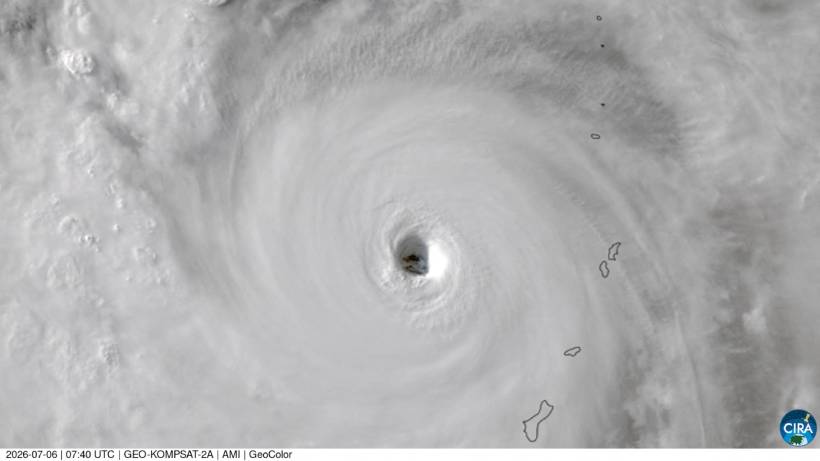
China is facing another severe test of its disaster preparedness after deadly floods swept through parts of the south this week. Scientists have warned that the combination of climate change and the expected emergence of a strong El Niño pattern could make the 2026 typhoon season one of the most active in recent years, increasing the risk of floods, landslides and widespread infrastructure damage.
Flood disaster expands as Super Typhoon Bavi approaches
The floodwaters that devastated southern China this week are expected to spread to more provinces as Super Typhoon Bavi approaches, with forecasters warning the powerful storm could compound an already worsening humanitarian situation.
China’s National Climate Center expects up to six typhoons to develop in the Northwest Pacific and South China Sea during July, significantly above the long-term average of 3.8. Up to three are forecast to make landfall in China, compared with the historical average of 1.8, while the storms are also expected to be more intense than usual.
China is bracing for Super Typhoon Bavi on Saturday, just days after Typhoon Maysak battered the country’s southern coast.
Stay ahead of the geopolitical week.
MD Briefing delivers expert analysis across five global fronts — the Indo-Pacific, energy, geoeconomics, European security, and the Middle East — every Monday morning. Free.
Scientists link stronger storms to climate change and El Niño
Climate scientists say rising global temperatures are increasing the frequency and intensity of extreme weather events across China.
This year’s risks are being amplified by the anticipated development of a strong El Niño, which typically raises ocean temperatures and creates conditions favourable for more powerful typhoons across the Asia-Pacific region.
Benjamin Horton, dean of the School of Energy and Environment at City University of Hong Kong, warned that communities have little time to recover between increasingly destructive weather events.
He said stronger cyclones later this year could bring unprecedented rainfall, triggering floods, landslides, crop losses and greater risks to human life.
Typhoon Maysak leaves widespread destruction
Typhoon Maysak struck China’s southern island province of Hainan last week before moving into Guangxi, where it caused extensive flooding and infrastructure damage.
The storm’s remnants also generated at least two inland tornadoes in central China.
Authorities said at least six people have died in Guangxi while around 375,000 residents have been affected, with officials warning the death toll could rise as rescue operations continue.
Reservoir failures worsen flooding in Guangxi
The city of Hengzhou became the epicentre of the disaster after heavy rainfall caused reservoir failures that unleashed torrents of muddy floodwater across downstream villages and farmland.
State broadcaster CCTV reported that floodwaters reached the second floors of some homes, forcing residents onto rooftops while rescue teams struggled to reach isolated communities.
Social media posts described hundreds of people stranded in mountainous areas awaiting emergency assistance, although Reuters could not independently verify those reports.
Hengzhou, home to more than one million people, contains six medium-sized reservoirs and nearly 200 smaller ones. It is also the starting point of a 70-billion-yuan ($10.3 billion) canal project scheduled to open later this year.
Experts warn 2026 typhoon season could be unusually severe
Hui Su, chair professor of the Department of Civil and Environmental Engineering at the Hong Kong University of Science and Technology, said the impacts of Maysak and the approaching Super Typhoon Bavi suggest that 2026 is shaping up to be a far more destructive typhoon season than normal.
He said El Niño is expected to shift typhoon tracks westward towards China’s coastline, while climate change is making storms wetter and more damaging.
The World Meteorological Organization also raised its forecast last week for the rapid development of a strong El Niño in the coming months.
Future outlook
China is likely to face a prolonged period of elevated weather risks through the remainder of the typhoon season, with additional storms expected to test flood-control infrastructure, emergency response systems and agricultural resilience. As climate change and El Niño reinforce one another, scientists warn that extreme rainfall and stronger cyclones could become increasingly common, underscoring the need for greater investment in disaster preparedness, resilient infrastructure and early-warning systems to reduce future economic and human losses.
With information from Reuters.
