


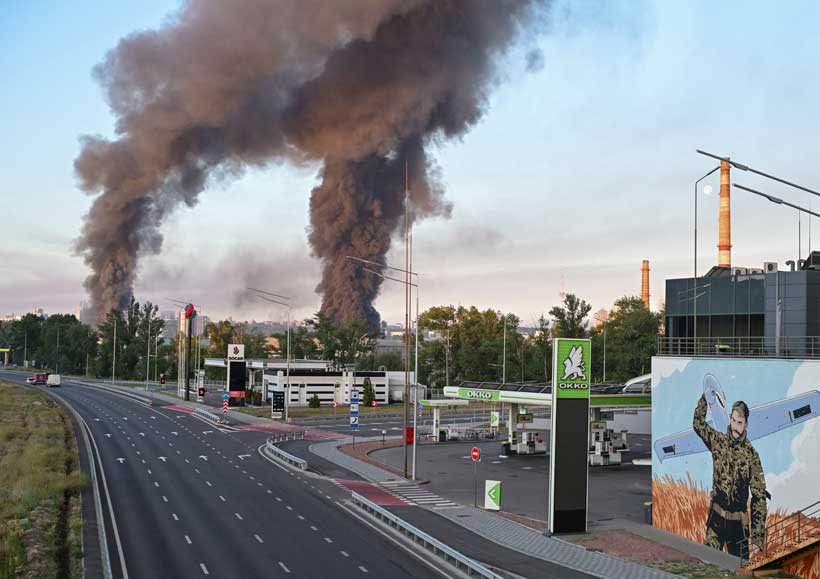
“The Russia–Ukraine War has now exceeded the duration of the First World War, yet Russia is short of achieving its original political objectives, and Ukraine, supported by NATO, hasn’t given up.” This prolonged contest of wills has morphed into a grinding, industrial-age war of attrition fought with twenty-first-century tools, where strategic patience and political endurance matter more than any single offensive. Although Russian territorial gains are undeniable, the signs of combat fatigue and extremely slow progress on the ground in Donetz are noticeable.
Ukraine has adopted, with help from NATO allies in terms of drone warfare, but the most significant factor has been its choice of ‘Centre of Gravity’ i.e. the energy infrastructure of Russians impacting their war waging potential, with some meaningful strategic targets like Moscow, Crimea, energy and connectivity grid. Moscow’s innovations in the recent past include the use of glide bombs and heavy production of drones and missiles amid depleting air defense equipment. The war in the Middle East has also deprived Russia of some crucial resources from Iran, adding to some critical shortages and causing undeniable concerns for Russians.
Backdrop: From Blitzkrieg to Attrition
When Russia invaded Ukraine in February 2022, the Kremlin clearly banked on a short, decisive campaign—rapid regime change in Kyiv, a compliant government, and a shock to NATO that would reinforce Moscow’s influence over Euro‑Atlantic security arrangements. That blitzkrieg failed spectacularly: overstretched logistics, poor coordination, shortage of infantry, and determined Ukrainian resistance—backed by Western intelligence and early arms flows—forced Russia to pull back from the outskirts of Kyiv and Kharkiv to execute a turning movement to turn the Ukrainian defenses of Donbass and make gains there.
Stay ahead of the geopolitical week.
MD Briefing delivers expert analysis across five global fronts — the Indo-Pacific, energy, geoeconomics, European security, and the Middle East — every Monday morning. Free.
Over time, the conflict has settled into a static yet ever more lethal battlefront, marked by slow Russian advances in the east, fortified “fortress belts” in Donbas, and escalating mutual deep strikes that bring the war into the energy grids, oil infrastructure, and cities of both countries. The frontlines today resemble a hybrid of Verdun and the drone age: little movement, high casualties, and a constant drain on manpower and industrial capacity.
Initial Aims: Political, Strategic, Military
Russia’s political aim at the outset was to arrest NATO’s eastward expansion, foreclose Ukraine’s membership, and redraw the security architecture in its favor by restoring a de facto sphere of influence in its near abroad. Strategically, Moscow sought to liberate the full Luhansk and Donetsk regions as a buffer, secure Crimea by establishing a land corridor through southern Ukraine, and, in an ideal scenario, cut Ukraine off from its warm‑water access and link up to Transnistria. Militarily, this required rapid decapitation of the Ukrainian leadership, seizure of key urban centers, and the collapse of organized resistance before the West could fully mobilize support.
Ukraine’s aims were the mirror image: defend sovereignty, prevent regime collapse, and impose a punitive cost on Russia while leveraging international sympathy to lock in sustained NATO and EU backing. Politically, Kyiv anchored its war effort to a narrative of existential defense and eventual restoration of territorial integrity; militarily, it prepared since 2014 to turn its towns into fortresses, its buildings into pillboxes, civilians into auxiliaries, and its information campaigns into strategic enablers of external support.
For the US-led NATO, the primary goal was to avoid direct war with a nuclear superpower, Russia, while degrading Russian military capacity and preserving alliance cohesion. The West’s strategic calculus has been to let Ukraine fight a proxy war that weakens Russia as an extension of Cold War 1.0, while keeping escalation below thresholds that might trigger a Third World War or nuclear exchange.
Strategies and Operational Art So Far
After the failure of the Kyiv offensive, Russia shifted from maneuver warfare towards creating a viable defense line, an artillery‑driven war of attrition centered on Donbas. It dug in along captured territories, constructed deep defensive belts, and turned Bakhmut, Avdiivka, and other nodes into grinding “meat grinders” where it was willing to absorb heavy casualties in exchange for incremental gains. Russia simultaneously put its military-industrial complex on a war-economy footing, ramping production of artillery shells, missiles, and drones, and drawing on assistance from partners such as Iran and North Korea.
Ukraine, confronted with asymmetry in manpower and firepower, adopted a hybrid operational art: static fortress defense in urban areas, mobile defense and counterattacks in open sectors, and long-range precision strikes to offset blunt numerical disadvantages. Its 2023 counteroffensive—built around NATO‑trained brigades and Western armor—ran into layered Russian defenses, dense minefields, and intensive drone‑enabled ISR, yielding limited territorial gains at a high cost in combat power. This outcome forced Kyiv to re-prioritize deep strikes on logistics, depots, and command nodes in occupied territories and inside Russia proper.
The US‑led NATO strategy in Joe Biden’s era has been to incrementally escalate the quality and quantity of aid—HIMARS, Western tanks, air defense systems, long‑range missiles, and eventually F‑16s—while keeping clear red lines against deploying combat troops. Alongside kinetic support, NATO wages a broad non‑kinetic campaign in economic, information, cyber, diplomatic, and political domains, using sanctions, export controls, and information warfare to squeeze Russia’s war economy and legitimacy.
Achievements and Setbacks: A War of Partial Gains
Militarily, Russia today controls about a fifth of Ukrainian territory, including Crimea, maintains a land corridor to the peninsula, and continues to exert pressure on the “fortress belt” in eastern Donbas, including areas around Kostiantynivka and Pokrovsk. Yet, after two years of high‑intensity combat and another year of grinding attrition, Moscow has not liberated the entire Donbas, has failed to capture Odesa, and has not joined up with Transnistria, falling short of its expanded territorial ambitions. Its territorial gains in recent months are measured in single‑digit square miles over weeks—hardly to be termed a decisive victory.
Ukraine’s achievements are less visible on maps but significant strategically. It blunted the initial Russian thrust on Kyiv, Kharkiv, and Mykolaiv; imposed heavy casualties; and forced Russia to abandon its maximalist regime-change goal. More recently, Ukraine has seized the initiative in the deep-strike domain, launching one of its largest drone campaigns with roughly 660 drones across multiple Russian regions, hitting oil refineries, depots, and logistics hubs and causing blackouts and fuel shortages in Crimea and even resulting in rare acknowledged fuel deficits in Russia. This shift to systematically targeting Russia’s oil infrastructure as a center of gravity has begun to erode Moscow’s war‑fighting capacity and complicate its domestic political narrative.
At the same time, Kyiv’s failed counteroffensive and its continuing dependence on Western arms and finances have cost it dearly in manpower, infrastructure, and economic resilience. Ukraine today faces a shortage of trained soldiers on the frontlines, a devastated economy, millions displaced, sovereign decision‑making constrained by the imperatives of its original principal sponsor, the United States, whose stance is not predictable, and a divided EU with high promises and low delivery.
War Fatigue on All Sides
After more than four years of intense war, fatigue is ubiquitous but asymmetrically distributed. Russia has suffered heavy casualties in men and material, borne economic sanctions, and lost high‑value naval assets in the Black Sea, yet has managed to expand defense production by an estimated 400 percent since 2021, far outpacing Europe’s modest increases. Its political leadership projects confidence, buttressed by control over domestic information space and an ability to frame the war as a civilizational struggle against NATO.
Ukraine and its Western backers face a different kind of exhaustion. In Kyiv, repeated mobilization waves, mounting casualties, and prolonged destruction have fostered a grim recognition that the geography of Ukraine may be altered permanently. In Western capitals, the rhetoric has shifted from “Putin must lose” to the more modest “Putin must not win,” with President Biden’s pledge to support Ukraine “for as long as it takes” quietly morphing into “as long as we can” to an era of ambiguity and uncertainty under President Trump. Aid delays, divergent threat perceptions, and competing crises—from the Middle East to the Indo‑Pacific—have deepened cracks in the Western narrative of open‑ended support.
This mismatch of fatigue is critical. Russia can afford to wage a protracted war of attrition within its maximal limits so long as NATO remains unwilling to risk nuclear escalation, while Ukraine’s ability to sustain high‑intensity operations is increasingly hostage to political cycles in Washington and European capitals.
Recent Ukrainian Gains and Russian Setbacks
In the latest phase, Ukraine’s most notable successes lie in the strategic targeting of Russian energy infrastructure and rear‑area military nodes. Large‑scale drone attacks have hit oil refineries in multiple Russian regions, disrupted logistics, inflicted blackouts in Sevastopol, destroyed fuel storage and ferries, and triggered gasoline shortages severe enough for local authorities in occupied Crimea to declare emergencies and impose sales bans. These operations have forced Russia to divert resources to air defense and internal security while exposing the vulnerability of its vast energy network.
On the frontlines, Russian advances in Donbas remain slow and costly. Despite pressure on Kostiantynivka and other strongholds in the “fortress belt,” Russia’s net territorial gains over recent weeks have been minimal—a few dozen square miles at most—suggesting diminishing returns for its offensive efforts. Ukraine has managed to halt Russia’s spring–summer 2026 offensive in several sectors, even as it struggles to generate forces for large-scale counterattacks.
Yet these Ukrainian gains should not be overstated. Russia still holds the initiative on several segments of the front, retains a numerical advantage in manpower, and has adjusted tactically to Ukrainian deep strikes by dispersing assets and hardening key facilities. The overarching strategic picture remains one of mutual frustration rather than impending collapse on either side.
Why Donbas Remains Elusive
The failure to fully secure Donbas—Russia’s declared minimum war goal—reflects both operational and structural constraints. The remaining portion of the Donetsk region is hilly, heavily fortified, and has been systematically prepared by Ukraine as a fortress zone, with trench networks, hardened positions, and integrated artillery and drone coverage. Russian forces, organized initially for mechanized maneuver warfare, have been forced into slow, attritional attacks against prepared defenses, paying a steep price in casualties for modest gains.
Moreover, the Ukrainian choice of centre of gravity—the Russian energy and logistics infrastructure—has imposed growing costs on Moscow’s war effort, complicating its ability to sustain high‑tempo offensives in Donbas. As long as Ukraine can continue to threaten Russian rear‑area nodes with long‑range drones and missiles, Russia’s operational tempo in Donbas will remain constrained, and achieving the declared end state of “liberating” the entire region will be delayed.
When and How Might It End?
Within the “hard realities” of this conflict, several boundaries are unlikely to be crossed. Russia, with the world’s largest nuclear arsenal, will not accept annihilation or a decisive battlefield defeat without contemplating escalation to weapons of last resort; the United States will not risk the annihilation of Washington or New York to save Ukraine or Poland; and Ukraine, continuously armed by NATO, is unlikely to be fully destroyed as a state. These constraints ensure that the war will continue to be prosecuted within maximal limits that stop short of total victory or total defeat.
Under these conditions, the most plausible endgames fall into three broad categories. The first is an imposed “cold peace” or armistice along de facto lines of control, akin to the Korean War outcome, leaving Russia with a buffer zone in Donbas and a secure Crimea, and Ukraine a truncated but sovereign state, possibly aligned with the EU but not formally in NATO.
The second is a negotiated settlement following mutual exhaustion, perhaps after a major shock—economic, political, or military—on one side that forces recalibration of aims; however, recent experiences such as the aborted Istanbul talks and the optics‑heavy but substance‑free Alaska summit suggest neither Moscow nor Washington is yet ready to absorb the political costs of compromise.
The third, more dangerous, and most unlikely scenario is escalation through miscalculation—an accident, a strike misinterpreted as strategic, or a chain of retaliations that breaches the current thresholds and invites direct NATO–Russia confrontation, bringing nuclear risks to the forefront. It is this specter of “nuclear Armageddon” that has so far constrained the West from committing troops and constrained Russia from directly attacking NATO territory, but the longer the war drags on, the greater the cumulative risk of such an outcome.
In all three scenarios, what is clear is that the war will not end in a cinematic surrender ceremony or a neat diplomatic “grand bargain.” It will end, if at all, in a messy compromise between incompatible narratives, with an altered map, a fractured European security order, and a world that has relearned the brutal lesson that industrial‑scale land wars in Eurasia do not end quickly—and rarely end on anyone’s original terms. It will also re-emphasize the lesson of the Iran War that wars can’t be won only by standoff attacks and there are limits to military power.
Conclusion
The Russia–Ukraine war has evolved far beyond the territorial dispute with which it began. It has become a defining strategic contest of the twenty-first century, testing not only military capability but also political resolve, industrial resilience, alliance cohesion, and the credibility of deterrence.
Russia has undeniably demonstrated remarkable endurance, adapting from a failed maneuver campaign to a sustained industrial war while preserving most of its core strategic objectives. Ukraine has displayed extraordinary national resilience and operational innovation, denying Moscow a decisive victory and transforming inexpensive technologies into instruments of strategic effect. Yet the political end state envisioned in February 2022 has not been achieved.
As long as Russia believes time favors its strategy of attrition, Ukraine believes Western support will eventually shift the balance, and NATO seeks to weaken Russia without inviting nuclear confrontation, the conflict is likely to continue within carefully managed limits rather than culminate in decisive victory.
History suggests that industrial wars rarely end on the battlefield alone. They conclude when political objectives become more expensive than political compromise. That moment has not yet arrived. Until it does, the countries concerned will remain trapped in a conflict that has already outlasted the First World War and reshaped the global security architecture.