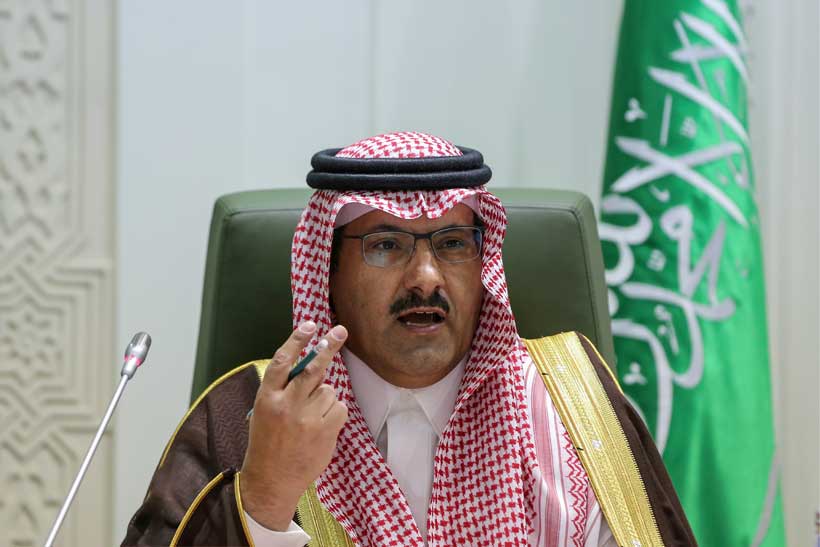
Saudi Arabia’s Yemen policy master, Riyadh’s ambassador Mohammed al-Jaber, believes in stick-and-carrot diplomacy—he shows the stick to Yemen’s dissenters and the carrot to Europe’s defense ministries. And it’s a contradiction that now runs straight through Europe’s own legal order.
Al‑Jaber is no ordinary envoy. Since 2014 he has combined the post of ambassador with a mandate to supervise Saudi “development and reconstruction” efforts in Yemen, making him the public face of what Riyadh markets as a transition from warfighting to peacebuilding. Saudi and Gulf media have cast him as the architect of the Riyadh Agreement and a tireless mediator, shuttling between Yemeni factions to build an inclusive political order. This is the image that has reassured European ministries keen to believe that the kingdom has learned its lessons from a disastrous air war.
On the ground in southern and eastern Yemen, the picture looks different. Over the past year, Saudi‑backed forces have moved aggressively against the Southern Transitional Council (STC), rolling back its territorial control and pushing new “Homeland Shield” formations loyal to the Saudi‑supported Presidential Leadership Council into key southern cities. When STC elements sought to expand in Hadramawt, the eastern governorate whose ports and energy assets are central to Saudi strategic depth, Riyadh publicly warned that any STC moves undermining de‑escalation would be “countered”—and separatist leaders accused Saudi warplanes of strikes on their positions.
The timeline is revealing. Al‑Jaber emerged in Riyadh’s narrative as the broker of the 2019 power‑sharing deal with the STC; as the supervisor of reconstruction programs that rebranded Saudi leverage as generosity; and as the man European officials met when they wanted to talk about detainees, aid access, and “political horizons.” Yet by late 2025 and into early 2026, Saudi‑aligned forces were fighting to reshape the south and east on their own terms, while Al‑Jaber was still being photographed greeting STC delegations in Riyadh and meeting UN envoys as if nothing fundamental had changed. Mediation and coercion had become two instruments of the same policy.
Stay ahead of the geopolitical week.
MD Briefing delivers expert analysis across five global fronts — the Indo-Pacific, energy, geoeconomics, European security, and the Middle East — every Monday morning. Free.
For Europe, this is not just a moral problem. It is a legal and strategic one. A detailed study titled “War in Yemen: Saudi responsibility, European complicity” has argued that many EU states’ continued arms exports to Saudi Arabia sit uneasily with their obligations under the Arms Trade Treaty and the EU’s Common Position on arms exports, given the well‑documented pattern of civilian harm in coalition operations. European NGOs and legal initiatives have reinforced that point, mapping specific European‑made weapons used in Yemen and warning that governments and manufacturers risk complicity in violations of international humanitarian law.
European institutions are not blind to this. The European Parliament has on several occasions called for an EU-wide arms embargo on Saudi Arabia over alleged breaches of international humanitarian law in Yemen and for member states to align their export practices with the Common Position and the Arms Trade Treaty. Human rights organizations such as Amnesty International and Human Rights Watch have demanded that all states halt arms transfers to the parties to the conflict, arguing that anything less undermines the treaty regime the EU claims to champion. Policy analysts and research institutes, from specialist arms‑control networks to broader foreign‑policy think tanks, have gone further, urging the creation of a stronger EU‑level review mechanism for arms licenses to high‑risk destinations and tighter financial due diligence on Saudi‑linked deals to manage legal and reputational exposure.
Taken together, these proposals amount to a simple agenda: stop issuing export licenses where there is a clear risk that weapons will be used unlawfully in Yemen; use targeted sanctions against officials responsible for grave abuses; and treat the Yemen file as a test case for whether European law really constrains trade with powerful partners. None of this would prevent Europe from talking to Al‑Jaber, but it would end the pretense that his presence alone converts Saudi coercion in Yemen into a peace process.
This is where Ambassador Al-Jaber matters. By presenting him as a mediator and reconstruction tsar, Saudi Arabia offers European policymakers a convenient fiction: that dealing with him is an investment in peace, not complicity in coercive state‑building. It allows governments in London, Rome, or Madrid to maintain defense contracts and sovereign‑wealth partnerships while insisting that they are backing a political process, not a war. The ambassador’s dual role masks the reality that Saudi Arabia is still using hard power to determine who governs the south and east of Yemen — and on what terms.
Yemen, in other words, has become a stress test of how seriously Europe takes its own rules. If member states are willing to bend the Arms Trade Treaty, the Common Position, and their human‑rights rhetoric for a partner that continues to use force in this way, it tells other governments—and European publics—that law in the EU is applied rigorously to small or hostile states, and flexibly to those who buy enough hardware.
The question for Europe is not whether it can persuade Mohammed al‑Jaber to deliver a tidier political settlement in Yemen’s south. It is whether European leaders are prepared to align their treatment of Saudi Arabia with the rules they claim to live by. As long as Ambassador Al-Jaber remains welcome in European capitals as a symbol of peace while Saudi jets and proxies reshape Yemen’s map, the answer looks uncomfortably clear.