


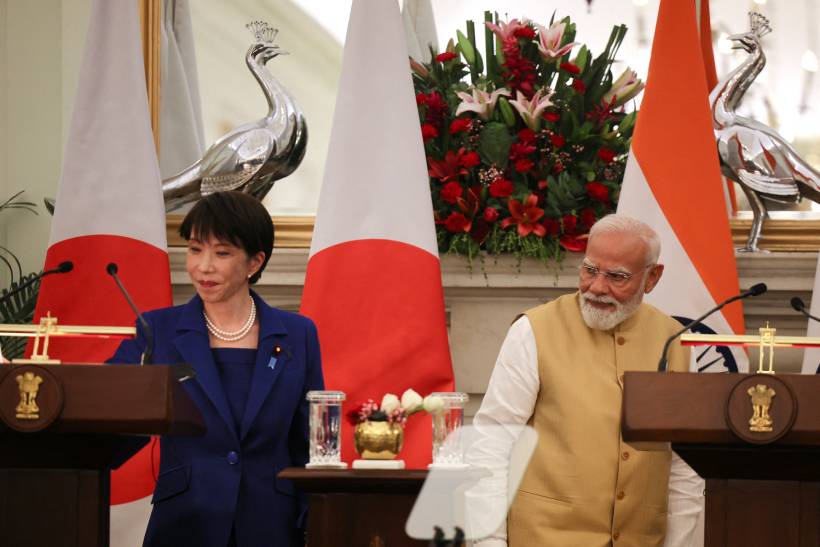
India and Japan signed a series of agreements to expand cooperation in artificial intelligence, critical minerals, energy and defence following talks between Prime Minister Narendra Modi and Japanese Prime Minister Sanae Takaichi during the 16th India-Japan Annual Summit in New Delhi.
The agreements reflect both countries’ efforts to deepen economic and strategic ties amid intensifying geopolitical competition in the Indo-Pacific.
AI emerges as a new pillar of cooperation
Artificial intelligence featured prominently in the discussions, with both leaders highlighting the complementary strengths of their economies.
Japan brings advanced manufacturing, precision engineering and industrial technology, while India offers a large software industry, skilled technology workforce and rapidly expanding digital economy.
Stay ahead of the geopolitical week.
MD Briefing delivers expert analysis across five global fronts — the Indo-Pacific, energy, geoeconomics, European security, and the Middle East — every Monday morning. Free.
The new partnership aims to combine these advantages to accelerate AI innovation and industrial applications.
Economic security takes centre stage
The two countries also agreed to prepare a joint roadmap on economic security, reflecting growing concerns over supply chain resilience, critical technologies and strategic industries.
Since the COVID-19 pandemic and rising geopolitical tensions, both governments have sought to reduce vulnerabilities in global supply chains, particularly in sectors such as semiconductors, critical minerals and advanced manufacturing.
The roadmap is expected to strengthen cooperation on securing essential resources while reducing dependence on concentrated supply chains.
Defence cooperation continues to expand
India and Japan signed an agreement covering their first joint defence co-development project, marking another step in expanding military cooperation.
Defence ties between the two countries have steadily strengthened over the past decade through joint military exercises, maritime cooperation and defence technology exchanges.
As members of the Quad alongside the United States and Australia, both countries share concerns about maintaining security and stability across the Indo-Pacific region.
Energy and green transition initiatives
Energy cooperation also featured prominently.
Under a new India-Japan Bio-Gas Initiative, the two countries plan to establish 1,000 bio-gas and organic fertilizer plants across India.
The project supports India’s efforts to diversify its energy mix, improve rural energy access and reduce dependence on imported fossil fuels while contributing to environmental sustainability.
Strong and growing economic relationship
Japan remains one of India’s largest foreign investors and development partners.
Japanese companies have financed major infrastructure projects, including the Mumbai-Ahmedabad high-speed rail corridor, while continuing to expand investments in India’s banking, manufacturing and technology sectors.
Bilateral trade reached approximately $27.5 billion during the 2025/26 fiscal year, with Japanese investment continuing to grow despite global economic uncertainty.
Why it matters
The agreements reinforce one of Asia’s most important strategic partnerships at a time of increasing competition between major powers.
Beyond expanding trade, India and Japan are positioning themselves as trusted partners in critical technologies, resilient supply chains and defence cooperation, helping reduce reliance on any single country for key industries.
Their cooperation also strengthens broader Indo-Pacific initiatives aimed at supporting a rules-based regional order.
Key stakeholders
- India: Gains investment, technology transfer and stronger supply-chain resilience.
- Japan: Expands economic opportunities while diversifying manufacturing and strategic partnerships.
- Businesses: Companies in AI, defence, energy and infrastructure stand to benefit from increased cooperation.
- Quad partners: The United States and Australia have an interest in closer India-Japan coordination as part of Indo-Pacific security.
- Regional economies: Stronger India-Japan ties could reshape supply chains across Asia.
Future outlook
India and Japan are expected to broaden cooperation beyond traditional infrastructure into emerging technologies such as artificial intelligence, semiconductors, quantum computing and clean energy.
Defence collaboration is also likely to deepen through joint research, technology development and greater interoperability between their armed forces.
Economic security initiatives may become increasingly important as both countries seek to build more resilient supply chains amid continuing geopolitical uncertainty and technological competition.
The latest agreements illustrate how the India-Japan partnership is evolving from an investment-driven relationship into a comprehensive strategic alliance centered on technology, security and economic resilience.
Artificial intelligence has become a particularly significant area of cooperation because it combines Japan’s strengths in advanced hardware and industrial engineering with India’s software expertise and digital talent. If implemented successfully, the partnership could create an alternative innovation ecosystem alongside those led by the United States and China.
The economic security roadmap is equally important. Rather than focusing solely on increasing trade, both governments are prioritizing resilient supply chains, critical minerals and strategic technologies that have become increasingly vulnerable to geopolitical disruptions.
Defence cooperation also carries strategic weight. Although the announcement of a first joint defence co-development project is symbolic at this stage, it reflects growing trust between two countries that increasingly view regional security through the lens of Indo-Pacific stability. As China’s military and economic influence expands, India and Japan are likely to continue strengthening defence and technology partnerships both bilaterally and through the Quad.
Overall, the summit demonstrates that India-Japan relations are entering a new phase, with cooperation extending well beyond infrastructure financing toward long-term collaboration in frontier technologies, industrial policy and regional security.
With information from Reuters.
