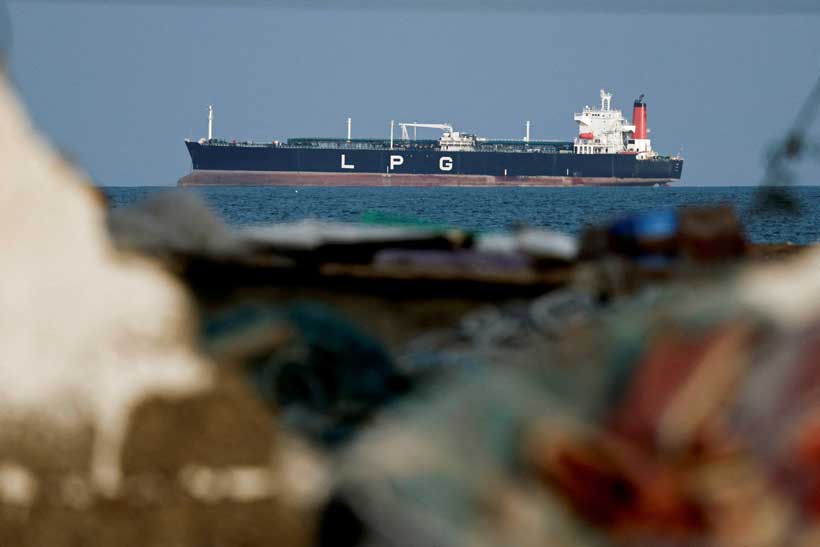
On 27 May the United States Treasury placed the Persian Gulf Strait Authority on its sanctions list, the body Iran had set up three weeks earlier to charge ships for passing through the Strait of Hormuz. The designation meant that any vessel paying the Iranian toll, reported at up to two million dollars and settled in yuan or in cryptocurrency, would price itself out of the dollar system. More than three hundred non-Iranian ships, most of them oil tankers, have filed their papers with the Iranian authority in the weeks after it opened. Between the Iranian toll and the American sanction, a single stretch of water now carries two prices, set by two governments, neither of which recognizes the other’s right to charge.
The obvious reading is that Iran is weaponizing a chokepoint while Washington punishes it, and that both are simply being transactional in the way leaders always have been. That reading is too narrow. It sees the toll and the sanction as two countries punishing each other. What they show instead is something both governments now do as a matter of routine, towards allies as much as adversaries, which is to treat every commitment, every guarantee, every piece of territory, and every law as a position to be valued and priced rather than an obligation to be kept. And where Iran prices a strait that it controls, Washington reprices the alliances that it has inherited, two movements that, opposite in appearance, obey the same logic.
The war that produced the toll has since paused without settling anything, and the pause makes the point better than the fighting did. On 17 June, over dinner at Versailles after the G7, the American president signed a memorandum opening a sixty-day window to negotiate an end to the conflict, the Iranian president adding his signature remotely from Tehran, and within a day the mediators announced that Iran would reopen the strait and that the American blockade would lift. The reopening is partial and contested. The blockade lifted, and the first ships moved on 18 June, among them the first Saudi tanker to sail since February, hugging the Iranian and Omani coasts to avoid the central channel, said to be still mined. By 20 June the Iranian military had declared the strait closed again, even as American tracking showed ships still passing.
Despite this, the toll itself is suspended for sixty days under the deal. However, its mechanism stays alive under a new name, reframed by Tehran as a service fee for navigation and safety, with the right to charge reserved for later. The Iranian parliament, for its part, had been moving for months to write the arrangement into law, requiring fees paid in rial and barring vessels tied to hostile states. A ceasefire stops the shooting. It leaves maritime access, sanctions, frozen funds, and regional security untouched, each still open to be bargained over long after the guns go quiet.
Stay ahead of the geopolitical week.
MD Briefing delivers expert analysis across five global fronts — the Indo-Pacific, energy, geoeconomics, European security, and the Middle East — every Monday morning. Free.
The idea of a toll has outlived the war, because it was never really a weapon of the war but an asset the war revealed. And an asset is something that can be leveraged to pay back. What Iran has found at Hormuz is not just the leverage it has always held but a way of turning that leverage into income in a currency of its choosing on a schedule it sets.
Tehran has since put a number to it, telling Gulf neighbors that charging for security and environmental services in the strait could raise some forty billion dollars a year, to be shared among the states that join the scheme, on the model of the fees Turkey levies in its straits under the Montreux Convention. In this regard, its chief negotiator has said that management of the strait will never return to what it was before. It has since pressed Oman to take a share of the revenue and join the scheme, and Muscat has refused.
This is the shift worth naming. For most of the past century a commitment drew its value from the obligation itself, and an alliance meant something because it bound you. What seems to be replacing that is a way of running foreign policy in which a commitment is worth only what it returns and is kept, dropped, or sold accordingly. This is not really transactionalism, since states have always bargained, and bargaining is as old as diplomacy, nor is it quite the leverage a state draws from sitting astride the world’s pipelines and payment systems, because that leverage was always there. The real change lies elsewhere.
What is being traded is no longer the deal but the commitment itself, so that the commitment becomes the good and not the means of reaching one. There was even an old habit of treating alliances as a kind of portfolio, a spread of partners held the way an investor holds a mix of safe and risky bets, but that idea was defensive, a way of managing risk inside an order whose rules everyone took as fixed. Here the rules are not fixed, and so they become one more thing to be priced.
The change runs in two columns at once. A strait, an alliance, a guarantee has always yielded strategic value, leverage, deterrence, and the alignment of others, and now is made to yield financial value as well. The strait earns a currency as much as a hold over the states that depend on it, and the alliance, while it still buys alignment, is also billed for it. Geopolitical return was always the point. Money is the column the old order did not keep. Where the old approach balanced its holdings inside a system it accepted, the new one puts the system itself up for valuation.
On the American side this has stopped being improvisation and become written doctrine, which is what makes it more than one president’s temperament. The National Security Strategy of December 2025 states it plainly, calling for “burden-shifting” instead of “burden-sharing”, and dropping by name the old bargain in which American protection was traded for alignment. And it holds, more revealingly, that the influence of the larger and richer and stronger nation is a permanent fact of international life, a line that seems to sort the world into the powers that decide and the powers that are told. It announces that with American energy production rising, the region’s historic claim on American attention recedes, leaving it to matter less as a security concern and more as a place to invest. Its revival of the Monroe Doctrine declares that the United States will deny rivals the right to own or control strategically vital assets in the Western Hemisphere, the word “asset” being the document’s own. A national strategy that once listed allies now lists holdings, some to keep, some to sell, all of them priced.
The same demand turns up wherever the United States keeps a commitment. For years Washington has pressed Seoul and Tokyo to pay far more for the troops stationed on their soil, asking at one point that South Korea cover the full cost of those forces plus a further fifty percent, a markup that turns a guarantee into a margin, and it once moved the cost talks from a five-year cycle onto a yearly one, repricing the alliance like any other position held on a short term. A Singapore minister, watching this, remarked that the United States had gone from liberator to disruptor to a landlord collecting rent. The allies, without ceasing to be allies, are now tenants.
Turning those holdings into money requires a second move the old order never needed, which is to treat the law not as a limit but as a cost. The rules once marked the edge of what a state could take from shared waterways, from allied land, and from third countries. The Law of the Sea protects free passage through international straits and forbids the bordering state from blocking or taxing it. The rules written for undersea cables protect them on the open shelf but leave them exposed in a country’s own coastal waters, the very gap Iran’s plan to charge for them was built to exploit. The principle against intervention, for its part, forbids the use of economic pressure to force a state to surrender its sovereign rights. None of this is being torn up, only repriced.
Iran runs its toll against the passage rules, the opening being that it signed the Law of the Sea without ratifying it. Washington threatened to tariff eight European countries unless Denmark sold Greenland, running against the rule on intervention, treating an ally’s land as a position whose sale could be forced by taxing unrelated trade. That demand was never really about buying an island but about treating the island as part payment on a debt, as though decades of American protection had been a loan now being called in. The same logic surfaced when Trump suggested that, if no final deal held, the United States would itself charge for passage through Hormuz, in payment for services rendered as the region’s “Guardian Angel” and for the reimbursement of costs past, present, and future. The guarantor now invoices the guarantee, dating the bill back across decades. The law still stands. What has changed is the way states reckon it.
When the Danish prime minister said that she could negotiate on everything political, on security, money, and investment, but not on sovereignty, she was speaking the old language in its purest form, drawing the very line the new language refuses to see. No deal over Greenland has been signed, and the two ways of thinking sit fixed across the same object, one calling it not for sale, the other calling it simply not yet priced.
Europe is the third case and the most exposed because it owns a great deal and cannot manage what it owns. A portfolio, after all, is not simply a collection of assets but a set of holdings under common management, valued together, some kept and some traded, each priced against the rest. That management is precisely what Europe lacks. Its economy, its single market, its old reach into former colonies, and its diplomatic networks add up to real weight, yet no one in Europe holds the authority to value those things together and move them at the speed with which Washington reprices its guarantees or Iran works its strait. The money raised since 2025 for joint defense, behind the pledge to spend five percent of GDP, buys more capacity without building the machinery to run it, so that Europe gains resources faster than the power to direct them. The clearest sign came around the very moment the war was paused. As Trump signed the memorandum at Versailles, hosted by the French president, France was offering to help reopen the strait, its president reminding the room that French ships were already in the area, the Charles de Gaulle among them. The one player without a manager was volunteering to do, for free, the work the two players with managers had just finished pricing over its head.
The same logic showed when Washington warned Oman, the quiet go-between whose waters carry much of the strait, that it would behave or be destroyed, pressing it with sanctions until it promised to levy no tolls of its own. A country was forbidden to price the water inside its own borders because that price was being held as someone else’s monopoly. Europe felt the reverse only this week, when Washington threatened a hundred percent tariff on any European state that taxed American digital services, a levy that would override the trade deal signed only weeks before, so that Europe’s one attempt to open a revenue line of its own was met at once by the repricing of everything it sells.
None of this shows up in speeches or summit photographs, for it is being built inside the rooms where governments now weigh their own commitments against tests that did not exist ten years ago. The old alliances remain on paper, but their worth is being quietly reassessed in the books of the powers that back them, against a standard that is no longer the one that created them. At Munich in February the German chancellor told the room that the order built after 1945, for all its faults, was gone and, in the same breath, asked to repair the trust across the Atlantic. The old words are still spoken, only now in the past tense, by leaders who have already conceded that the order that gave them meaning is over. The difference will show first in how the old commitments are valued and then in how quickly anything at all, an alliance, a strait, or an island, can be called in, repriced, or sold.
Two grammars are now in the room at once. The one still speaks of obligations, of what is owed and what is guaranteed, and it is the language the German chancellor reached for at Munich even as he called its order dead, while the other speaks only of positions and prices, and has no word for an obligation that cannot be sold, because in its world no such thing exists. The first grammar is how the postwar order described itself. The second is how it is now being wound down.