


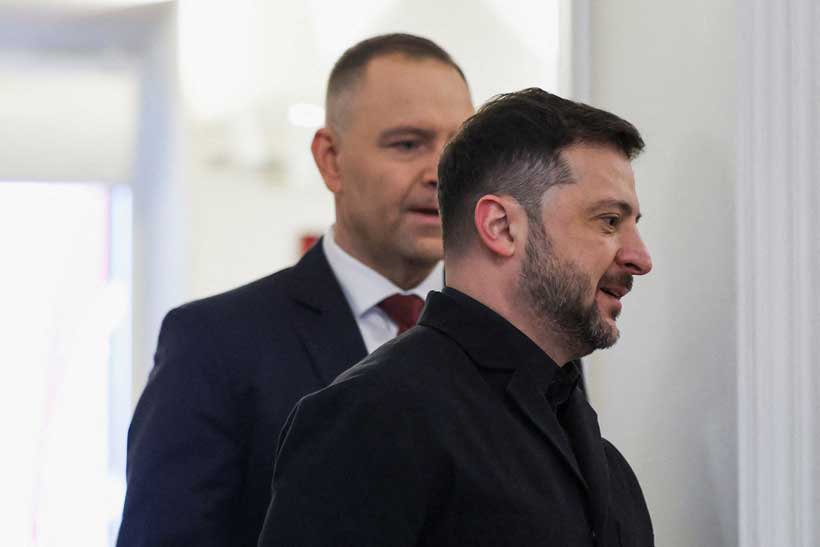
Poland and Ukraine remain close allies in the war against Russia, but their relationship has been strained by a dispute over how to interpret World War Two history. The latest tensions were triggered after Kyiv named a military unit after the Ukrainian Insurgent Army (UPA), a nationalist force that Poland accuses of carrying out mass killings of Poles during the war. The decision sparked a political backlash in Warsaw and revived long standing historical grievances between the two neighbours.
The Ukrainian Insurgent Army Dispute
The Ukrainian Insurgent Army, or UPA, operated during and after World War Two in territories that were then part of the Soviet Union. It fought against Soviet forces and at times collaborated with Nazi Germany in pursuit of Ukrainian independence.
Ukraine views the UPA as part of its national liberation struggle and argues that commemorating it reflects resistance to Soviet rule rather than hostility toward Poland. Polish officials strongly reject this interpretation, pointing to the group’s wartime activities and its role in violence against Polish civilians.
Volhynia Massacres and Competing Historical Narratives
The most sensitive element of the dispute is the Volhynia massacres of 1943 to 1945.
Stay ahead of the geopolitical week.
MD Briefing delivers expert analysis across five global fronts — the Indo-Pacific, energy, geoeconomics, European security, and the Middle East — every Monday morning. Free.
Poland says around 100,000 ethnic Poles were killed by Ukrainian nationalist forces in what it describes as a genocide. Ukrainian historians acknowledge large scale civilian deaths but argue the violence occurred in a complex wartime environment involving mutual ethnic conflict and reprisals.
The disagreement over terminology, particularly the use of the word genocide, has become a central diplomatic sticking point, as recognition would carry major political and moral implications for both countries.
Symbolism and Political Fallout in Poland
The controversy escalated when Polish President Karol Nawrocki revoked a top honour previously awarded to Ukrainian President Volodymyr Zelenskiy following Kyiv’s decision on the military unit name.
Nawrocki, a conservative nationalist historian, has made historical accountability a key political issue. He has repeatedly called on Ukraine to formally recognise the Volhynia killings as genocide and has criticized what he sees as reluctance from Kyiv to fully confront this chapter of history.
His position reflects broader domestic political pressures in Poland, where public memory of wartime atrocities remains highly sensitive and influential in shaping foreign policy debates.
Exhumations and Memory Politics
Another key point of tension is access to burial sites in western Ukraine.
Poland has long sought permission to exhume remains of Polish victims of wartime violence in order to properly identify and commemorate them. Progress has been slow, although recent approvals for exhumations in parts of the Volhynia region suggest some limited movement.
For Poland, exhumations are framed as a humanitarian and historical necessity. For Ukraine, they are often politically sensitive, tied to fears of reopening territorial and historical disputes.
Post War Population Transfers
The dispute is further complicated by events after World War Two.
In 1947, Poland forcibly relocated around 140,000 ethnic Ukrainians and members of the Lemko minority from southeastern Poland in an operation aimed at weakening support for Ukrainian insurgent groups. Ukraine views this as ethnic cleansing, while Poland argues it was a security driven relocation in a highly unstable post war environment.
These reciprocal historical grievances continue to shape how each side interprets past events and fuel mutual distrust.
Current Political Dynamics
Despite their historical disputes, Poland remains one of Ukraine’s strongest supporters in its war against Russia, providing military aid, political backing and refuge for Ukrainian civilians.
However, the rise of nationalist political narratives in Poland, combined with Ukraine’s need to maintain strong international support during wartime, has made historical issues more politically sensitive. Even symbolic decisions, such as naming military units or revisiting wartime events, can quickly escalate into diplomatic friction.
Analysis
The dispute reflects a broader pattern in which unresolved historical memory becomes politically active when contemporary alliances come under pressure. Poland and Ukraine are strategically aligned against Russia, but their national identities are shaped by conflicting interpretations of the same wartime events, particularly around the UPA and the Volhynia massacres.
This creates a relationship that is stable at the strategic level but fragile at the symbolic level. Both governments have strong incentives to maintain cooperation due to security threats from Russia, but domestic politics in Poland and nation building narratives in Ukraine make compromise over historical memory difficult.
The result is a recurring cycle where historical symbolism triggers diplomatic tension, followed by rapid efforts to stabilize relations due to shared security interests. Unless there is sustained progress on sensitive issues such as exhumations and historical recognition frameworks, these tensions are likely to re emerge periodically even within an otherwise strong alliance.
With information from Reuters.
