


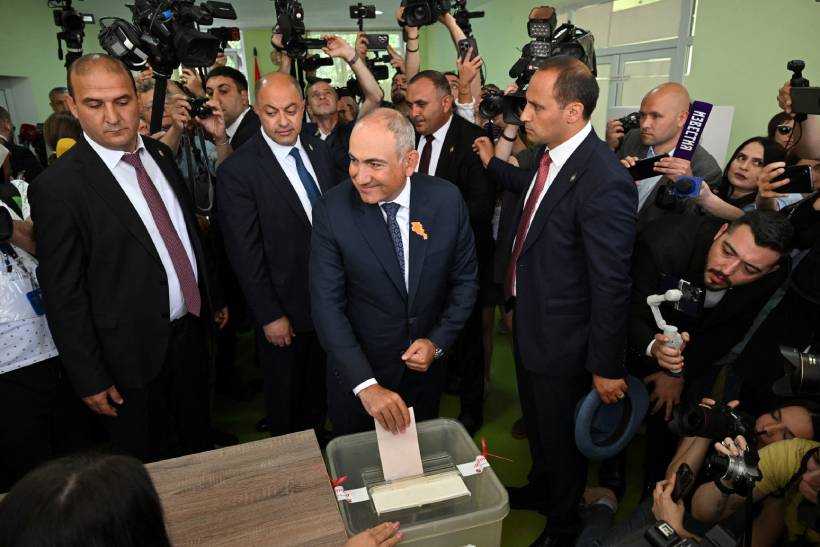
Armenia’s governing Civil Contract party, led by Prime Minister Nikol Pashinyan, won a parliamentary election with 49.8 percent of the vote, according to the Central Election Commission. The result gives the party a parliamentary majority under Armenia’s electoral system.
The election was widely seen as a test of Pashinyan’s handling of Armenia’s post war transition after the 2023 conflict with Azerbaijan and his broader effort to shift the country’s foreign policy closer to Western partners while reducing reliance on Russia.
The vote also followed heightened political tension, including arrests of opposition figures, and came amid ongoing uncertainty over a potential peace deal with Azerbaijan and regional normalization with Turkey.
Why it matters
The result strengthens Pashinyan’s mandate but also highlights deep political division in Armenia, where pro Russian opposition blocs collectively secured around one third of the vote.
Stay ahead of the geopolitical week.
MD Briefing delivers expert analysis across five global fronts — the Indo-Pacific, energy, geoeconomics, European security, and the Middle East — every Monday morning. Free.
The election outcome is closely tied to the stalled peace process with Azerbaijan and the unresolved status of constitutional changes that Baku has demanded as part of a long term settlement. These issues directly affect the future of regional stability in the South Caucasus.
It also reflects a broader geopolitical shift. Armenia’s gradual movement away from traditional security dependence on Russia toward engagement with Western institutions is reshaping regional alliances in a strategically sensitive area between Russia, Iran, Turkey, and Europe.
The primary stakeholder is Prime Minister Nikol Pashinyan and his Civil Contract party, which now holds governing authority and responsibility for advancing peace negotiations and economic reforms.
Opposition groups such as the Armenia Alliance and Strong Armenia represent the domestic pro Russian political bloc, advocating closer ties with Moscow and criticizing the government’s handling of the election process.
External stakeholders include Azerbaijan, which is central to ongoing peace negotiations and constitutional demands related to territorial disputes, and Turkey, which has linked normalization of relations to broader regional settlement progress.
Russia remains a key geopolitical stakeholder due to Armenia’s historical security dependence and the opposition’s support for closer alignment with Moscow.
Future outlook
One scenario is that Pashinyan uses his parliamentary majority to push forward peace negotiations with Azerbaijan and pursue regional normalization, potentially unlocking trade routes and economic integration with Turkey and neighboring states.
A second scenario is political deadlock, where constitutional and peace agreement requirements stall due to lack of consensus with the opposition, slowing or freezing the peace process and prolonging regional uncertainty.
A third scenario involves rising domestic polarization, where pro Russian opposition groups mobilize against government policy, increasing political instability and complicating governance despite the parliamentary majority.
In all cases, Armenia’s trajectory will depend on whether it can balance domestic political divisions with external pressures from Azerbaijan, Turkey, and Russia while attempting to stabilize the post conflict regional order.
With information from Reuters.
