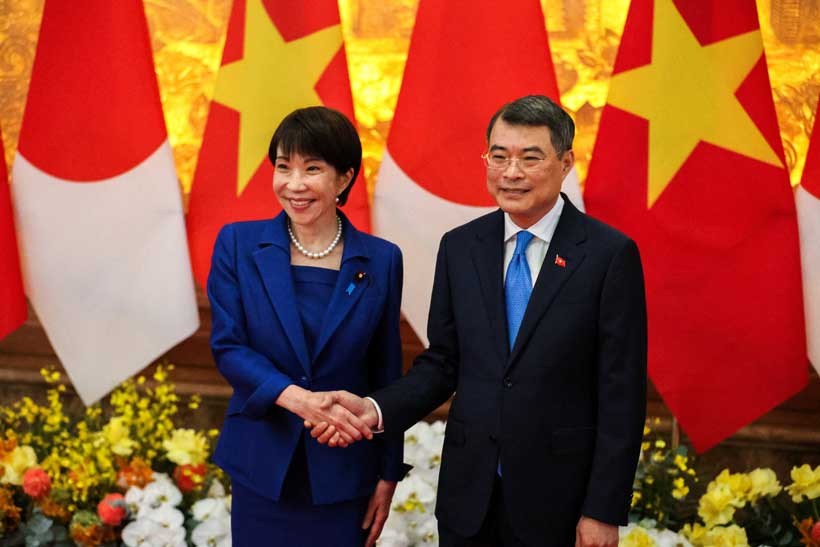
Prime Minister Sanae Takaichi was on her first official visit to Vietnam from 1st to 3rd May, since taking office in Japan last year. Her visit exemplifies the continued importance Japanese leadership attaches to Southeast Asia, even as the country is repositioning its domestic security policy amid a changing regional geopolitical landscape. Takaichi’s pragmatic approach at home has been complemented by her assertive stance on regional security issues and by a vision to elevate Japan’s strategic presence in the Indo-Pacific as a responsible and norm-driven power.
Taking cognisance of the intensifying U.S.-China rivalry and its impact on the Indo-Pacific economies, Tokyo has gradually adopted a more formalised policy approach to matters of economic security. Under Takaichi, who previously held the position of Economic Security Minister (during her tenure, Japan enacted the landmark Economic Security Promotion Act 2022), safeguarding strategic economic domains, such as open supply systems, is indispensable for resource-poor Japan.
Matters of economic security remained at the core of discussions in Takaichi’s Vietnam visit. In her address at the Vietnam National University on 2nd May, Takaichi reiterated this idea within the context of Japan’s Free and Open Indo-Pacific (FOIP) vision. By recalling former prime minister Shinzo Abe, she underscores the important role FOIP has played over the past decade in shaping regional policy norms. Reflecting on its achievements in establishing norms for mutual economic growth and security, Takaichi recognised that the contemporary situation demands a repositioning of FOIP’s priority matters.
Firstly, she points to the need to strengthen economic infrastructure, primarily to safeguard energy and critical minerals supply chains. The weaponised nature of contemporary economic dependencies has heightened the need for a streamlined policy to ensure resource supplies and maintain techno-industrial security. In the past, the strategic turn in its ODA policy became a key action in this regard, linking it to competition with China and furthering its normative approach under the FOIP framework (referred to as realism diplomacy of the new era under former PM Kishida). In Southeast Asia, this has included the critical role of the Partnership for Quality Infrastructure (PQI) in countering the impact of the Chinese Belt and Road Initiative (BRI), providing a responsible alternative that guaranteed sustainable infrastructure in the region. Her Vietnam visit exemplified this approach even as she recounted Japanese support for strategic infrastructure development, including the Vietnam National Space Centre at the Hoa Lac Hi-tech Park, and the NEXI support mechanism for the Nghi Son Refinery and Petrochemical Complex (as a part of the POWERR Asia initiative agreed at the ASEAN summit 2025).
Stay ahead of the geopolitical week.
MD Briefing delivers expert analysis across five global fronts — the Indo-Pacific, energy, geoeconomics, European security, and the Middle East — every Monday morning. Free.
Secondly, Takaichi emphasises the need for public-private collaboration to create economic growth opportunities. This has remained central to Japan’s strategic approach in Southeast Asia, as public financing limits ODA capacity, and many developing partner countries lack the financial and technical capabilities to handle and maintain the strategic infrastructure. Particularly in domains of energy, critical minerals, electronics, etc. Japanese firms have played a key role in building technological capacity in Southeast Asia, doing so with trust and goodwill. For example, Japanese companies such as Hioki, Chubu, JERA, etc. have been involved in the renewable energy domain and have played a critical role in reducing risks and setting standards for Vietnam’s energy transition ambitions.
Finally, Takaichi’s repositioning of the FOIP strategy is intrinsically linked to ensuring peace and stability in its primary market by building security initiatives. Fundamental to this pillar is the development of the Overseas Security Initiative (OSA), launched in 2023 as a strategically remodelled twin of the ODA policy. OSA has focused on providing defence and security-related equipment, such as surveillance radars and patrol vehicles, to partner countries in the Indo-Pacific, primarily those in Southeast Asia. At the ASEAN Summit 2025 in Malaysia, PM Takaichi pledged that, as a key pillar of the remodelled FOIP, OSA grants would be deployed to assist Malaysia, Indonesia, and the Philippines with their security infrastructure. While other countries like Papua New Guinea and Tonga have already received assistance in disaster relief and coastal surveillance, the ambitious target of extending the security cooperation to Thailand, Cambodia, and Laos in the following years displays the centrality that Southeast Asia holds for Japan’s OSA strategy as a component of its broader FOIP vision.
While these pillars of cooperation receive renewed attention under the Takaichi administration, Tokyo continues to target conventional economic cooperation, as investments and trade flourish in Southeast Asia. Her Vietnam visit marked a reiteration on this ground, as bilateral agreements pushed for increasing Japanese investment to USD 5 billion annually and trade push to achieve over USD 60 billion by 2030. These targets are made with the realisation that Japan is losing its title as the region’s top investor to other actors, such as the European Union and China, especially as the latter has grown to hold substantial control in certain Southeast Asian economies, such as Cambodia, through its effective corporate networks.
Japan’s attempts to gain ground in this regard have proven effective through regional engagements such as the Indo-Pacific Economic Framework (IPEF), in which most Southeast Asian countries have marked their involvement. National measures under the Economic Security Promotion Act (especially the Overseas Supply Chain Diversification Project) have complemented these approaches by providing effective corporate support through low-interest loans and aid schemes. For example, bilateral trade with Vietnam reached USD 50 billion in 2025, thereby underscoring the effectiveness of Japan’s norm-driven approach in the region.
As Southeast Asian economies strive for greater bargaining power in regional interactions amid the emerging US-China economic rivalry, economic security discourses no longer remain a supplementary issue in Japan’s regional cooperation. It has become foundational to Japan’s future regional economic strength and to the evolution of its Indo-Pacific vision.