


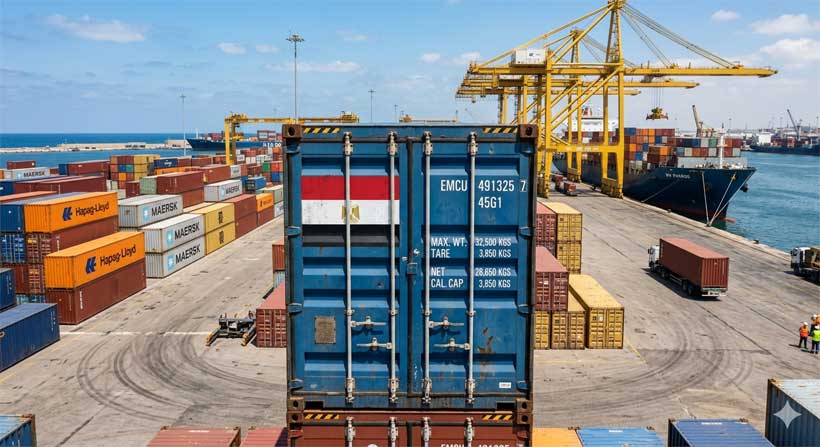
China’s move to exempt Egyptian imports from customs duties (zero-tariff policy), which began in May 2026 as part of its Belt and Road Initiative, represents a historic opportunity. However, Egypt’s ability to capitalize on this opportunity depends on the speed of industrial adaptation and the quality of its products. China’s decision to exempt Egyptian imports from customs duties (zero tariffs) starting May 1, 2026, is a historic strategic step, part of a broader Chinese initiative to support exports to Africa (53 countries). This decision presents a genuine opportunity to increase Egyptian exports, but it requires intensive internal efforts to fully leverage it. This Chinese decision coincides with the conclusion of China’s 15th Five-Year Plan and its alignment with Egypt’s Vision 2030, aiming to enhance trade and facilitate the entry of Egyptian products into Chinese markets (1.4 billion Chinese consumers). Beyond its political and economic dimensions, the Chinese decision to lift tariffs on Egyptian goods carries a strategic political significance. It reflects the deepening partnership between Cairo and Beijing within the framework of the Belt and Road Initiative and the Global South, as well as China’s desire to secure stable supply chains. The Egyptian sectors most likely to benefit from this Chinese decision and exemption include agricultural products such as oranges, grapes, dates, and frozen strawberries; food industries such as textiles and ready-made garments (with an expected increase in Egyptian exports of these products between 30% and 200%); building materials, including marble and granite; and chemicals and fertilizers.
While considering the competitiveness of Egyptian products, which currently enjoy a price advantage (especially with the elimination of tariffs that reached 25%), their success ultimately depends on quality and speed of export. In addition to complementary internal Egyptian initiatives by the government and private sector to align Egyptian standards with stringent Chinese standards, Egypt is shifting from exporting raw materials to exporting finished products with higher added value. This includes activating logistics and express shipping services to enhance smart marketing within the Chinese market. Currently, to maximize the benefits of this Chinese exemption, the Egyptian government and private sector need to localize Chinese technology in Cairo. This involves focusing on transferring Chinese technology and training Egyptian personnel to increase added value, rather than exporting raw materials. Simultaneously, green channels should be activated, meaning expediting customs and logistical procedures at Egyptian ports to reduce the time it takes for goods to leave Egypt. Emphasis was placed on the necessity of studying the needs of the Chinese market by directing Egyptian factories to produce goods that meet the tastes of Chinese consumers, particularly in the food and textile industries. Furthermore, it was stressed that maximizing the benefits of China’s economic zones in the Egyptian market is crucial. This can be achieved by leveraging the TEDA industrial zone in Ain Sokhna, west of the Suez Canal, to attract more Chinese companies to manufacture goods for export within the Egyptian market.
Regarding the impact of the Chinese decision concerning the exemption on the dollar and investment, this decision contributes to reducing Egypt’s trade deficit (which currently favors China) by increasing export revenues. This, in turn, alleviates pressure on foreign currency reserves. The decision also encourages Chinese investors to relocate their supply chains and manufacturing operations to Egypt, such as the TEDA industrial zone west of the Suez Canal, for export to China or Africa, thus benefiting from the zero-tariff policy on Egyptian goods. On the other hand, the Chinese decision strengthens Egypt’s role as a logistics/industrial hub amidst current regional and global tensions. It reinforces Egypt’s position as a key gateway for Chinese products to the African continent and the Arab region, particularly given the trade tensions between China and the West.
This Chinese decision also contributes to alleviating Egypt’s dollar crisis by boosting exports. While the decision indirectly contributes to supporting Egypt’s foreign currency reserves, it does so effectively, provided that added value is increased. Significant growth in trade between Egypt and China is expected, potentially reaching record levels (exceeding $20 billion by 2026) if the opportunity is seized. The zero-tariff entry of Egyptian products into Chinese markets enhances their competitiveness, leading to increased exports and a rise in dollar reserves in the Egyptian market. Furthermore, this Chinese decision will attract new Chinese investments to Egypt, encouraging a significant influx of foreign investment. There are also Chinese offers already exceeding $2.4 billion in investments to establish industrial projects and a logistics city in Egypt by 2026. Egypt aims to increase Chinese investments to $15 billion by the end of 2026, given China’s growing interest in relocating some of its industries to Egypt, such as electric vehicles, clothing, and textiles, to serve as a gateway to Africa and the Middle East.
Stay ahead of the geopolitical week.
MD Briefing delivers expert analysis across five global fronts — the Indo-Pacific, energy, geoeconomics, European security, and the Middle East — every Monday morning. Free.
A number of challenges remain, most notably fierce competition from other countries, strict technical standards, shipping costs, and the need for huge production quantities. These are challenges that Egypt can overcome by restructuring certain industries, providing training on Chinese standards, and leveraging other trade agreements, such as COMESA with Africa, to enhance the added value of Egyptian exports.
Finally, the Chinese message behind the decision to exempt Egyptian exports reflects China’s confidence in the Egyptian economy and Egypt’s regional standing as a long-term strategic partner, not merely a temporary preferential treatment. This Chinese decision opens a historic door, but the real benefit depends on the speed with which the Egyptian private sector adapts to Chinese standards and improves quality. In short, starting in May 2026, the ball will be in the Egyptian producer’s court. Egypt will either become a regional manufacturing hub for China or the gains will be limited to temporary advantages. True success here depends on the rapid development of Egyptian national industries and the localization of advanced Chinese technology in Cairo, in accordance with the directives of President El-Sisi’s political leadership.
