


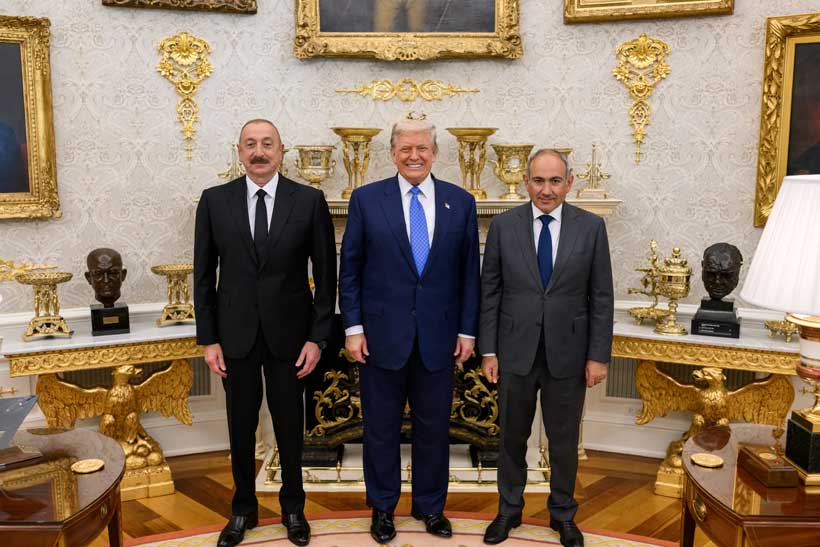
On 8 August 2025, Armenian Prime Minister Nikol Pashinyan and Azerbaijani President Ilham Aliyev signed a Joint Declaration at the White House establishing the Trump Route for Peace and Prosperity (TRIPP). The agreement aimed to open a corridor linking Azerbaijan’s mainland to its Nakhchivan exclave through Armenia’s southern Syunik region, with reciprocal connectivity benefits for Armenia.
The corridor concept has deep roots — over a century of Azerbaijani and Turkish ambitions for unbroken land connectivity between their two countries, with Armenia as the geographic obstacle. The modern impetus came from Article 9 of the November 2020 ceasefire ending the second Nagorno-Karabakh war. For years, negotiations deadlocked over naming rights, jurisdiction, and control. The TRIPP deal broke that impasse by having Armenian officials retain legal border control while a private third-country company conducts checks — an idea previously floated under earlier administrations but given new branding and White House fanfare by Trump’s team.
Crucially, TRIPP has already achieved something underappreciated: it deferred Azerbaijan’s otherwise imminent military seizure of the corridor. President Aliyev had openly warned the corridor would be established “whether Armenia wants it or not.” U.S. engagement postponed that threat indefinitely.
What Was Agreed — and What Was Not
Stay ahead of the geopolitical week.
MD Briefing delivers expert analysis across five global fronts — the Indo-Pacific, energy, geoeconomics, European security, and the Middle East — every Monday morning. Free.
Nine months in, the most striking feature of TRIPP is how little has been operationally resolved. A January 2026 TRIPP Implementation Framework (TIF) established a “TRIPP Development Company” — 74% U.S.-owned, 26% Armenian — to develop 43 kilometers of rail, road, fiber optic, and energy infrastructure through Syunik over an initial 49-year term. But the TIF is notably thin: no construction timetable, no dispute resolution mechanism, and — most strikingly — an explicit disclaimer that it imposes no legal obligations on either the U.S. or Armenia.
The security architecture is also ambiguous. Armenia formally retains sovereignty, but private contractors may assume day-to-day security responsibilities. The use of a U.S. intermediary company between Armenian and Azerbaijani customs officials is the central innovation — but the ongoing U.S.–Israel war against Iran makes deploying U.S. personnel near the Iranian border highly problematic.
Sovereignty erosion risks lurk in the Special Purpose Vehicles (SPVs) to be created under the development company. History consistently shows that states lose effective control of transit infrastructure not because they lack legal authority, but because exercising it becomes prohibitive once commercial and arbitration structures are in place.
Winners and Losers
Azerbaijan is the clearest winner: it obtains the direct Nakhchivan link it has sought since 2020, without military action. Turkey’s pan-Eurasian strategic ambitions are advanced. The U.S. gains a strategic foothold in the South Caucasus, mineral access, and a signature foreign policy achievement.
Armenia’s gains are conditional and asymmetric. It faces a structural reciprocity gap: Azerbaijani cargo and passengers will enjoy privileged transit through Armenia, but Armenian cargo and passengers have no equivalent guarantees through Azerbaijan. Yerevan interprets “reciprocal benefits” to mean comparable access through Azerbaijani territory; Baku interprets it as overall mutual benefit — not identical arrangements. No mechanism currently exists to enforce Armenian reciprocal access, and no timeline has been committed to by Baku.
Armenia’s financial returns — a 26% equity stake, customs duties, and fees — are mentioned but not quantified. Foreign Minister Mirzoyan has stated plainly: if the railway section to Gyumri is not included, TRIPP loses its relevance. The financial model only functions if Armenia becomes a genuine east–west transit hub, not merely a service corridor for Azerbaijan.
Structural Choke Points
Two structural vulnerabilities could derail the entire project.
First, Armenia’s railway network has been under a 30-year concession to South Caucasus Railway (SCR), a wholly owned subsidiary of Russian Railways, since 2008. Russian Railways is in severe financial crisis ($51 billion in debt), and mandatory investment commitments have remained largely on paper. Pashinyan has formally requested Moscow to accelerate restoration of the Soviet-era rail segment foundational to TRIPP and has threatened to withdraw that segment from the concession if Russia fails to deliver. Armenia could legally do so, but the geopolitical complexity of compelling Moscow is considerable.
Second, TRIPP is legally entangled with a peace treaty that has been initialed but not signed. Azerbaijan insists Armenia remove references to the 1990 Declaration of Independence, which mentions Nagorno-Karabakh, before signing. Baku itself maintains constitutional provisions that imply claims to Armenian territory without acknowledging their controversial nature. Full border demarcation is years away, and the entire TRIPP corridor runs through this non-demarcated zone. The draft peace agreement contains no reference to the rights of displaced Karabakh Armenians, or the 19 Armenian hostages held in Azerbaijani jails.
The Missing Half: Turkey
TRIPP’s full economic promise to Armenia cannot be realized while the Turkish border remains sealed after 33 years. Armenian Foreign Minister Mirzoyan has been explicit: the Kars–Gyumri railway is not a footnote to TRIPP — it is its western terminus. In April 2026, Turkish and Armenian officials met in Kars to establish a joint working group on reopening the line, but Turkey’s position remains that normalization awaits a signed Armenia–Azerbaijan peace agreement. Turkey is also constructing a parallel railroad on its territory. Armenia is the structurally weakest of the three parties in this triangular relationship.
The EU’s Absence
TRIPP is a bilateral deal witnessed by a U.S. president, not a multilateral framework — which structurally sidelines the European Union despite its deep strategic interest in the Middle Corridor’s success. The EU has welcomed the project rhetorically and is investing in Armenia through separate instruments (Resilient Syunik, Global Gateway) but is not a co-investor in TRIPP’s governance structure.
This is a missed opportunity. The EU brings deep experience in cross-border infrastructure governance through TEN-T and Global Gateway, large-scale financing capacity through the EIB and EBRD, and institutional continuity that does not depend on any single leader’s attention span. A 2026 European Commission study found the TRIPP route would cut travel times by up to 25% compared with the Baku–Tbilisi–Kars railroad — meaning Brussels has already done the technical homework. A U.S.–EU co-management model — with Washington providing political guarantee and security, and Brussels providing bulk financing, technical governance, and institutional continuity — could address TRIPP’s two most glaring vulnerabilities: its dependence on Trump personally, and the absence of legally binding commitments.
The Iran Variable
The U.S.–Israel war against Iran is simultaneously strengthening TRIPP’s strategic rationale and threatening its physical implementation. With Hormuz shipping disrupted and Iran’s transit role compromised, the Middle Corridor’s value has sharply increased — cargo takes 12–15 days via the corridor versus 40 days by sea. But deploying U.S. personnel near the Iranian border is now difficult; site survey visits have already been postponed; and the commercial companies the U.S. hoped to attract are reassessing security risks. The same small U.S. team — led by Steve Witkoff — responsible for TRIPP is now primarily consumed by the Iran crisis.
Meanwhile, Russia is capitalizing on regional uncertainty. Azerbaijan is hedging — Aliyev recently visited Georgia to signal the Tbilisi route remains viable — and there are signs of Kremlin optimism that the Iran war has at least temporarily buried TRIPP.
Conclusion: A Corridor Without a Foundation?
TRIPP has achieved real, if fragile, results: it has substituted for a Russian-controlled corridor, deferred Azerbaijani military pressure on Syunik, and initiated the first genuine normalization of Armenian Azerbaijani relations in a generation.
But the project is built on compounding fragilities. Nine months in, not a single meter of construction has occurred on Armenian soil. There is no signed peace treaty, no finalized operating company contract, no resolved Russian railway concession, and now a war literally across the border. The governing Implementation Framework explicitly disclaims legal obligation on either party — an extraordinary admission for a project of this scale.
Armenia’s structural position remains asymmetric. It provides the territory, absorbs the sovereignty risk, hosts U.S. security personnel near the Iranian border, and depends on political processes entirely outside its control — a signed peace agreement, an open Turkish border, Azerbaijani reciprocity — for the promised dividends to materialize. Azerbaijan gets its corridor. Turkey gets its logistics hub. The U.S. gets its minerals and its trophy deal. Armenia gets a conditional promise and a 49-year commitment.
The deeper question TRIPP poses has not changed since 8 August 2025: is this a genuine crossroads of peace, or a corridor for everyone else’s prosperity? The answer lies in the details that remain stubbornly unresolved — the security contract, the railway concession, reciprocal access, the Armenian hostages in Azerbaijani jails, and the Turkish border sealed for 33 years.
