


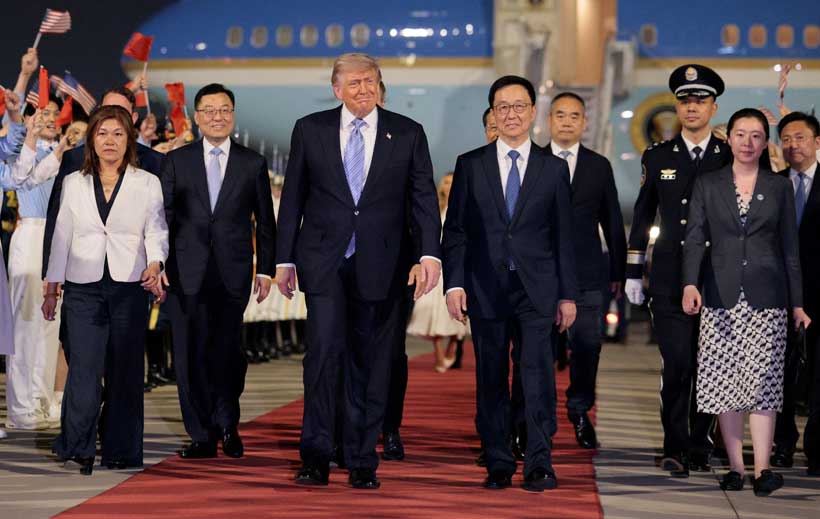
Trump is heading to Beijing for the most consequential foreign policy meeting of his second term. He arrives as the first US president to visit China in nearly nine years — the last visit was his own, in November 2017, when Xi rolled out a “state visit-plus” with a private dinner in the Forbidden City, a parade through Tiananmen Square, and $250 billion in commercial deals announced with considerable fanfare. That visit was followed, within months, by the opening salvos of a trade war that battered both economies and defined the next seven years of the bilateral relationship.
This time is different. The fanfare will be similar; the Great Hall of the People, the Temple of Heaven, a state banquet, tea and lunch together. The strategic context is not similar at all. Trump arrives with his tariff ambitions blunted by court rulings, his approval ratings at record lows driven by an Iran war more than 60% of Americans disapprove of, and his main ask being something only Beijing can deliver: Chinese pressure on Tehran to end a conflict Washington started and has not been able to finish.
As one analyst put it plainly: Trump “kind of needs China more than China needs him.”
The Seven Months That Shifted the Balance Toward Beijing
When Trump and Xi last met at Busan in October 2025, Trump had just imposed triple-digit tariffs on Chinese goods and was presenting himself as the president who had finally called China’s bluff. Xi had responded by restricting rare earth exports, brutally exposing the West’s dependency on materials vital to everything from electric vehicles to weapons systems. Both sides stepped back, Trump suspended the tariffs, Xi suspended the rare earth restrictions and the encounter produced what analysts have been calling a fragile truce ever since.
Stay ahead of the geopolitical week.
MD Briefing delivers expert analysis across five global fronts — the Indo-Pacific, energy, geoeconomics, European security, and the Middle East — every Monday morning. Free.
Since that meeting, the trajectories of the two leaders have moved in sharply different directions. Trump has been fighting one battle after another: US courts ruled his tariffs unlawful, narrowing his trade options considerably. He waged a war on Iran that was predicted to last four to six weeks and is now in its seventy-second day. He tried to capture Venezuela’s president and threatened to annex Greenland. His approval rating has sunk to 36%, one of the lowest recorded for a sitting president.
Xi, meanwhile, has been quietly expanding China’s economic pressure toolkit. Since Busan, Beijing has enacted laws to punish foreign entities that shift supply chains away from China, tightened its rare earth licensing regime, and invoked an unprecedented “blocking rule” in response to US sanctions on Chinese refiners buying Iranian crude, directing Chinese companies not to comply with American regulatory demands and placing US firms in the position of choosing between two incompatible legal regimes. China has been building leverage while Washington was distracted, and it has done so without generating the kind of dramatic headlines that would force a response.
The asymmetry going into Beijing is visible and significant. China feels confident enough, according to CSIS analysts, to stand up to Trump on several key issues simultaneously ; sanctions, technology controls, critical minerals, and Iran. The eagerness to hold the summit at all signals that Beijing is not as confident as it appears, but the confidence gap between the two sides entering these talks is considerably wider than it was at Busan.
The Three Things Trump Needs and Only Xi Can Deliver
The agenda for May 14 and 15 has been described by officials involved in the planning as producing a handful of deals and mechanisms to manage future trade notably not a resolution of the fundamental tensions, and notably not a confirmed extension of the Busan trade truce, which remains uncertain as of Trump’s departure.
On the economic side, the deliverables most analysts expect are Chinese purchases of American agricultural goods: soybeans and beef have been specifically mentioned Boeing aircraft orders, and the establishment of a bilateral Board of Trade and a parallel Board of Investment to create regularized channels for handling commercial disputes. These are meaningful in terms of headlines but modest in terms of structural change. The core tensions over semiconductor export controls, advanced memory chips, and technology decoupling remain unresolved and are unlikely to be resolved in two days of meetings.
The Iran dimension is where Trump’s need is most acute and Beijing’s leverage is most visible. More than 60% of Americans disapprove of the Iran war. The Strait of Hormuz remains contested despite the ceasefire. The Islamabad nuclear talks collapsed in April. Trump needs China to press Iran toward a settlement that can be presented as a diplomatic win before the November midterms. Beijing has been positioning itself for exactly this moment, Wang Yi hosted Iranian Foreign Minister Araghchi last week, called for Hormuz to reopen, and generated considerable diplomatic credit in Washington for doing so. The price of that credit will be discussed this week.
Trump has also said he will raise arms sales to Taiwan and the case of jailed media tycoon Jimmy Lai, two issues that are almost certain to generate friction and equally certain not to be resolved.
What Xi Wants, and Why Taiwan Is the Real Priority
Beijing’s agenda going into the summit is more disciplined and more strategic than Washington’s, which is itself a reflection of the asymmetric positions both sides occupy.
China’s primary objective is what analysts have called “institutionalized friction”, an end to the unpredictable lurches and dramatic escalations that characterized the first year of Trump’s second term, replaced by a more stable pattern in which both sides can continue managing their competition without triggering a crisis. Beijing wants to know the rules of managed competition. That is a more modest goal than a grand bargain, but it is also considerably more achievable and more durable if established.
Taiwan sits at the top of Xi’s actual agenda, and it has been placed there deliberately. Beijing will push for changes in how Washington describes the cross-strait relationship, specifically, language that would have the US “support peaceful unification” rather than simply “not support independence,” and changes to arms sales commitments that would weaken one of the Six Assurances the US has maintained since the Reagan era. Trump’s announcement on Monday that he planned to discuss arms sales to Taiwan with Xi, breaking with standard US practice of keeping such discussions separate from bilateral diplomacy, sent alarm signals through Taipei and across US allies in the region.
Taiwan is watching closely for any deviation that Beijing could exploit to bolster its position. The concern in Taipei, shared by several US allies in the region, is that Trump’s confidence in his personal relationship with Xi will produce verbal commitments in Beijing that narrow US flexibility on Taiwan without those commitments being fully thought through in advance. Precedent from the 2017 visit, which produced warm atmospherics followed by a trade war, suggests that nice photographs and state banquets do not guarantee strategic alignment.
China also wants the Trump administration to commit to rolling back existing export controls on chipmaking equipment and advanced memory chips, and to stop taking what Beijing frames as retaliatory trade actions under the guise of national security. These are structural demands that Washington has shown no sign of meeting, which is why most analysts expect the summit to produce a symbolic stabilization rather than a substantive breakthrough.
The Win That Might Not Be a Win
Scott Kennedy of CSIS described the most likely outcome of the summit plainly: “a superficial ceasefire that is largely to China’s advantage.” That framing captures something important about the current dynamic. A ceasefire, even a superficial one, would allow Trump to claim a foreign policy win. Extending the trade truce, securing Boeing orders and soybean purchases, and walking away with a commitment from Xi to press Iran, all of this could be packaged for domestic consumption as proof that Trump’s approach to China is working.
Whether it is actually working is a different question. China has spent the past seven months since Busan expanding its economic leverage toolkit while Washington managed crises elsewhere. The rare earth weapon has been tested and found effective twice. The blocking rule has been deployed for the first time. The Belt and Road relationships across the Global South have deepened. The Iran war has given Beijing diplomatic currency it is now spending in Beijing’s own capital, on its own terms.
A majority of Americans — 53% — now say the US should pursue friendly cooperation and engagement with China, up from 40% in 2024. That shift in public opinion gives Trump political cover to emerge from Beijing with a stabilization agreement and present it as responsible statecraft rather than capitulation. Whether it is responsible statecraft or capitulation depends on what was traded for it, and those details will take considerably longer than two days to become clear.
The Temple of Heaven photographs will be striking, the state banquet will be cordial and the announcements will be significant enough to generate headlines. What will matter more is what was said in the rooms where the cameras were not about Taiwan’s future, about the terms of Chinese cooperation on Iran, and about the export controls and technology competition that will define the bilateral relationship long after Trump has left Beijing and Xi has welcomed Putin in his place.
