


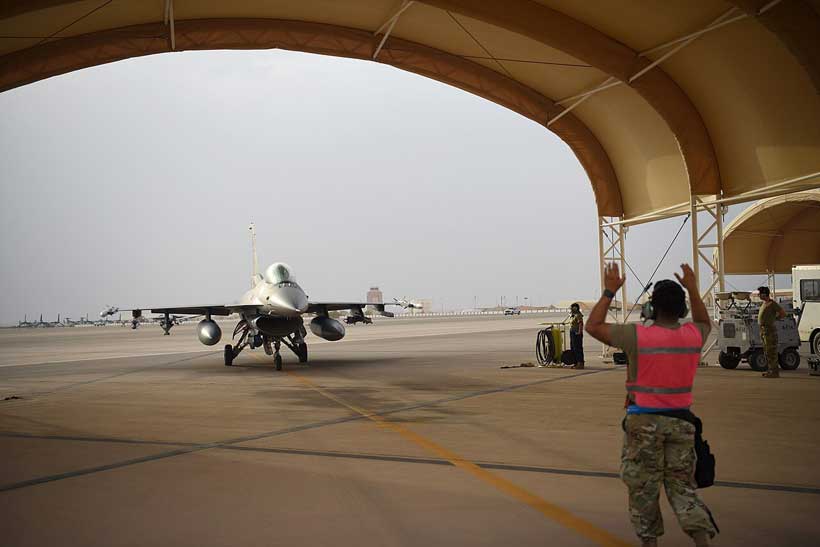
According to Chinese intelligence reports and military analyses in May 2026, the Chinese side (both military and academic) views Saudi Arabia’s refusal to allow the use of its bases and airspace in the US operation known as Project Freedom to reopen the Strait of Hormuz as a significant strategic shift in the Middle East. Riyadh refused to allow US forces to use its bases, such as Prince Sultan Air Base, or its airspace for offensive attacks against Iran, fearing escalating Iranian retaliation and seeking to maintain regional stability. However, Riyadh continues to allow the US to use Saudi bases for defensive purposes, such as counterterrorism, intelligence gathering, and maritime security, thus balancing the preservation of Saudi security with avoiding involvement in a war with Iran.
Therefore, Beijing views Saudi Arabia’s refusal to allow the use of its bases and airspace for the US-led Operation Freedom to reopen the Strait of Hormuz as a strategic opportunity for China to expand its influence in the Gulf. Saudi Arabia is seen as a pragmatic player seeking de-escalation and stability, making the Chinese model of security in the region more attractive than the American model based on escalation. The decline in trust in Washington is pushing Gulf states toward diversifying their partnerships to mitigate risks, thus providing China with an opportunity to expand its influence in a region historically dominated by the United States for many years.
Here, we can summarize and understand the Chinese intelligence analysis of the implications of this Saudi refusal to allow the US to use its bases against Iran. China understands the dimensions of Saudi Arabia’s growing strategic independence from Washington. This Chinese analysis is based on assessments from military and intelligence agencies and think tanks concerned with the Middle East. Chinese experts believe that Riyadh no longer considers its security to be exclusively dependent on the United States. In Beijing, relevant circles believe that Saudi Arabia’s rejection of the American request reflects a strong Saudi desire to adopt a realistic diplomacy that balances international power and avoids entering into offensive US-Israeli military alliances against Iran. Beijing also sees this as having particular significance, as Riyadh is sending a clear signal to Washington that its bases are not open for unilateral operations that could harm its national interests. Furthermore, Riyadh’s refusal to allow the use of Saudi bases, such as Prince Sultan Air Base, and its airspace is interpreted as a Saudi desire to avoid being drawn into direct military confrontations with Iran, thus opening the door for Chinese initiatives to de-escalate tensions.
The Chinese analysis also suggests that Saudi Arabia’s fear of Iranian retaliation and its calculations of the costs involved are crucial factors behind its refusal to allow the US to use its bases and airspace. Saudi intelligence reports, which Beijing has access to, indicate that Saudi Arabia understands that participating in a potential military attack against Iran would make its vital oil facilities and bases direct targets for Iranian missiles, as has happened before. Therefore, Saudi Arabia has taken a firm stance against the use of its territory to prevent a destructive escalation, having realized that the US cannot guarantee complete protection. This strengthens Beijing’s role as a regional guarantor within the framework of the partnership with China. Beijing sees this Saudi action as consistent with its own global security initiative, which advocates resolving conflicts through dialogue, not US military intervention. Here, Beijing is exploiting the current Gulf discontent with American unpredictability to solidify its image as a reliable alternative and a stable security and diplomatic partner, especially after its success in brokering the Saudi-Iranian agreement. This aligns with China’s desire to expand its economic and geopolitical influence. China is seen as a major trading partner (the largest energy importer) seeking to link its economic power with geopolitical ambitions in Saudi Arabia and the Gulf region, thus providing an opportunity to increase Gulf dependence on it, independent of American volatility.
Stay ahead of the geopolitical week.
MD Briefing delivers expert analysis across five global fronts — the Indo-Pacific, energy, geoeconomics, European security, and the Middle East — every Monday morning. Free.
Beijing also believes that this Saudi stance reinforces the Gulf states’ confidence in China as a reliable political and economic ally capable of persuading Iran to de-escalate tensions. As a major oil importer, Beijing fears supply disruptions but prefers diplomatic solutions. Furthermore, Chinese analysts believe that Saudi Arabia’s rejection of Trump’s abrupt policy and Riyadh’s anger are significant factors behind the Saudi refusal. They note that the Saudi decision stemmed from a lack of American coordination, as Trump announced the operation via social media. Consequently, Riyadh refuses to be drawn into an ill-advised war and is reshaping its relationship with Washington on the basis of reciprocity. This is in addition to the continued policy of hedging between the superpowers. Chinese intelligence analysis is based on the view that Saudi Arabia is not ending its alliance with the United States but rather practicing a policy of hedging. Saudi Arabia refuses to allow the use of its bases and airspace for offensive purposes but continues to use them for other defensive purposes, allowing it to benefit from American and Chinese security equipment.
In this context, Saudi foreign policy in 2026 is viewed, from the perspective of Chinese strategic and intelligence analyses, as an advanced model of strategic hedging, not a break from the American alliance. Beijing believes that Riyadh is cleverly managing risks by balancing its relations between the two superpowers, benefiting from Chinese technology while maintaining the American security umbrella, without directly engaging in regional conflicts that serve Washington’s agendas exclusively. The Saudi hedging strategy, as analyzed by Chinese analysts, is based on a policy of not ending the alliance with America but maneuvering with it. Beijing recognizes that the United States remains Saudi Arabia’s primary security guarantor, as the Saudi military relies heavily on American systems, training, and intelligence. Simultaneously, Saudi Arabia desires to diversify its international partners. From Beijing’s perspective, this hedging strategy means reducing absolute dependence on Washington by diversifying partnerships, particularly with China, in areas such as technology, artificial intelligence, and infrastructure, like the NEOM project. According to analyses by relevant Chinese intelligence and military agencies, Saudi policy is also based on deterrence through interdependence. Riyadh seeks to make China a vital partner in its national development (Vision 2030), ensuring continued Chinese investment in the security of the Arabian Peninsula and establishing China as a partner committed to non-interference in internal affairs, unlike American policies. Here, Saudi Arabia leverages its hedging strategy to maximize its interests with both the United States, through continued advanced arms deals, joint military exercises, and security guarantees, and with China, through acquiring Chinese technology without political strings attached, localizing Chinese defense capabilities, and strengthening economic partnerships within the framework of China’s Belt and Road Initiative. This fills the void created by Washington’s reluctance to make absolute security commitments to Saudi Arabia and the Gulf states.
Beijing believes that this Saudi hedging approach to its relations with Washington is facing increasing pressure, particularly from the US. The Trump administration, in 2026, sought to restrict Saudi Arabia’s reliance on Chinese infrastructure, such as Huawei’s 5G networks, and to limit its dependence on Chinese 5G weapons, warning Washington that this could jeopardize its defense interoperability with China. Here, Chinese intelligence and military agencies present Saudi Arabia with a scenario of being forced to choose between Washington and Beijing. This is especially relevant given the deepening technological and military competition between the two countries, which may shrink the gray area in which Riyadh operates. This could ultimately compel Saudi Arabia to choose sides in major conflicts, such as the one concerning Taiwan.
Finally, relevant circles in Beijing analyze Saudi Arabia’s current policy toward Washington, concluding that the Kingdom is not turning the tables on America, but rather reordering its priorities. Riyadh is employing a zero-enemies policy regionally to achieve its Vision 2030 and prefers to be an independent and effective ally, not a blind follower of American policy. This makes Saudi Arabia a balanced strategic partner, balancing reliance on American equipment with Chinese services.
