


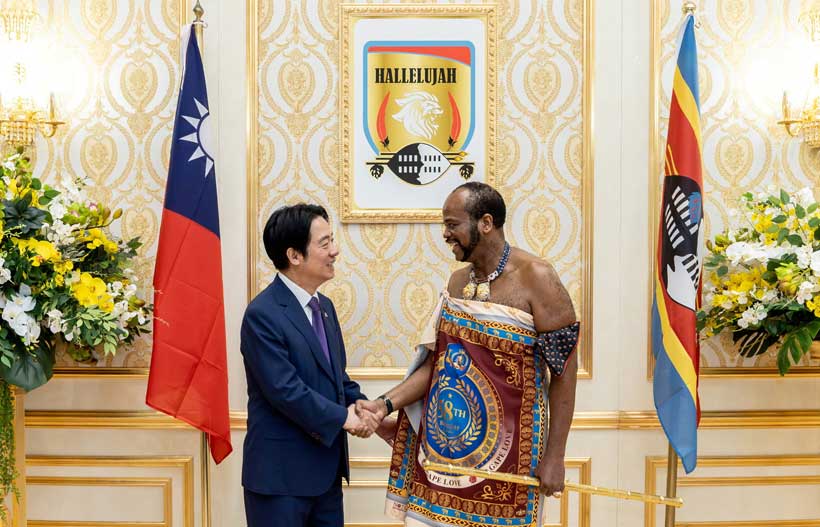
Beijing launched a sharp diplomatic attack, strongly condemning Taiwanese President Lai Ching-te’s visit on Saturday, May 2, 2026, to the Kingdom of Eswatini in Africa (Taipei’s last remaining diplomatic ally in Africa). The visit aimed to commemorate the 40th anniversary of King Mswati III’s accession to the throne and his birthday, as well as to strengthen diplomatic ties. Beijing urged Eswatini and other countries to see the direction of history and cease supporting Taiwanese independence. Eswatini (formerly Swaziland) is Taiwan’s only remaining diplomatic ally in Africa. This visit comes amid heightened tensions between China and Taiwan, with China seeking to isolate Taiwan internationally, while Taiwan asserts its right to engage with the world. China maintains that Taiwan is an inalienable part of the Chinese mainland and that any attempts to cooperate with separatists are doomed to failure.
Following his visit to the Kingdom of Eswatini, Chinese state media described Lai Ching-te in a variety of terms, including accusing him of being a troublemaker. Chen Bin-hua, spokesperson for the State Council’s Taiwan Affairs Office, described Lai’s visit as a staged performance and a sneaky escape, comparing him to a rat. The Chinese official used strong language, saying that Lai Ching-te sneaked into Eswatini like a rat scurrying down the street. The spokesperson also referred to Lai’s so-called diplomatic achievements as nothing but petty tricks that make him a laughingstock in the eyes of the world and accused him of wasting taxpayers’ money during his visit to Eswatini. In Taiwan, the visit was described as a ridiculous stunt. Lai Ching-te’s trip finally arrived in early May 2026 after delays, amid Taiwanese accusations that Beijing pressured African countries to revoke overflight permits for Lai Ching-te’s aircraft in April 2026. Beijing labeled Lai Ching-te a troublemaker with a stubbornly separatist stance and dismissed the visit as a farce. China considers such visits provocative and strongly condemns them, viewing Taiwan as part of its territory.
The most significant details of this Chinese condemnation and the context surrounding the visit are highlighted by the sharp Chinese criticism and personal attacks on the Taiwanese president. Chen Bin-hua, spokesperson for China’s Taiwan Affairs Office, described the visit as a secret infiltration and referred to Lai Ching-te as a rat fleeing the island. Here, intelligence circles in Beijing analyzed the timing of Lai Ching-te’s visit to the Kingdom of Eswatini. Beijing criticized Lai for undertaking the trip while Taiwan was still reeling from the aftermath of the Yilan earthquake, accusing him of abandoning his people and squandering taxpayers’ money on a political charade aimed at promoting Taiwanese independence. At the same time, China emphasized the One China principle, stressing that these Taiwanese actions would not alter the fact that Taiwan is part of its territory. China urged the Kingdom of Eswatini to cease supporting separatists.
Lai Ching-te’s arrival in Eswatini, Taipei’s only diplomatic ally in Africa, on May 2, 2026, came after a previous trip scheduled for April 2026 was postponed due to Chinese pressure that prevented his plane from crossing the airspace of certain countries. This prompted a firm response from Beijing. Chen Bin-hua, spokesperson for the State Council’s Taiwan Affairs Office, described Lai as a troublemaker seeking secession, labeling the visit a farce and an attempt to smuggle him out of the island. China reiterated its firm stance that Taiwan is an inalienable part of its territory and the Chinese mainland, condemning Taiwan’s handling of any foreign affairs or diplomatic relations with any other country, such as Eswatini. Taiwanese President Lai Ching-te responded to this Chinese escalation by declaring that Taiwan will never be deterred by external pressure, while King Mswati III of Eswatini affirmed that his country would not sever its ties with Taiwan.
Stay ahead of the geopolitical week.
MD Briefing delivers expert analysis across five global fronts — the Indo-Pacific, energy, geoeconomics, European security, and the Middle East — every Monday morning. Free.
It is worth noting that several countries revoked permits for President Lai Ching-te’s visit. Originally scheduled for late April 2026, the visit was postponed after several African nations, including Seychelles, Mauritius, and Madagascar, revoked overflight permits for his aircraft to maintain their relations with China. Taiwan attributed this to intense economic pressure from Beijing. To circumvent these obstacles, President Lai took an alternative route, traveling on a private plane belonging to the King of Eswatini to the capital, Mbabane, on Saturday, May 2, 2026. The trip was shrouded in secrecy for security reasons. Regarding the Taiwanese reaction and the stance of Taipei and the Kingdom of Eswatini on the visit, Lai defended it, emphasizing Taiwan’s right to international engagement. He stated that determination and commitment will continue despite external challenges. King Mswati III of Eswatini also affirmed that his country would not sever ties with Taiwan, considering the relationship between the two sides to be historical and beyond the influence of any external party.
Based on the preceding analysis and understanding, we understand that adhering to the one-China principle represents the shared aspirations of the international community and, from China’s official perspective, constitutes an irresistible historical trend. China emphasizes that the correct historical direction of national reunification is unstoppable.
