


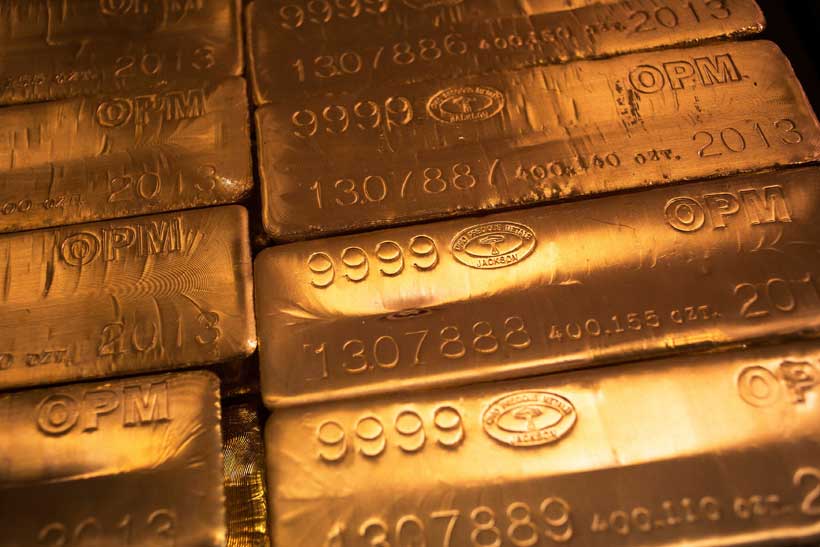
Russia has now sold physical gold from central bank linked reserves for the first time in about a quarter century, and the headline number is real enough to matter. bne IntelliNews reported sales of 300,000 troy ounces in January and 200,000 in February. The Bank of Russia’s January bulletin showed 74.8 million fine troy ounces at the end of December, while the central bank’s monthly reserves table and follow up reporting from The Moscow Times put the stock at 74.3 million ounces after February. That is a decline of 500,000 ounces, or about 15.5 metric tons. But one popular claim needs correcting. Using Reuters’ March 24 gold price of $4,389.26 an ounce and the official Bank of Russia dollar rate of 81.8763 rubles, that two month sale is worth closer to 180 billion rubles, not 3.5 trillion. The 3.449 trillion-ruble figure belongs to the budget deficit, not the bullion sale.
That does not mean the pressure is imaginary. Interfax says Russia’s federal budget deficit in January and February reached 3.449 trillion rubles, or 1.5 percent of GDP. Reuters reported the government was preparing possible cuts of about 10 percent in non-sensitive spending, while another Reuters report estimated March oil and gas revenues could fall 52 percent year on year to 520 billion rubles. So yes, the fiscal squeeze is serious. My view, though, is that calling this “panic selling” misses the mechanism. Moscow is not liquidating gold because gold stopped mattering. It is liquidating gold because gold can still do something yuan cannot easily do inside Russia, become immediate ruble liquidity without asking an anxious bank in Shanghai for permission.
The sanctions era pushed Russia toward China, and the numbers are striking. A Carnegie analysis found that Russian banks held $68.7 billion in yuan in 2023, above their dollar holdings, and that the yuan had become the most traded currency on the Moscow Exchange. Later, Reuters said around 90 percent of Russia China trade was already being conducted in rubles and yuan, while Anadolu cited Russian officials putting the share at 99.1 percent. Yet the same relationship is not frictionless, because Reuters also reported that total China Russia trade in 2025 slipped to $228.1 billion, the first annual decline in five years. That is the point many commentators still miss. Settlement in yuan is not the same thing as free conversion into working rubles.
Russia has money, but not the right kind of money
Stay ahead of the geopolitical week.
MD Briefing delivers expert analysis across five global fronts — the Indo-Pacific, energy, geoeconomics, European security, and the Middle East — every Monday morning. Free.
The payments channel has been degrading for two years. Reuters documented rising payment problems and falling imports from China as banks tightened checks. Another Reuters investigation described the “China Track” netting system set up to keep flows moving outside the most exposed banking routes. A separate Reuters report said up to half of Russia’s payments to China were being routed through intermediaries. This is not what a healthy trade currency system looks like. It is what a damaged one looks like. Russia is not short of assets. Russia is short of clean monetary transmission.
That is why the gold sale makes sense. On March 18, The Moscow Times reported that demand had exhausted the Bank of Russia’s 5 billion yuan swap facility, and overnight yuan borrowing rates on the Moscow Exchange spiked as high as 44 percent. Interfax then reported that the central bank would not raise the swap limit. This sits neatly beside a Reuters report from November saying the National Wealth Fund now operates with a 60 percent yuan and 40 percent gold structure and that the central bank had been selling yuan and gold for rubles to support the budget. Here is the new and more useful way to read the story: gold is no longer just a reserve asset for Moscow; it is a domestic settlement rail. It turns trapped external value into usable internal cash.
The export ban completes the design
That also explains why Putin’s export ban is not contradictory. Xinhua reported that Russia will ban exports of refined gold bars over 100 grams from May 1, with exemptions in limited cases. Anadolu added Deputy Finance Minister Alexei Moiseev’s explanation, gold had become a substitute for foreign currency in illicit transactions, capital flight, and money laundering. In plain language, the Kremlin wants gold to stay inside the country as an official liquidity instrument, while preventing households, firms, and shadow networks from using it as a portable escape hatch. This is not anti-gold policy. It is a state bid to monopolize gold’s convertibility.
So, the cleanest description is not “Russia dumping gold in panic.” It is this: Russia has become a split reserve state. Yuan handles a big share of external trade. Gold bridges the gap between foreign asset holdings and domestic fiscal needs. Rubles still do the only job that matters at home, paying soldiers, suppliers, pensions, and factories. Sanctions did not eliminate Russian trade. They fractured convertibility between Russia’s different stores of value. That is why the same government can sell gold and ban gold exports at the same time without contradicting itself. It is not madness. It is financial compartmentalization under pressure.
What the West should notice
The uncomfortable policy lesson is that sanctions did not just isolate Russia. They also encouraged a workaround economy where monetary functions are split across currencies and commodities. As long as China keeps buying energy, as long as gold remains liquid inside Russia, and as long as the state can still turn bullion into rubles, this machine can keep running, though clumsily. But it is also brittle. Countries with normal financial sovereignty do not need to use bullion as a fiscal bridge. When a central bank’s reserve asset becomes a budget cash register, that is not a sign of confidence. It is a sign that the pipes between trade, finance, and the domestic state have cracked, and that Moscow is surviving by routing around the damage.
