


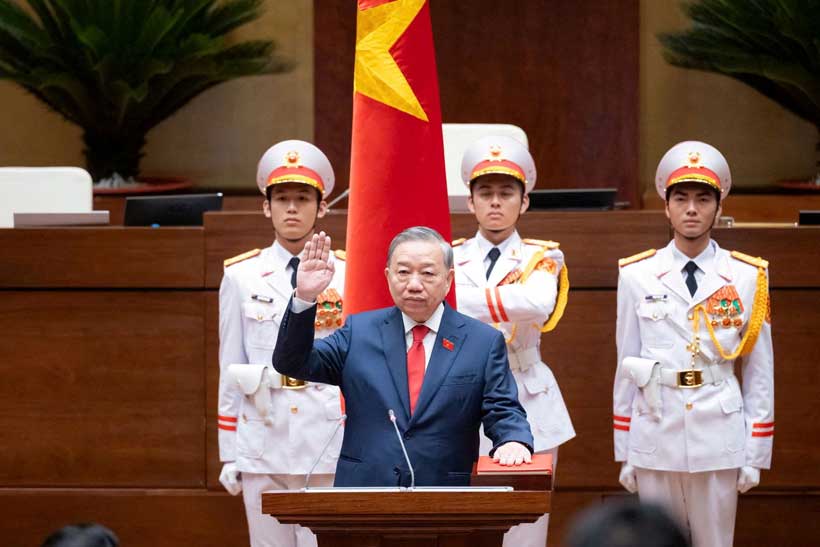
Historic Break from Collective Leadership
To Lam’s election as state president alongside his role as Communist Party chief marks a major departure from Vietnam’s long standing model of collective leadership.
Traditionally, power in Vietnam has been distributed among top positions to prevent dominance by a single figure. This move concentrates authority in one leader, signaling a structural shift in governance.
Emergence of a China Style Power Model
The consolidation of roles mirrors governance patterns seen in China, where leadership centralization enables tighter political control and faster policy execution.
Analytically, this suggests Vietnam may be moving toward a more centralized and decisive system, reducing internal fragmentation but increasing risks associated with concentrated authority.
Stay ahead of the geopolitical week.
MD Briefing delivers expert analysis across five global fronts — the Indo-Pacific, energy, geoeconomics, European security, and the Middle East — every Monday morning. Free.
Dual Mandate Strengthens Policy Execution
Holding both top party and state positions gives To Lam an unusual level of institutional control. This dual mandate allows him to align party direction with state implementation more efficiently.
In theory, this reduces bureaucratic delays and internal competition, enabling quicker rollout of economic and political reforms.
Economic Vision Focused on Transformation
To Lam has outlined a shift toward a new growth model driven by technology, innovation, and digital transformation. This reflects an effort to move beyond reliance on low cost manufacturing.
The strategy aims to reposition Vietnam higher in global value chains while sustaining rapid economic growth. However, such transitions require strong coordination and long term investment.
Balancing Reform with State Control
Despite supporting private sector expansion, To Lam has also emphasized the importance of state owned enterprises. This dual approach reflects an effort to balance market driven growth with state control.
This balancing act is politically necessary but economically complex, as it may create tensions between efficiency and control.
Risks of Authoritarian Drift
Analysts warn that concentrating power in a single leader increases the risk of authoritarianism. Without internal checks, decision making may become less transparent and more prone to policy errors or favoritism.
There are also concerns about corruption risks, especially with increased support for national champions and large scale economic projects.
Continuity in Foreign Policy Strategy
Despite domestic political changes, Vietnam is expected to maintain its Bamboo Diplomacy, balancing relations with major powers while avoiding alignment with any single bloc.
This pragmatic approach has been key to Vietnam’s stability and economic success, and there is little indication that consolidation of power will alter this strategy.
Analysis
To Lam’s rise represents a fundamental shift in Vietnam’s political structure from collective leadership toward centralized authority.
This transition creates a trade off. On one hand, it enhances policy coherence and speed, which can support ambitious economic reforms. On the other hand, it increases systemic risks related to governance, accountability, and long term stability.
The key takeaway is that Vietnam is entering a new political phase. The success of this model will depend on whether centralized power can deliver sustained economic transformation without undermining institutional balance.
