


The most durable damage from Washington’s war with Iran may not be in Iran at all. It may be inside the alliance system the United States spent decades building. For weeks, Donald Trump and Pete Hegseth have tried to treat allied backing as if it were an extension of American will: something to be demanded on cue, measured in access, overflight rights, and public deference. But alliances are not stage props. They rest on trust, consultation, and a shared sense that risk is being taken for a common purpose. When that foundation is used to pressure partners into supporting a war many never endorsed, the immediate result is friction. The longer-term result is something worse: allies begin to think less about how to stand with Washington and more about how to protect themselves from Washington’s choices.
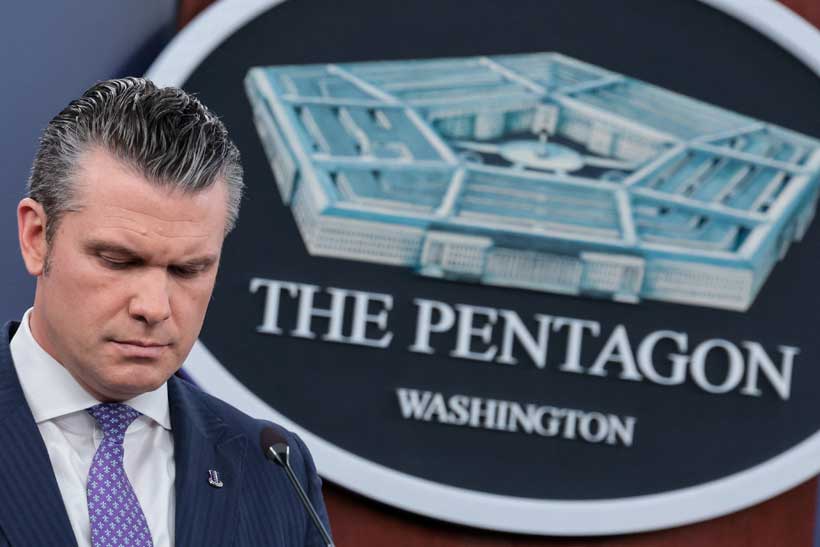
That is why Hegseth’s refusal to reaffirm Article 5 matters so much. Article 5 is not a slogan. It is the alliance’s core political promise: that an attack on one member is considered an attack on all, with each ally obliged to assist in restoring security. When the U.S. defense secretary declines to restate that commitment in the middle of a crisis and says the matter is effectively up to Trump, he is not projecting toughness. He is introducing conditionality into the one part of NATO that was designed to be least conditional. Trump then pushed the point further by threatening to reconsider America’s place in the alliance after European governments refused to support his Iran war on his terms. That is not burden-sharing. It is strategic extortion dressed up as realism.
The allied pushback has been telling. France denied overflight rights to Israeli aircraft carrying U.S. weapons. Italy refused access for U.S. planes to land at Sigonella for war-related purposes. Spain went further, closing its airspace to U.S. military aircraft involved in the war and making clear that NATO cannot be used as a cover for a conflict it considers unjustified. Britain, while still willing to support defensive measures, has resisted broader offensive involvement. These are not random irritants. They are signs that a number of U.S. partners see this war not as a shared allied obligation but as a war of choice for which Washington and Israel want retrospective buy-in.
From an American perspective, this should be understood as self-inflicted strategic malpractice. NATO’s credibility is one of the few assets in world politics that cannot be improvised in a crisis. It exists because America spent generations convincing allies that its guarantees were larger than the mood of any one administration. Trump and Hegseth are burning through that accumulated credibility for a war that is not tied to NATO’s treaty obligations, was not seriously co-owned by the alliance, and has already imposed heavy economic and political costs on partners who had little voice in its initiation. A serious strategist would preserve alliance capital for genuine collective defense. This administration is spending it on coercive diplomacy against its own friends.
Stay ahead of the geopolitical week.
MD Briefing delivers expert analysis across five global fronts — the Indo-Pacific, energy, geoeconomics, European security, and the Middle East — every Monday morning. Free.
The British response is especially revealing. Keir Starmer has not broken with Washington, and he has been careful not to stage his disagreement as a transatlantic rupture. But his public insistence that Britain’s long-term national interest now requires a closer partnership with Europe says a great deal about how this war is being read in allied capitals. It suggests that Trump’s handling of the Iran crisis is accelerating a quiet but important adjustment: allies are beginning to hedge, not because they want to abandon the United States, but because they increasingly doubt the wisdom of a White House that treats alliances as wartime bargaining chips. That is a profound shift. Once partners begin planning around American volatility rather than around American leadership, the old alliance model does not disappear overnight, but it does start to hollow out.
This is where the criticism of Trump and Hegseth should become brutally simple. They appear to believe that allied loyalty can be extracted through pressure, humiliation, and threats of abandonment. In reality, those tactics produce exactly the opposite of what they claim to want. Governments that feel bullied do not suddenly become more invested in America’s wars. They become more cautious about enabling them. They tighten legal procedures, narrow base access, insist on parliamentary cover, and look for alternative diplomatic and security frameworks. That is not softness. It is what states do when they begin to suspect that the strongest actor in the room is also the least predictable.
The danger is not that NATO will collapse tomorrow. The danger is subtler and arguably more serious. If Washington keeps teaching its allies that core commitments may be politicized whenever the White House wants support for an unrelated war, future assurances will carry less weight. In a real collective-defense crisis, European governments may still side with the United States; they likely would. But they will do so with more suspicion, more hedging, and less assumption that Washington is acting on behalf of a common strategy rather than a short-term presidential impulse. That erosion is hard to measure day by day, but it is exactly how alliance systems lose depth before they lose form.
Modern diplomacy is often described as the management of interdependence. By that standard, Trump and Hegseth are practicing something closer to managed estrangement. They are taking the most valuable element of American power—the willingness of others to trust U.S. commitments—and wagering it on a war key allies will not own. From Washington, that may look like leverage. From abroad, it looks like a lesson: America’s guarantees can no longer be cleanly separated from America’s whims. If that lesson sinks in, the strategic cost of this war will far exceed its battlefield results. And the people who will have done the most to weaken the Western alliance will not be in Tehran or Moscow. They will be sitting in Washington, congratulating themselves on strength.
