


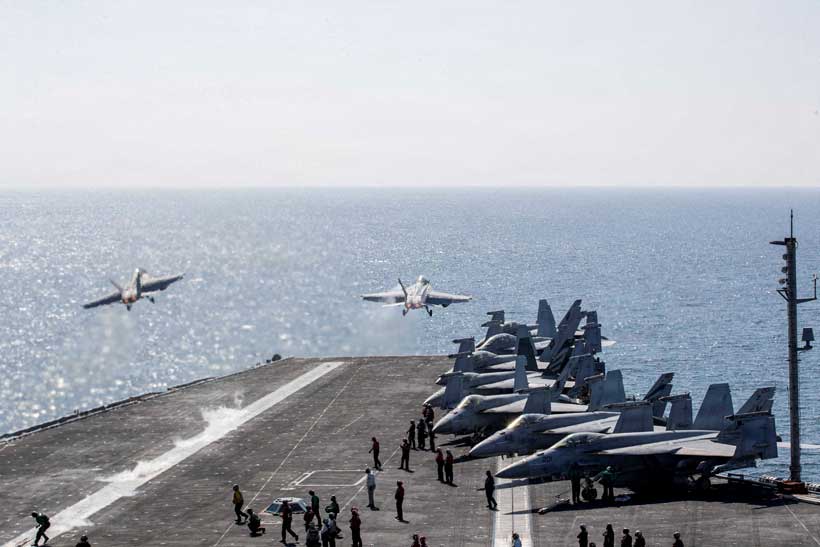
If there is a gun hanging on the wall, it has a purpose in the plot, and it is not merely for aesthetics. That’s the concept of Chekov’s Gun. A concept that rhymes with “Peace Through Strength.” Strength is the best deterrent; restore the warrior ethos, rebuild the military, and reestablish deterrence to emphasize that a strong military can preserve peace. This is the US emblem for the Trump administration. The foundations on which US strategies are built and enforced as well.
Strength when it is offensive in nature rarely remains a deterrent and, within time, becomes compulsion and coercion and is ultimately used. Though it is necessary to understand that with Clausewitz’s lens, there has to be a purpose attached to use the means. But with Trump’s lens, ambiguity works fine as well. The Chekhov gun that the US has, has a dual purpose to use and to sell.
The US is the world’s largest arms exporter, and it was responsible for 43% of the exports of major conventional weapons worldwide between 2020 and 2024. According to the SIPRI data, 35% of US exports were to Europe, followed by 33% to the Middle East, with Saudi Arabia accounting for 12% of total US arms exports. According to the recent March 2026 SIPRI reports, the U.S. has cemented its position as the world’s largest arms supplier, increasing its exports by 27% (2021–25) and controlling 42% of global arms transfers. The Military Power Index of the United States in 2025 was 0.0744 points. In 2024, the index value was 0.0699. The lower the index value, the more powerful the country’s military is. Since 2022, this indicator has increased by 1.64 times.
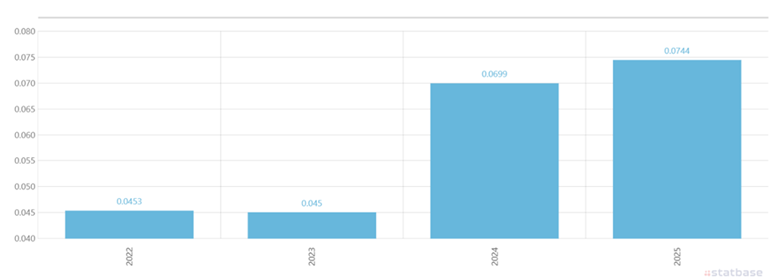
Source: Global Fire Power Index
Stay ahead of the geopolitical week.
MD Briefing delivers expert analysis across five global fronts — the Indo-Pacific, energy, geoeconomics, European security, and the Middle East — every Monday morning. Free.
The Department of Defense, which is now the Department of War, paid $381.2 billion to contractors in fiscal year (FY) 2019, a figure that jumped to $445.1 billion in FY 2024. In FY 2026, the Department of Defense had $1.43 trillion distributed among its six components defense-wide: Navy, Marine Corps, Air Force, Army, International Security Assistance, and military assistance. The internal nexus is built to strengthen the forces and weapon capability and capacity combined and to create a sales pitch for defense business across the world.
“Peace through strength” can be titled as a deterrent as the US pitches it, but by no means is it a deterrent; what they have is far more than what deterrence would require. Chekhov’s Gun was hanging on the wall, and it had to be used.
Trump’s idea of peace through strength is rooted in the Roman strategic ethos, Si vis pacem, para bellum (if you want peace, prepare for war). And why does someone prepare for war? because they have certain political objectives, and they will use the war as the means to achieve those objectives. They built a Chekhov’s Gun to use it in the war, and thus the gun hanging on the wall finally had a purpose.
The US laid out its objectives in NSS. Foreign terrorist organization removal in the Western Hemisphere. Then it attached objectives with regard to Iran, though it was not successful in achieving them. It overstretched its operation in Iran, and it is still continuing. There is a fine balance that is required to maintain the peace gained through strength, and Trump has long tiptoed around that in Iran.
Chekhov’s gun used in Venezuela involved military and naval buildup in the Caribbean and eventually the abduction of the president. With regard to Iran, the same pattern of naval buildup, this time named Armada, was followed. Further nuances were added by redirecting USS Gerald Ford, stationed in the Caribbean, towards Iran and in the Mediterranean Sea. In addition to that, the radar systems sold to Gulf States such as THAAD, Patriot, and Early Warning radar were tested and tried as Iran’s retaliation engulfed the whole region in the conflict, and now the closing of the Strait of Hormuz has resulted in global implications.
Now, the dual use of Chekhov’s Gun must have been an epiphany for the world that the weapons advanced and sold are not merely for the purpose of deterrence or for the purpose of business. Even the sold weapon will be used for either defensive or offensive purposes. But the top military spender and exporter cannot be doing all that merely for deterrence; there must have been an offensive political objective attached. Some strategies might give a sneak peek into what is really in it, but they can never offer the full insight.
There are two reasons for that. One is that the anarchic world is ambiguous, the very reason it is anarchic. States pursue self-interest; they all have objectives, but it is not necessary that they all be laid out in a strategy. First is the secrecy, which can also involve interests of pressure groups, leaders in question, and stakes of the business elite; second is the fog of war, where things can change midway due to the uncertainty of events. Iran is the pertinent example of that. The objectives are clear, but they keep changing, so there is secrecy, and the second is the fog of war, the asymmetric capabilities, and the rigid regime structure of Iran that has stretched the war for almost a month. In short, Chekhov’s Gun must have a purpose, a political objective that could be peace through strength, but it should not be overstretched to the point that it thrash peace and bring a fiasco.
